

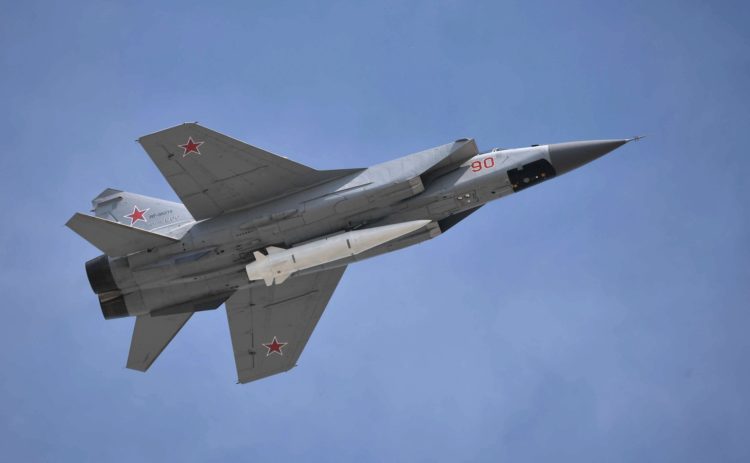
Carnegie Endowment for International Peace Nuclear Policy Specialist James Acton also stated that he did not see the usage of the Kinzhal missile as anything significant as there would be little advantage Russia is obtaining from using hypersonic missiles. Furthermore, he also said that these missiles were Iskander-M missiles that were modified further for fighter jet usage. This would be in line with a number of analysts stating that Russia was running out of Iskander missiles, so it “raised the stakes” with the Kinzhal.
On the other hand, Russian analyst Vasily Kashin in an interview with Agence France-Presse, stated that the Kinzhal system would present an advantage to Russia as it had more penetration and destructive power, being more efficient at destroying underground military targets.
US officials have claimed that Russia had fired more than 1,000 missiles into Ukraine since the start of February. In line with analysts’ perspectives, the Ukrainian Defense Ministry has also claimed that Russia had fired nearly all of its missiles into Ukraine, leaving them with a significant loss of offensive potential.
“The enemy has significant problems with logistics, continues to suffer losses. In some areas, it blocks units of the Armed Forces of Ukraine. Due to the fact that the enemy used almost the entire set of cruise missiles based on the sea ‘Caliber’ and operational and tactical missile systems ‘Iskander’ during the first twenty days of the operation, the enemy continues to launch missile and bomb strikes on infrastructure and housing neighborhoods of large cities using indiscriminate weapons,” the defense ministry said in a translated version of the statement.
Acton also weighed in on the number of missiles launched by Russia, “[That] is an astonishing number and a very significant fraction of Russia’s pre-war inventory,” Acton said. “They may very well be running short of accurate munitions.”
Along with these reports, the Ukrainian Defense Ministry also claimed that Russia’s 960th Assault Aviation Regiment of the 4th Army of the Russian Armed Forces had been severely depleted of soldiers and that their psychological conditions were “unsatisfactory.” Units from the 252nd Motorized Rifle Regiment of the Western Military District fighting in Kharkiv and Izyum had lost about 30% of its personnel. Both claims could not be independently verified. However, it has been widely reported that there had been instances of Russian soldiers surrendering without a fight due to morale issues and food supply shortages.
What Is The Kinzhal Missile?
Russian President Vladimir Putin first announced the hypersonic aero-ballistic air-to-surface Kinzhal “Dagger” missile in 2018, where he unveiled six new Russian “invincible” weapons. Other notable hypersonic missiles announced during that time were the Avangard and the 3M22 Zircon.
However, it’s been rumored that the missile had been used earlier during Russia’s intervention in Syria in 2016. Putin has described the missile to be “an ideal weapon” that could allegedly fly at ten times the speed of sound and is maneuverable mid-flight. It was said to be “undetectable” by western air defense systems, according to Al Jazeera’s Dorsa Jabbari.
Said missiles are said to be designed specifically to destroy NATO missile defense systems and NATO warships due to its growing concerns with NATO’s expansion into former Soviet bloc states. The Russians claim that the missile could overwhelm the US-made Patriot surface-to-air missile (SAM) systems, the THAAD anti-ballistic missile defense system, as well as the naval Aegis Combat System as it could be maneuvered, making it difficult for these air-defense systems to intercept.
These missiles are said to be capable of carrying both conventional and nuclear warheads that could be launched from Tu-22M3 bombers or MiG-31K interceptors with a range of about 1,200 miles if delivered by the MiG-31K and 1,900 miles if delivered by the Tu-22M3. It can reportedly reach speeds ranging from Mach 5 to as much as Mach 12. However, we could not verify the exact speed of the said missile.
The US is also developing hypersonic weapons as part of its Prompt Global Strike program since it launched in the early 2000s, which aims to develop responsive, long-range strike options for the United States in the future. A congressional report published just this March 17 confirms that the program is still actively developing maneuverable weapons that fly at speeds at least Mach 5. It’s been said that the Pentagon’s budget request for hypersonic weapons research is at $3.8 billion for FY 2022.
The Royal Navy and the French Navy have also been developing hypersonic missiles since 2011, known as Perseus, in response to Russia and China’s growing interest in building their arsenal of hypersonic missiles.








COMMENTS