

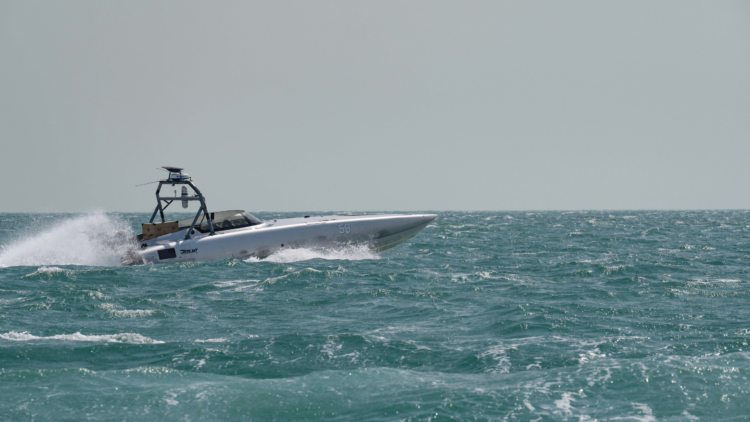
The plan? A swarm of these unmanned devils at sea, coupled with a cloud of drones in the sky, ready to give any would-be aggressor a moment of serious pause.
“This is their effort to try to get some new kinetic, lethal USV fielded that can be employed probably in a western Pacific context – maybe the Strait of Taiwan,” naval analyst Bryan Clark told USNI News, adding, “They want to go out to the commercial world and say, ‘Alright, what do you got in terms of kinetic, lethal USVs that can be produced at scale.‘”
The Specs: Small Vessels, Big Impact
Don’t let their size fool you; these USVs pack a serious punch.
With the guts to cover 500 to 1,000 nautical miles (around 926 and 1,852 kilometers) and carry a load of 1,000 pounds (roughly 453 kilograms), these drones are no lightweights.
They’re diesel-driven demons, hitting speeds over 35 knots and ready to prowl for days.
Drone Boat Swarm Vision Laid Out By DoD – The Pentagon, through the Defense Innovation Unit (DIU), seeks to revolutionize naval capabilities with the Production-Ready, Inexpensive, Maritime Expeditionary (PRIME) Small Unmanned Surface Vehicle (sUSV) project. This initiative aims… pic.twitter.com/RBpdUE2QuK
— Last24Report (@Last24Report) February 5, 2024
Navigating through treacherous waters, dodging hazards, and teaming up for complex maneuvers – that’s the name of their game.
According to the requirements detailed by the Defense Innovation Unit, the future lethal USV should be “capable of autonomously transiting hundreds of miles through contested waterspace, loitering in an assigned operating area while monitoring for maritime surface threats, and then sprinting to interdict a noncooperative, maneuvering vessel.”
“Interceptors will need to operate in cohesive groups and execute complex autonomous behaviors that adapt to the dynamic, evasive movements of the pursued vessel,” it added.
Kamikaze at Sea
While it’s hush-hush in the official papers, the spirit of these USVs whispers tales of suicide surface attack drones, not unlike the specters seen in the Ukrainian fields.
These autonomous, lethal machines are ready to throw a wrench in any invader’s plans, using off-the-shelf parts to get into the fray faster.
Joining Forces with Industry Mavericks and Marine Visionaries
The PRIME project isn’t just a Navy affair; it’s a clarion call to the industry’s pioneers – companies like Saronic, Textron, and MARTAC – to bring their best to the table.
And it’s not just the Navy getting in on the action; the Marine Corps, with its eye on the future, is scouting these USVs for its Force Design 2030.
As the Navy sets its course towards armed small unmanned surface vessels, it’s a clear signal that the US is not just watching the Pacific’s shifting tides but steering through them with resolve.
With the PRIME project leading the charge, the Navy is not just flexing its technological muscle; it’s ensuring that when it comes to defending its waters and interests, it’s ready to bring the thunder.








COMMENTS