

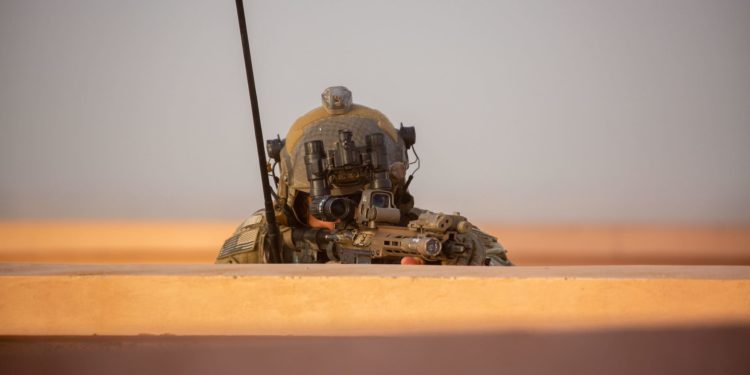
Such operations will yield “insight into near-peer military critical infrastructure. This is to respond to near-peer anti-access/[area]-denial strategies through major lines of communication, particularly in the Pacific Region,” Hasken said.
Anti-access/area-denial, or A2/AD, weapon systems are meant to create “bubbles” around strategic areas so rival forces, such as U.S. Navy aircraft carriers, won’t be able to approach.
U.S. strategists are particularly worried about Russian A2/AD systems across Eastern Europe and Chinese A2/AD systems across the western Pacific.
In a testimony to the Senate Armed Services Committee earlier this year, Gen. Richard Clarke, the SOCOM commander, stressed the need to deploy cutting-edge technology to special operators both for offensive and defensive reasons.
For the former, SOCOM wants its commandos to be able to or “see and sense the battlefield” without losing a step. For the latter, SOCOM wants to reduce their digital and electronic presence to make it harder for adversaries or their proxies to target U.S. operators.
“Our [HEO] initiatives seek to accelerate gains in our ability to provide power, protection, and force projection at the tactical edge,” Clarke said at the hearing.
An additional feature is the ability to communicate with locals and partner forces through an advanced talk-to-translate device, removing the need for an interpreter. With special operators already deployed in scores of countries, this will greatly increase their effectiveness in dealing with locals and winning them over.
For example, a Special Forces operational detachment deployed in Kenya to train local forces and conduct counterterrorism operations against al-Shabaab could use certain sensors and communications devices to collect information and “atmospherics” on Chinese troops or activities nearby.
Any data collected would be quickly processed and analyzed, informing both the special operators’ mission in the country and the Pentagon’s planning back in the United States.
Getting the Right Gear on Time
The acquisition process is a big part of the HEO program. Technology is evolving fast, and SOCOM doesn’t have the luxury to be too bureaucratic when it comes to cutting-edge systems that special operations troops need in the field.
There doesn’t need to be an open conflict for special operators to deploy overseas, and they often encounter competitors or their proxies in third countries.
“SOCOM continues to look at multiple means by which new technologies can be introduced to the command for evaluation,” Hasken said, advocating “the immediate establishment” of a proving ground that can develop and evaluate electronic-warfare, information-warfare, and cyber-warfare technologies to support special operations forces’ core missions.
“This will also require the ability to move beyond just adjustments in procurement. It also requires a thorough examination of other obstacles,” added Hasken, who spent time at the National Security Agency as SOCOM’s chief cryptologist.
A lot of these systems already exist in the private sector. U.S. military commanders have been making greater use of off-the-shelf technology, and companies like MarkPoint have sought to develop new commercial technologies to fill capability gaps for special operations and cyber communities.
SOCOM’s establishment of the Joint Acquisition Task Force is a step in the right direction, but Hasken said it also needs resources that will allow it to accelerate its ability to design and test prototype tools and send them into the field for further evaluation and integration.
This article was written by Stavros Atlamazoglou and originally published on the Insider.








COMMENTS