

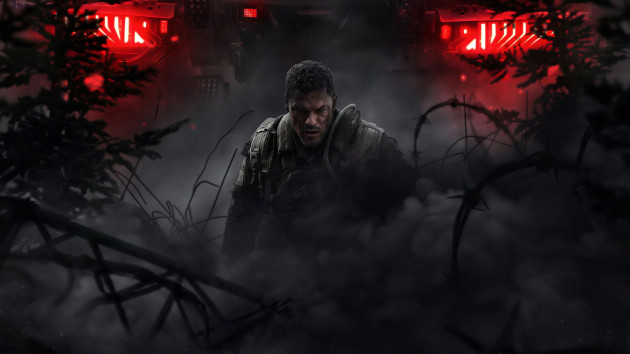
War Machine (2026) sets you up for a grounded military story, then blows it apart halfway through and replaces it with something else entirely.
And no, I’m not talking about War Machine (2017) with Brad Pitt leaning into satire and slow-burn absurdity. This War Machine kicks the door down, dumps you into the mud, and doesn’t bother explaining itself.
The good news is you won’t need a single functioning brain cell to enjoy it.
Major spoilers ahead!
The Calm Before the Mechanical Storm
War Machine opens like a familiar story. You have the hardened soldier, the ghosts of combat, and the promise of redemption through elite training. Alan Ritchson plays US Army Staff Sergeant “81,” a man defined more by what he failed to do than what he survived.
After Afghanistan, he carries a specific weight. His literal brother (played by Jai Courtney) died because he could not carry him back to medical attention in time. That moment loops in his head. It shapes every decision, every silence, every sleepless night.
Two years and after many attempts later, he signs up for the Ranger Assessment and Selection Program (RASP). Not for glory. Not for career advancement. For closure.
You see, one of his brother’s final wishes was for the two of them to complete RASP together and become Rangers with the 75th Ranger Regiment.
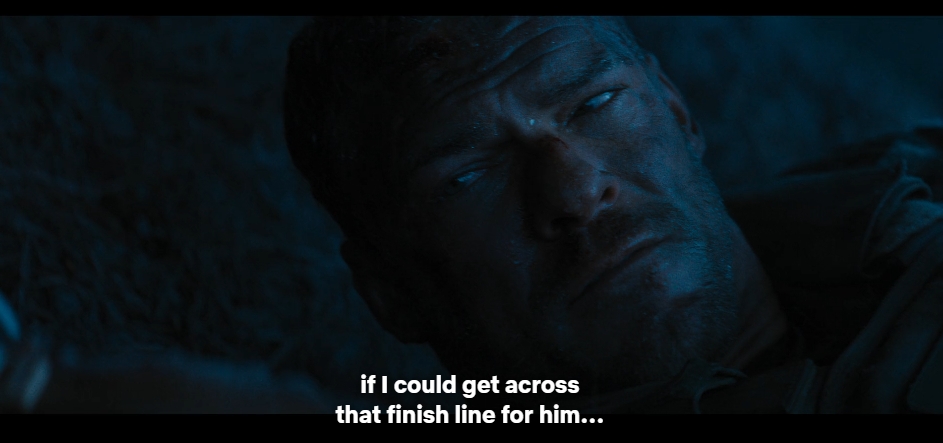
“I just thought… if I could get across that finish line for him, maybe it could help me sleep.”
The fact that he is doing it for closure tells you everything about 81. He is not chasing a badge. He is chasing peace.
Director Patrick Hughes builds this first act with a grounded, almost nostalgic rhythm. You can feel echoes of Full Metal Jacket (1987) in the structure. The punishing drills. The dehumanizing pace. The friction between recruits. Dennis Quaid’s Sergeant Major Sheridan fills the archetype of the unforgiving authority figure, while supporting actors like Esai Morales (as First Sergeant Torres) and Stephan James (as Staff Sergeant “7”) round out a cast that feels appropriately hostile and worn.
For a while, it works.
You think you’re watching a character study about grief, brotherhood, and the cost of carrying both.
Then the movie detonates its own premise.
The Death March
The shift comes during the final Death March exercise (the fictional capstone exercise for RASP). It should be routine, the ultimate test of endurance, navigation, and survival. The last grueling stretch to earn the coveted 75th Ranger Regiment Scroll. Instead, the elite candidates stumble onto something buried in the wilderness. At first glance, it looks like a downed aircraft, a remarkably sophisticated one. One candidate even joked that the cadre is going all out on the special effects.
Except, they weren’t.
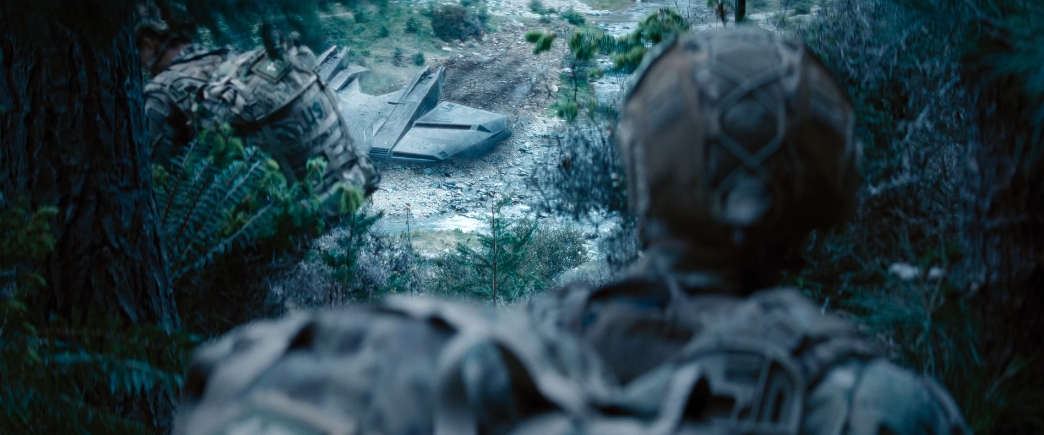
But still in the mindset of completing the final assessment, they stuck to the main objective. They rig it with C4s. Lots of it.
That decision snaps the film in half.
What emerges is not wreckage. It is alive, mechanical, and utterly indifferent to human survival. The grounded military narrative gives way to full-blown sci-fi chaos. Suddenly, tactics fail. Blank adapters become a cruel joke (they are anyway). Training offers no preparation for an enemy that does not think and does not DIE.
One moment, the film is about trauma.
Next moment, extraterrestrial.
The transition is not gradual. It is abrupt and violent. For some, it may feel like a betrayal. For others, it is exactly the point where the film becomes fun.
81: A Man Fighting Himself
Even as the narrative spirals outward, 81’s internal struggle remains the film’s most compelling thread. His grief isolates him. He cannot bond with the other candidates. He barely speaks unless necessary. Sleep becomes a luxury he cannot afford, so he leans on medication just to function.
Physically, he is elite.
Mentally, he is cracking.
His obsession with finishing RASP becomes dangerous. It blinds him. It narrows his world to a single objective. Cross the line. Earn the scroll. Fix what cannot be fixed.
The film sets up a powerful arc. A soldier navigating the grueling training while carrying repressed grief is asked to step up as a leader. He refuses at first, unsure he can bear the responsibility of others. The narrative hints at growth, at closure earned through endurance and trust.
Then the film pivots hard.
Explosions replace introspection. Trauma gives way to chaos. The psychological depth that anchored the first act is swept aside by nonstop spectacle.
The Unlucky, Lucky 7
Though a side character, Staff Sergeant “7” deserves mention. Man, just couldn’t catch a break in the latter half of the film, the poor guy! His ordeal borders on absurd: he is demoted during the final exercise, suffers an excruciating broken leg, and has his femur reset with no morphine, passing out in the process. He spends much of the story strapped to a Sked, immobilized, watching his unit get annihilated around him. He is dumped into a freezing river, dragged through a waterfall, and thrown around like dead weight.
And yet, he survives.
Not only that, he crosses the Ranger finish line. Carried by 81, but still. He makes it.

There is something darkly compelling about that. He is both the unluckiest and luckiest man in the film. At some point, you realize he and 81 share the same plot armor.
They are not allowed to die.
Action Overload, Logic Optional
Once the extraterrestrial machine enters the picture, War Machine fully commits to being a spectacle. The action sequences are where the film shines brightest.
The first encounter is bloody chaotic and disorienting in the best way. The machine’s ability to scan and hunt its marked targets with relentless precision, blasting units to bits and pieces, leaves the audience gripping their seats. The river crossing sequence stands out as a brutal test of endurance, blending environmental danger with the constant threat of pursuit. The chase sequence featuring the M1117 Guardian delivers a claustrophobic tension that works in the film’s favor.
Director Hughes even leaned into that constraint during production. The vehicle interiors had to be expanded just to fit actors like Ritchson, which ironically enhances the feeling of being trapped inside a metal box with something relentlessly hunting you.
“With the Guardian, it was about confined space. We wanted to use the M1117. Now, the reality of those vehicles is [that] once you’re inside, they’re incredibly confined, especially for someone like Alan. I’m six four, so that also doesn’t help. [Alan and I] couldn’t fit in it together because there was no room, so I had to be on the outside.” —Director Patrick Hughes in an interview with whats-on-netflix.com
Still, the tactics of these supposed elite candidates often feel questionable. The film sacrifices realism for momentum. Weapons that should matter do not. Strategies collapse quickly.
And then comes the moment, in my humble opinion, defines the film’s logic.
The most effective weapon against the unstoppable machine is an EXCAVATOR, paired with a cone crusher that rained rocks onto the machine’s vent – its weak spot.
Not advanced military hardware. Just one man and a coordinated use of heavy construction equipment and the power of thermodynamics.
It is ridiculous. It is also strangely satisfying.
Themes Left Behind
There is a better version of this film buried underneath the one we got. A version that fully commits to exploring grief, leadership, and the psychological toll of war.
You can see it in the setup. You can feel it in Ritchson’s performance. He plays 81 with a quiet intensity that carries the early scenes.
But the film somehow does not trust that story to hold attention.
So, it trades depth for speed.
That does not make it bad. It just makes it something else. A frickin’ action-packed sci-fi flick!
Ending on Forward Momentum
By the end, 81 gets what he came for. He crosses the finish line. He earns his Ranger scroll. More importantly, he finally speaks about his brother. Through 7, albeit severely injured, he confides and finally lets go of the repressed grief that he has long been holding.
It is not a clean closure, but it is enough to complete his emotional arc before the film plunges back into more explosions.
And at the end of the film, 81 didn’t even pause for hot chow, a shower, or even a fresh uniform. He boards a helicopter and heads straight back to the front to battle the rest of the War Machine’s taking over the countryside. No rest. No reset. Just relentless forward motion.
The war machine keeps moving. No pun intended.
Final Verdict
War Machine (2026) is a contradiction that somehow works.
It sets up a thoughtful character study, then abandons it halfway through for chaos and spectacle – as most action flicks do, I guess. What it loses in narrative depth, it makes up for in raw entertainment.
The action hits hard. The performances are committed. The pacing never lets up once the shift happens.
Just do not expect it to fully deliver on its themes.
Watch it for what it becomes, not what it promises to be.
And yeah, by the end of it, you realize something.
81 is not just fighting a machine.
He is one.
Want to see how it all unfolds? Watch it here on Netflix.








COMMENTS