

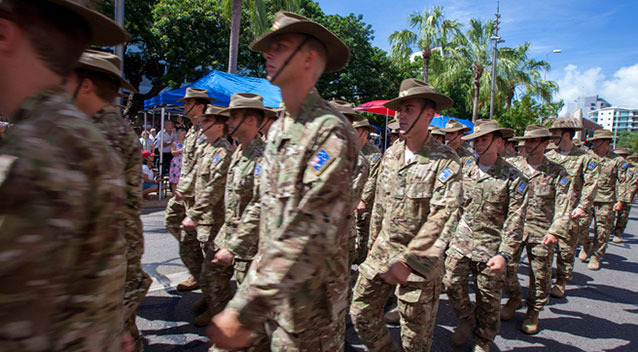
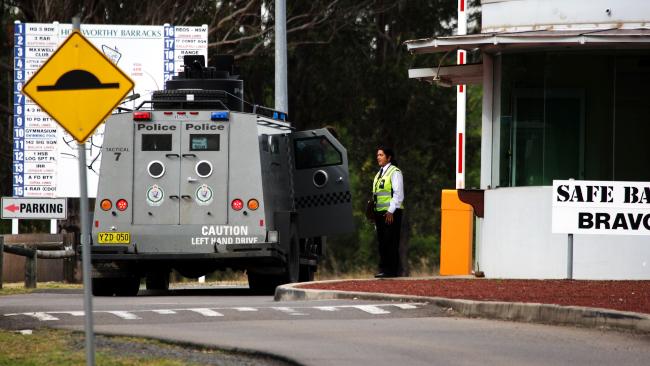
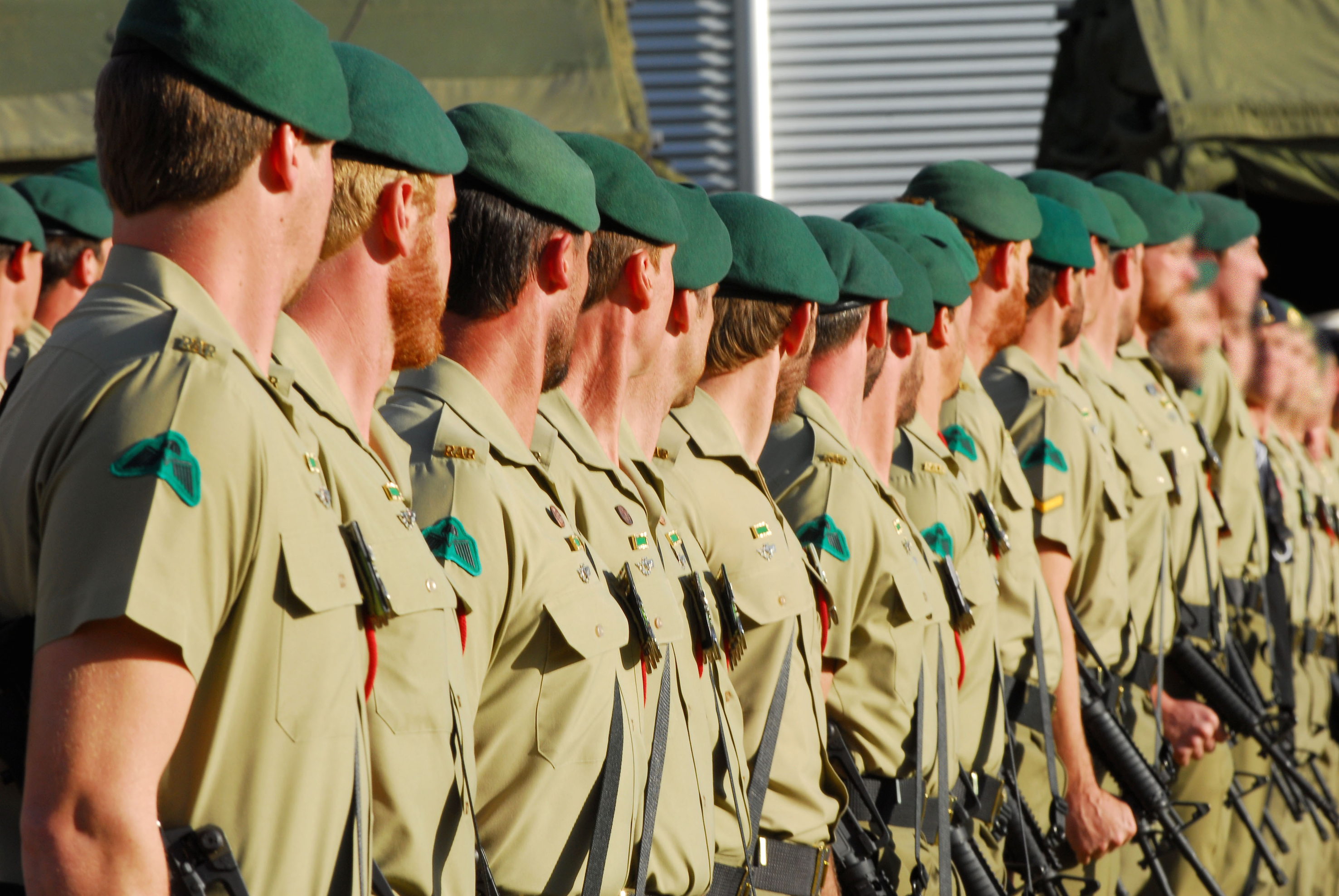
Despite the trainee believing that the charge was a gross overreaction, the culture of SOCOMD that we were subsequently immersed in suddenly made sense of it all. We were very quickly indoctrinated into the operational-security (OPSEC) culture where taking a few extra minutes each day to change into and out of uniform simply became the norm. Just because we could not wear a uniform outside of work did not make us any less proud of who we were and the service that we were providing our great nation.
We understood the sensitive nature of our employment and the need to keep our identities a secret. In fact, the OPSEC culture within SOCOMD is so strong that the mere thought of wearing a uniform in a public place becomes extremely uncomfortable to bear. We exert a large amount effort operationally trying to blend in, remain unseen, and avoid compromise until a time of our choosing, and this focus and attitude cannot help but spread to our personal lives as well.
This is no different for the Police Technical Units (PTU) and other government agencies (OGA) that we work with extensively as part of our domestic counterterrorism responsibilities with the Tactical Assault Group – East (TAG-E). OGAs in particular operate in an even more covert and taciturn environment than we do, and the reticence and OPSEC surrounding their employment is the most aggressive of any government organisation in the country.
To give you an example, Australia has recently introduced some of the toughest penalties in the world for anyone who discloses the identity of an intelligence agent, with penalties of up to five years imprisonment or 10 years for an aggravated offence. Some of these individuals cannot even disclose their employment to their families and must live their lives according to their permanent cover story; their only recognition coming from within their ranks and from their immediate work colleagues. Like us, these people are still exceptionally proud of serving their nation, however the type of work that they are involved in does not afford them the right nor privilege to wear a uniform and advertise their profession to the public.
I also fully acknowledge the counterarguments to the suggestion that we should refrain from wearing our uniform based on these threats. There is always the exceptional amount of pride that current and former members of the ADF have in their service and what the uniform represents to them. We should in no way feel intimidated while wearing our uniform and accompanying accoutrements and embellishments, which are steeped in our nation’s collective identity. No one has the right to take this away from us, and the wearing of the uniform in the face of such threats is the ultimate act of defiance.
So what decision does this leave us with? Do you wear your uniform forthrightly with little or no concern in doing so? Do you acknowledge the threat and exercise common sense and judgment when considering where and when to wear your uniform in public? Or, do you simply set aside a few extra minutes a day to get changed into and out of your uniform at your place of work?
Well, I guess this decision depends on you as a person and the level of risk that you are willing to accept. The likelihood of any one soldier in particular being the victim of such an act of violence is, realistically, exceptionally low. The consequences of such an attack, however, could not be assessed as anything less than catastrophic. From my experience, wearing a uniform outside of work was never an option and thus not a point of contention. I sometimes question my stance on the issue given the indoctrination of self-effacement I received as a member of SOCOMD. I have looked at this as objectively as possible in order to elicit an unbiased raison d’être that I can share, and I have come up with the following interpretation.
To start, the threat is real, whether we like it or not. We can discuss at length how we should be free to wear our uniform in the country that we have sworn to defend without fear or intimidation and, whilst this is certainly true, the reality of the world that we live in today is that we, as current and former soldiers, are considered high-priority targets for certain types of extremists.
I come from a proud lineage of veterans going back to the First World War and, whilst many a conversation with colleagues have surrounded the rhetoric of what our military forebearers would have done if faced with a similar problem, our short-lived aggrandizement of the past is always replaced with the harsh realities of today. Conflicts are no longer isolated to the battlefields on which they are fought, and there should be an acknowledgement that we need to defend ourselves from enemies on both foreign and domestic soil.
Whilst camouflage does do an exceptional job of concealing the soldier, its operational effectiveness is inversely proportionate to the upper hand given to the enemy within a domestic setting. Rather than camouflage providing us with the advantage it does in combat, wearing a uniform at home provides an easily identifiable target for those who seek to do us harm. We do not willingly present ourselves as obvious targets on the battlefield, so why would we do it at home?
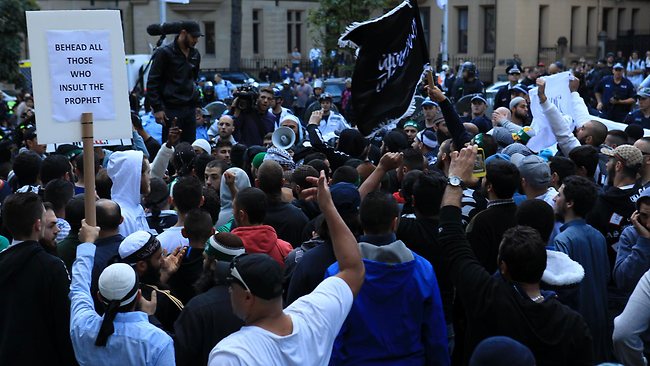
Whilst it is not my intention to add to the debate on whether terrorism is a crime or an act of war, for the purposes of this paper, let us assume that it is a crime. It would be a fair assumption to say that a terrorist, or criminal, who plots to kill a serving military member in their own country has, amongst other things, a complete disregard for the rule of law. It is this contempt for the law which immediately places military personnel at a further disadvantage in a number of important ways.
For one, if a criminal is committed to killing a soldier, then they have already accepted the fact that they are going to break the law. Once this decision has been made, these criminals will use whatever resources they can get their hands on in order to achieve their desired outcome. In the cases of Warrant Officer Patrice Vincent, Corporal Nathan Cirillo, and Drummer Lee Rigby, the perpetrators used a combination of cars, knives, and in the case of Corporal Cirillo, a firearm, to savagely murder each of these unsuspecting and defenseless soldiers.
As well as the advantage of surprise being on the attacker’s side, they are also using the law and the honourable characteristics of our troops against them to further increase their chances of success. The differences in what military personnel can do operationally to protect themselves, as compared to domestically, could not be further or more unfavourably apart. Unfortunately, our rules of engagement (ROE) and access to weapons for personal protection is something which is, for the most part, only mandated in an operational context.
At home, ADF members do not have the legal luxury to carry anything off-duty that could be considered a weapon, and most would not do so anyway as law-abiding citizens. It is this divergence between our military personnel’s respect for the rule of law, as compared to a would-be terrorist’s absolute antipathy for it, which leaves our ADF members dangerously exposed and severely disadvantaged.
To explain this further, let me use Australia as an example.
Australia has some of the strictest firearms laws in the world. Whilst you are legally allowed to own firearms, the type of firearm, and what you are licensed to use it for, are heavily regulated. Following the 1996 Port Arthur massacre, a raft of state, territory, and federal legislation was introduced which included restrictions and bans on certain semiautomatic and self-loading rifles and shotguns, specific licensing and permit criteria, minimum levels of safe-storage requirements and mandatory inspections by police, and greater restrictions on the sale of firearms and ammunition.
The granting of firearms licenses became dependent on an applicant completing a safety course and having no history of mental or physical conditions which would render the individual unsuitable for owning, possessing, or using a firearm. Most importantly, applications for a gun owner’s licence are required to prove a “genuine reason” to possess a firearm. Under Australian law, personal protection is not in any way considered a genuine reason.
Similarly, the carrying of knives and blades without reasonable excuse is also a summary offence. In my state of New South Wales, the Summary Offences Act 1988 – Sect 11C (3) clearly states that “…it is not a reasonable excuse for the purposes of this section for a person to have custody of a knife solely for the purpose of self defence or the defence of another person.” Carrying a knife without reasonable excuse would almost certainly land you in court and facing a heavy fine and/or criminal conviction. So, based on the worst-case scenario of a terrorist confronting a soldier on home soil with the intent of killing them, it is almost certain that the only person who would be armed in such a confrontation would, unfortunately, be the terrorist.
The point of this example is not to push a pro-gun agenda nor to convince people to not wear their uniforms in public. Rather, I am seeking to highlight an obvious disparity that exists between (a) criminals who wish to do us harm by utilising any means available and by breaking any law necessary, and (b) those of us who are targets but have a respect for the law, thus leaving us unarmed and defenceless against such threats. By virtue of their employment, it would be reasonable to assume that most military personnel in Australia have a basic respect for the law.
So, based on this assumption, it would also be reasonable to assume that ADF members do not carry firearms or knives in a domestic or non-operational environment for the purposes of self defence. If ADF members are not carrying firearms or knives for self defence out of a respect for the law, then they are left dangerously exposed and at an immediate disadvantage to any armed extremist. Unlike working in an operational environment where we are armed and have a very clear set of ROEs, domestically, we are left shamefully defenceless against anyone who is plotting to murder a military member with weapons up to and including firearms.
While I completely acknowledge why people would continue to wear their military uniforms in defiance of such threats, one should at least stop and question the rule of law and who it is really dealing the upper hand to. For instance, the government is more than comfortable sending its soldiers to war to further its national interests by what Clausewitz refers to as “other means,” and one of the nine core behaviours of the Australian Army is listed as “Every soldier an expert in close combat.” Both imply the use of weapons and neither can be achieved without them, yet zero reprieves exist for ADF members to use them off-duty to protect themselves, their colleagues, or their families if the need ever arose.
Even though the likelihood of being the victim of such an attack is negligible, minimising when and where you wear your uniform lowers this likelihood even further by denying a potential aggressor an easily identifiable target. We never questioned the SOCOMD directive that prohibits us from wearing our uniform in public; we understood that it was the nature of our work that restricted us from doing so, and we just left it at that. Based on the current security climate, it would appear that simply being a member of the military altogether is enough to warrant a change of thought. I would never go into a gunfight armed with the proverbial knife; under Australian law, however, it appears that we would not legally be allowed to do even that.








COMMENTS