

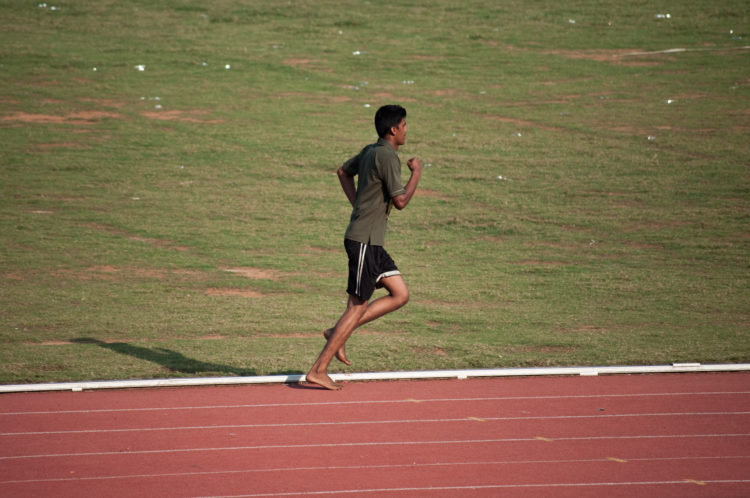
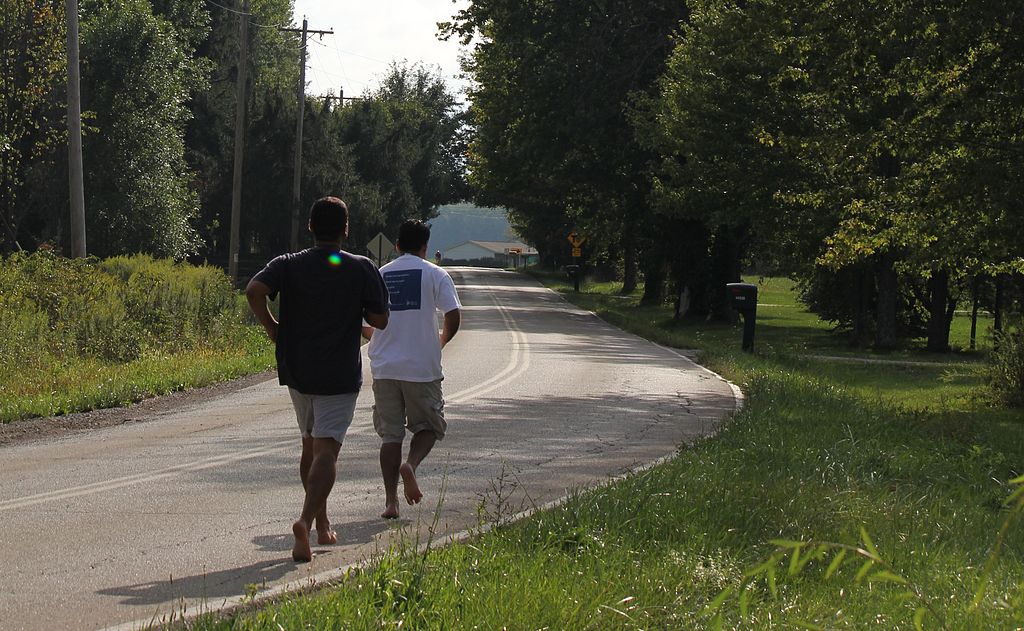
This can lead to all sorts of issues like back pain and posture problems. When you’re sitting for long periods of time, you’re not working your core muscles. This can lead to a saggy stomach area, which is never attractive. Running barefoot can help strengthen your core muscles and improve your posture. This is because when running, you will have to engage your entire core to remain upright. This can help prevent back pain and improve your posture, making you look and feel better.
Boost Your Immune System and Digestive Tract
When you’re running, you’re getting a great cardio workout, but you’re also helping your body in other ways as well. Running can help boost your immune system and even help with your digestion.
By running a few times a week, you can help strengthen your immune system, which can help prevent you from getting sick. Running may also help improve your digestion by helping you breathe deeply, which can actually help break down energy. When you run, you’re typically in a “push” position, which can help break up energy.
Take Caution
There is a great deal of debate surrounding the topic of barefoot running. Some people swear by its benefits, while others claim that it can actually be harmful to your body. So, what is the truth?
To start with, let’s take a look at what barefoot running is. As the name suggests, this is a type of running where you are barefoot, or wearing minimalistic shoes that allow your toes and feet to move freely.
There are a number of reasons why people might choose to run barefoot. For starters, proponents of barefoot running claim that it strengthens your feet and ankles and can help improve your balance and coordination. Additionally, because you are engaging more muscles when you run barefoot, it can also help you burn more calories and tone your body.
Finally, some people believe that running barefoot helps reduce the risk of injuries, as you are less likely to land on your heel when you run this way. This is because when you land on your heel, it puts a lot of stress on your joints, leading to pain and injuries over time.
So far, there is some scientific evidence to support the benefits of barefoot running. One study published in the British Journal of Sports Medicine found that runners who switched to barefoot running experienced less pain in their feet and ankles and improved their balance and coordination.
Another study published in Footware Science showed that when runners landed on their forefeet rather than their heels, they experienced less impact force on their knees and hips. This could potentially lead to reduced rates of injury in these areas.
However, while there is some evidence to suggest that barefoot running can be beneficial for certain people, it’s important to note that not everyone may experience these benefits. In fact, for some people, running barefoot could actually lead to injuries.
This is because when you run without shoes, you are exposed to a number of hazards such as sharp objects on the ground or hot pavement. Additionally, if you are not used to running without shoes, your feet may not be strong enough to handle the impact force from landing on them. As a result, you could experience pain or injuries in your feet or ankles.
Man is an animal that is a natural runner. In the caveman days, men hunted in packs and ran down animals on the African savannahs like Gazelles and other four-footed prey. That sounds counter-intuitive doesn’t it? How could a man run down a swift-footed gazelle? The answer is endurance. Most animals lack the ability to sweat off heat they build up during exertion, they cool off by panting, expelling heat in their exhaled breaths, and exchanging it for cooler air from the outside. Men could chase a gazelle and keep him running until it overheated and collapsed from heat exhaustion, when it could then be bashed in the head with a rock or stabbed with a wooden spear. If a man saw a lion far enough away, he could actually outrun it. The lion was capable of a burst of energy but could not sustain it over any distance, and a human hunter could run for miles.
So overall, while there may be some benefits to barefoot running, it’s important to remember that this type of running may only be suitable for some. If you are thinking about giving it a try, make sure to take things slowly and build up your strength and endurance gradually so that you don’t risk injuring yourself.
Conclusion
Running barefoot is a great way to strengthen your feet and improve your posture. It can also help improve your cardio fitness, boost your immune system, and even help your digestion. All that from just running a few times a week! If you’re a vet or know a vet that is trying to get back into shape or just get into shape for the first time, running is a great way to do so. Barefoot running is even better as it helps strengthen your feet, posture, and even your immune system and digestion.
For more, check out Dr. Mark Cucuzella’s feature on barefoot running below. Want to get started but don’t really want to go full-on barefoot? Try minimalist barefoot shoes today!









COMMENTS