

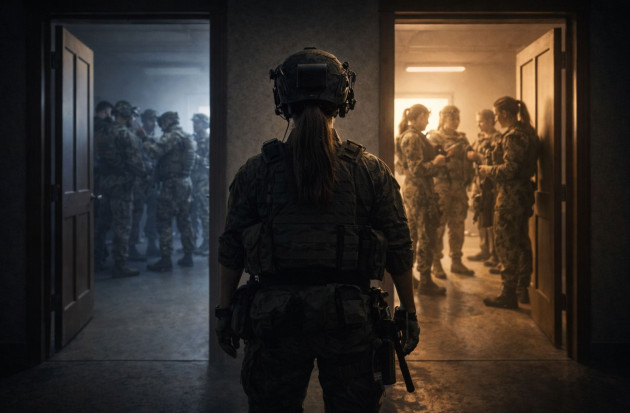
In World War II, the Soviet Union trained nearly 2,500 female snipers. One of them, Lyudmila Pavlichenko, recorded 309 confirmed kills… including 36 enemy snipers. She was 25 years old. The Germans called her “the Russian bitch from hell.” Eleanor Roosevelt called her a friend.
Of those 2,500 women, only about 500 survived the war. They weren’t protected. They weren’t coddled. They were in the fight.
So, when someone says women can’t handle combat, history has already answered that question. They can. They have. Some of them have been better at it than almost any man.
But we all know special operations is a specific kind of combat. Elite warriors. With specific physical demands, conducted in specific team environments over extended periods. And that’s where this conversation gets interesting.
We should also consider that in the U.S., there are professions dominated by women where men are largely absent. Not because men are banned… but because the roles evolved that way.
Nursing is over 90% female. Midwifery even higher. Childcare, speech pathology, dental hygiene… all north of 90%. Men can enter these fields. Some do. But most don’t, and nobody’s calling it a crisis.
We accept, without much debate, that certain roles attract certain people. That biology, socialization, and practical reality all play a part. We don’t demand 50/50 representation in every labor and delivery room.
So why does the conversation shift when we’re talking about who kicks down doors?
Israel figured something out.
The Caracal Battalion is a mixed-gender infantry unit… about 70% female. They patrol borders and engage smugglers. On October 7th, 2023, a squad of 12 women from Caracal engaged Hamas terrorists for nearly 14 hours, eliminating close to 100 of them. Their commander, Lt. Col. Or Ben-Yehuda, had already been decorated for valor in 2014 after being wounded in an ambush on the Egyptian border.
Israel also has all-female tank crews now. Female soldiers in elite intelligence units. Women in combat roles that would make many American policymakers nervous.
But there’s nuance: Israel’s female combat units are largely separate. Caracal isn’t embedded into their tier-one commando units. The women aren’t mixed into existing all-male special operations teams… they operate within their own structure.
Is that a limitation? Or is it wisdom?
I sat down with Mike Ritland last year. If you don’t know Mike, he’s a former Navy SEAL who built and ran the West Coast SEAL canine program, now runs multiple businesses, including the Warrior Dog Foundation, and hosts the Mic Drop podcast. The man has been in rooms most of us will never see.
I asked him about women in special forces because I know and respect him, and I wanted an honest answer from someone who’s actually been there.
He didn’t dodge it.
He acknowledged that good ideas could come from anywhere, regardless of gender. He even acknowledged that some elite female athletes might be physically able to complete the training without lowering the standards.
Then he added:
“The complexity and the hassle that is going to infuse into the community is not worth adding one or two or a handful of people.”
He pointed to Israel as a model…. as a way to include women intelligently. Not exclude them.
Mike continues: “I’m not saying women shouldn’t be allowed to or be in special operations capacities. I just don’t think that they should be put into existing all-male units that have decades of only being male units… Israel, I think, is a shining example of how to incorporate that other element. They have all-female special operations units. I’m all for that.”
And then he hit the point most dance around:
“You’re filled with 20- to 40-year-old men in the prime of their life, full of piss and vinegar and testosterone. And now you put them in an environment where they’re not around any women for months at a time, and now you throw a very physically capable, physically fit woman in the mix and it’s going to cause problems. People can say that it shouldn’t… whether it should or shouldn’t is irrelevant. It will.”
Whether you agree or disagree with Mike, you can’t say he hasn’t thought about it. And you can’t say he’s speaking from ignorance.
What I appreciate is that he didn’t just say “no.” He said, “Not like this… but maybe like that.” He offered a framework, not a wall.
The facts are clear: Women can fight. Women can operate at high levels. Women have proven themselves in combat across history and around the world. And in America, women are already serving in special operations roles… just not in every unit.
So, the question concerns structure, not capability.
Do we continue trying to integrate women into existing male units and manage the complications? Or do we follow Israel’s model and build parallel structures where women can operate at elite levels without the friction of integration?
I don’t have all the answers, but I do think this conversation deserves honesty, nuance, and a willingness to think more deeply from multiple perspectives.
What do you think?
───────────
Tegan Broadwater spent 13 years with the Fort Worth Police Department, including two years assigned to the FBI working deep undercover inside a violent Crip organization. That operation, detailed in his book Life in the Fishbowl, resulted in 51 convictions. He has since founded Tactical Systems Network, an armed security & protection firm primarily staffed by veterans, is a creative writer and musician, and hosts The Tegan Broadwater Podcast. All book profits benefit children of incarcerated parents. Learn more at TeganBroadwater.com








COMMENTS