

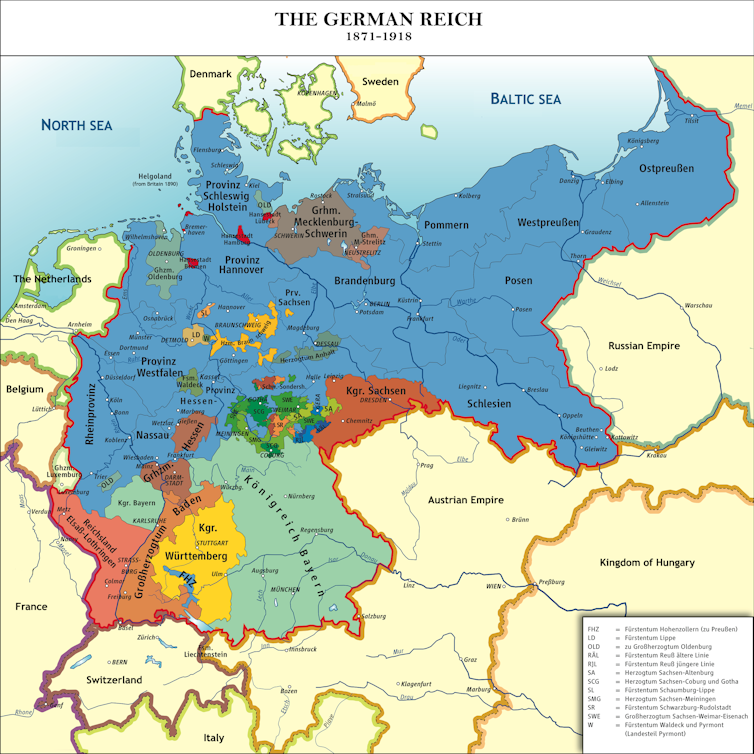
Some supporters believe Germany’s true form existed between 1871 and 1918, when the German Reich was established following unification and before the first world war. Others cite the constitution of the interwar Weimar Republic as that of the true Germany. And others still focus on 1937 to demonstrate what they perceive as the legitimate boundaries of German territory, which then included the former Kingdom of Prussia, now Poland and Russia, but not Austria, which was annexed in 1938.
A uniting belief among the Reichsbürger is that the current German state lacks sovereignty. They think the western allies (France, the UK and US) supposedly retained control after their occupation of West Germany ended in 1955. Therefore, some believe that the current German state is a puppet regime which does not support the interests of the German people.
They sometimes refer to it as Deutschland GmbH (Limited), implying it has no power over itself and exists only to enrich its controllers. The name BRD GmbH is also used, referring to the abbreviated name for post-war West Germany.
Revisionist history and antisemitism
The focus on historical revisionism and erasure of German sovereignty can encourage a conception of Germany as a blameless country with uncomplicated pride. By focusing on pre-war borders and overlooking post-war history, the Reichsbürger can ignore Germany’s defeat in the second world war, as well as its process of coming to terms with its Nazi and colonial past, notably the Holocaust and the 1904 Herero and Nama genocide in Namibia. The removal of these dark moments in German history enables the movement’s supporters to focus on their own perceived victimisation as subjects of a German state which they do not recognise.
A similar revisionism is common in the wider German far right, notably some members of the populist AfD party. Repudiation of the Holocaust’s importance and an emphasis on “positive” moments in German history encourages Holocaust relativisation and antisemitism.
However, unlike the AfD, which has adapted its rhetoric to fit into the political mainstream, some Reichsbürger followers entirely disregard current German laws banning Holocaust denial and the dissemination of Nazi propaganda. The group is linked to overt antisemitism and the spread of antisemitic conspiracy theories about the power of “high finance” as well as outright Holocaust denial. In March 2020, German police seized neo-Nazi propaganda during raids on the homes of some Reichsbürger members.
However, the historical revisionism can confuse the picture. Although many of its adherents are antisemitic and glorify the colonial past, the Reichsbürger is not specifically defined as a group of right-wing extremists. In truth, only a small portion of the movement can be defined as such.
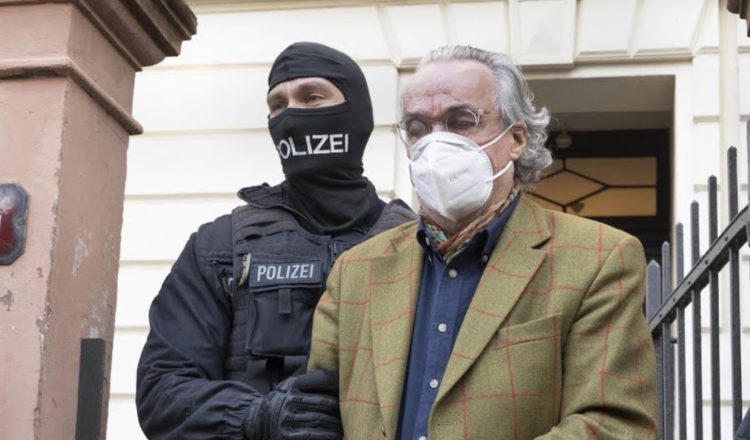
At its core, right-wing extremism is largely defined as anti-democratic. While many Reichsbürger refuse to endorse the legitimacy of Germany’s current democratic state, the lack of unified vision within the movement makes it unclear which system would be preferable, the constitutional monarchy of Kaiser Wilhelm II, the democratic experiment of Weimar Germany or the dictatorship of Nazi Germany. However, in the case of the most recent plot, the key role of Heinrich XIII implies that the goal was the restitution of a constitutional monarchy in the style of Kaiser Wilhelm II’s regime.
Growing threat?
Some Reichsbürger followers are evidently beginning to engage in political violence. The latest arrests follow multiple other incidents. In 2016, a police officer was killed during a raid on a member of the movement’s illegal collection of weapons. In August 2020, members of the Reichsbürger attempted to enter the German parliament as part of a protest against COVID-19 restrictions.
The presence of former military figures and a former parliamentarian among the most recently arrested group suggest the Reichsbürger are not without potential influence. The AfD has long denied any links to the movement, but has been shifting further and further to the right in recent years. In 2019, the German interior ministry reported that it had identified some isolated connections between the Reichsbürger and the AfD.
The Reichsbürger could be viewed as a fringe group but their ideas clearly appeal to some enough to convince them a coup is a worthwhile undertaking. And links to more influential organisations would make them more dangerous – which is why this matter has been taken so seriously by the authorities.
***
This piece is written by Claire Burchett, PhD candidate in European Politics from the King’s College London. Want to feature your story? Reach out to us at [email protected].
This article is republished from The Conversation under a Creative Commons license. Read the original article.









-en.png)
COMMENTS