

The objective remains simple: compress revenue, force decisions, shift leverage. The path there is less controlled.
What the Island Is
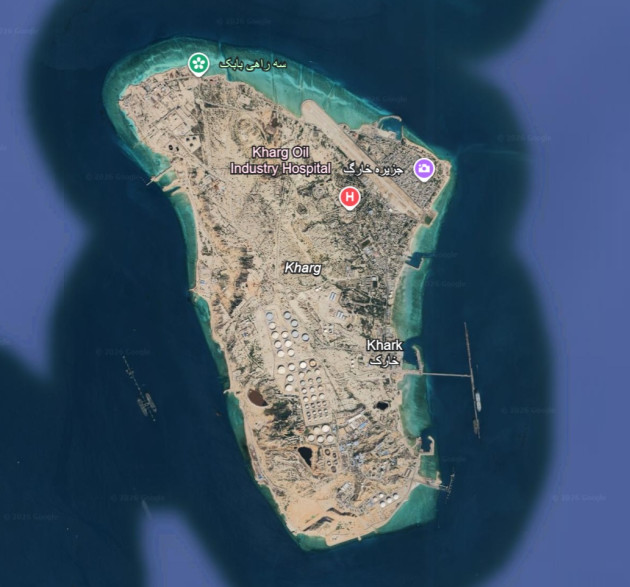
Kharg does not offer much in the way of natural defense. The terrain is low, largely flat, and exposed. Limestone underfoot, sparse vegetation, limited elevation. You can see across large portions of the island without effort.
The infrastructure defines the ground. Storage tanks rise in clusters. Pipelines cut across open space. Piers extend into deep water built for large tankers. Housing and support facilities sit close to the industrial core. A single airfield runs along one side, functional and vulnerable at the same time.
Everything is close together. That proximity simplifies movement. It also concentrates risk.
Industrial systems behave differently under fire than hardened military positions. Damage does not stay contained. Fires spread. Secondary explosions follow. Access routes become obstructed. The fight and the environment begin to interact in ways that are difficult to predict and harder to control.
There are indications of hardened sites tied to military use, including storage for missiles and naval mines. The open record does not suggest a deeply buried network capable of sheltering large forces. Protection appears limited and specific.
A force on Kharg would operate in a space built for throughput, not survivability.
The Problem After Arrival
Taking ground is one phase. Living on it under pressure is another.
Kharg sits close enough to the Iranian mainland that distance offers little comfort. Coastal systems can reach it without strain. The island falls inside a standing envelope of capability that includes missiles, drones, and maritime assets.
The threats are persistent rather than episodic. Missiles aimed at fixed points. One-way drones probing defenses and forcing a constant response. Smaller systems used to observe, harass, and exploit openings. Activity at sea that complicates movement and introduces the risk of mines. Iran’s strike options are not theoretical. Systems like the Fateh-110 and Shahab-series missiles can reach Kharg easily from the mainland, while one-way attack drones similar to those used across the region would force constant defensive engagement. Even limited success against air defenses would create cumulative damage over time, especially against fixed infrastructure like fuel storage and the airstrip.
The airfield becomes a focal point. If the runway is cratered repeatedly, resupply shifts almost entirely to sea, where even small numbers of naval mines or fast attack craft can slow or disrupt operations. At that point, sustainment becomes the center of gravity, not the initial seizure. It enables resupply and evacuation. It also draws attention. Damage to the runway shifts the burden to sea lines that are already under pressure. Repair becomes part of the daily routine.
The character of the fight settles into a pattern. Pressure is applied across multiple points. Infrastructure targeted for effect. Defenses stretched over time. The objective for the defender is not immediate recapture. It is accumulation. Raise the cost. Create friction. Force reconsideration.
Time works against anyone holding the island.
Forces and Limits
U.S. forces in the region include elements designed for this kind of mission. Marine Expeditionary Units operate from amphibious ships with aviation, logistics, and command capabilities built for limited-objective operations. A MEU brings around 2,200 Marines and sailors with the tools to seize and secure key terrain.
That package makes a Kharg operation conceivable. It does not make it easy to sustain.
Once on the island, the burden shifts. Protection against air and missile threats. Movement under observation. Maintenance of critical systems. Management of fires and damage. Continuous resupply in a contested environment.
Additional naval and air assets extend reach and provide support. They also widen the footprint of the operation. What begins on a small island can draw in a larger set of commitments.
How Iran Might Respond
Iran does not need to match a move on Kharg with a mirror image. It can respond across domains.
Maritime disruption sits at the top of the list. Mines, even in limited numbers, alter behavior. Shipping slows. Insurance costs rise. Routes shift. The Strait of Hormuz becomes a pressure point again.
Missile and drone activity would likely focus on the island first, then expand outward. Regional bases present additional targets. Proxy networks provide other avenues for pressure.
The objective would be consistent. Increase the cost of presence. Complicate logistics. Stretch defenses. Create political weight around continued occupation.
Energy markets would react in parallel. Price movement reflects both physical disruption and perceived risk. The psychological component carries its own force.
The Decision Point
Kharg offers clarity on a briefing slide. A defined objective. A direct link to economic pressure. A contained piece of geography.
The reality is more layered. The island compresses value and vulnerability into the same space. Actions taken there would move quickly beyond its shoreline.
The United States has the capability to act. That is not in doubt.
In a video game, the round ends when the objective is taken. On Kharg, that is where the real fight begins, and it does not come in waves. It comes continuously, across every domain, until the cost forces a decision.








COMMENTS