

The Duke was our invisible shield, designed to jam radio frequencies used to trigger IEDs. It worked by emitting a barrage of signals, drowning out remote detonation attempts—essentially poisoning the electromagnetic spectrum around us. In Baghdad, that meant safety. But in Ukraine, it would be useless. FPV drones are not triggered remotely; they are flown manually in real time. There’s no button to jam when the threat is watching you through first-person goggles, adapting mid-flight. While electronic warfare countermeasures have evolved, so too have the drones. Common control frequencies are being abandoned in favor of obscure, nonstandard bands—sub-400 MHz, or unconventional ranges like 5.9 to 6.1 GHz and 2.9 to 3.4 GHz—designed to elude detection and disruption. Every time a jammer is built, a workaround is engineered. It’s an arms race between signal and silence, and right now, the drones are winning.
Operation Spiderweb marked another turning point. Ukrainian forces developed a sprawling, distributed drone strike network—dozens of mobile teams, each with live ISR and strike capabilities, operating like neural nodes in a digital nervous system. The strikes weren’t just coordinated—they were edited mid-conflict, tagged, and disseminated with the urgency of a breaking news cycle. This wasn’t just the integration of technology into warfare—it was the fusion of combat and content creation. And it suggested something darker still: the birth of drone war as spectacle, and perhaps, as a new form of psychological warfare that transcends traditional doctrine on all fronts.
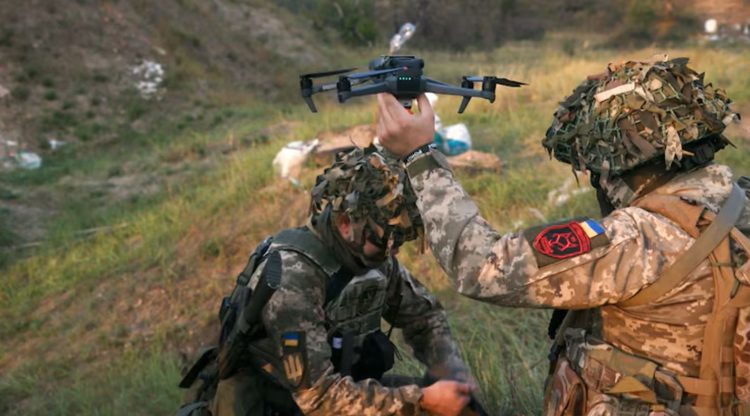
I recently came across a clip highlighted by Preston Stewart—a YouTuber respected in military circles for his precise breakdowns of modern combat—showing a group of Russian soldiers surrendering to a Ukrainian drone. They held their hands up to a flying camera, following its movement like it was a squad leader. It was a haunting image: technology not as executioner, but as witness and intermediary. For a moment, it felt like a sliver of humanity had survived inside the digital fog of war.
But scroll deeper into Telegram, and the picture curdles. You see wounded men crawling, unarmed, struck by drone-dropped grenades. Some are clearly hors de combat. Others are being medevaced. The clip Preston shared feels like an outlier, a flicker of moral clarity in a war defined by its absence. Perhaps that surrender wasn’t a sign of progress. Perhaps it was just a glitch in the algorithm.
But war is not only more technological; it is more accessible. Social media and mass communication have collapsed the distance between trench and timeline. Soldiers often carry their smartphones to the zero line, texting family through Starlink relays or conventional cell towers. They record battlefield footage, document poor decisions by commanders, or capture suicide assaults gone wrong—then upload the clips to Telegram or Signal within minutes. Rumors, disinformation, chain-of-command breakdowns—these ripple across the front in real time. Gone is the era of men going off to war, sending sanitized letters home, and returning in silence. Now, mutilated soldiers whisper voice notes into cracked phones, messages trembling across Starlink relays as they bleed out alone in no man’s land. The horrors are no longer hidden. They’re live-streamed—and we are growing calloused to them.
One of the more surreal and regrettable episodes of my time in Ukraine unfolded during the first year of the war. In Iraq or Afghanistan, you couldn’t message the enemy directly on a smartphone—even the thought would’ve been absurd. But Ukraine is different. The front isn’t just physical; it’s digital. And the enemy knows how to find you.
Hybrid Warfare
Not long after I appeared in a Fox News segment under the pseudonym “Ernest Fletcher,” a supposed friend from Thailand took a screenshot of the post I’d shared privately with friends and handed it off to Rybar, one of Russia’s most prominent military Telegram channels. From there, my identity was outed. My Facebook was combed through. My real name, location, and background were broadcast to hundreds of thousands.
The death threats came almost immediately—dozens a day, some clearly from Russian soldiers. It reached a peak when someone sent me a video of a Ukrainian prisoner being tortured and castrated—one of several grotesque clips weaponized as psychological warfare during those early months.
I lost it. I was off duty, holed up in a hotel, drunk and furious. I recorded a voice message—raw, unfiltered, threatening. Within hours, it had been clipped, stripped of context, and rebranded by Rybar as anti-Ukrainian propaganda.
That was the moment I realized I had become the first foreign casualty of a new kind of hybrid war: fought not just with drones and artillery, but with screenshots, disinformation, and Telegram feeds. There’s no training for this in the U.S. Army. War isn’t just changing fast—it already has.
Warfare has never evolved this quickly within the span of a single war. When Europeans first fielded the arquebus in the late 15th century, it didn’t immediately end the age of battlefield formations. For nearly four centuries, soldiers marched in tight ranks, firing volleys—from matchlocks to flintlocks to bolt-action rifles. The tactics clung to old forms long after the weapons changed. It wasn’t until the machine gun collided with industrial warfare that the world realized: old tactics plus new technology equals mass death. The lesson was learned in blood between Port Arthur and the Marne.
Today, we are accelerating toward a similar reckoning. We will soon witness human infantry charging AI-driven defenses—or worse, AI-directed swarms assaulting human lines. The balance is broken. The rules have not caught up. And we will have to ask: with this new technology, should we say a final farewell to arms?
I’d like to think that out of this carnage, we could finally take a lesson from the Battle of Solferino. In 1859, Henri Dunant—a Swiss civilian—saw wounded soldiers left to die on the battlefield, crying out for the peasant lives they’d once lived, torn apart by a war that was becoming industrial before the world was ready for it. That horror led to the founding of the Red Cross and, eventually, the Geneva Conventions.
War is Hell
Maybe it’s time we meet again—not in Geneva, with all its European baggage, but in a new setting. Abu Dhabi makes sense. It isn’t tied to the colonial legacy of Europe, and it sits at the crossroads of many of today’s conflicts. It’s a place that understands what war does to people.
I’d like to think that out of this carnage, we could finally take a lesson from the Battle of Solferino. In 1859, Henri Dunant—a Swiss civilian—saw wounded soldiers left to die on the battlefield, crying out for the peasant lives they’d once lived, torn apart by a war that was becoming industrial before the world was ready for it. That horror led to the founding of the Red Cross and, eventually, the Geneva Conventions.
As for me, I’ve seen enough. I don’t believe we will evolve a new set of rules fast enough to meet this moment. If anything, we are abandoning what little restraint we had. Maybe one day it will be drone vs. drone, code vs. code. But before that, just like in 1914, there will be cavalry charging into machine guns. Ahead lies a brutal lesson we seem unwilling to learn.
Humanity is a word invented by a species ashamed of its history. And history itself is an algorithm written in blood—innovation by annihilation, always a generation ahead of the ethics meant to restrain it.








COMMENTS