
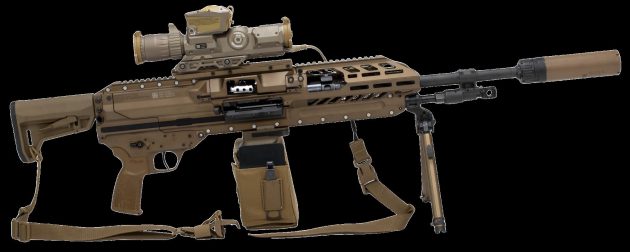
The New Standard in the Fight
The M249 used to be a squad’s insurance policy. When rifles could not solve the problem, the SAW did. It worked, for a long time, until the fight started asking for more reach than 5.56 could reliably deliver.
But weapons are built for fights, not legacies. It had to go the way of the eight-track tape.
The next fight looks different, stretches farther, and punishes old assumptions. The U.S. Army knows it. That is why the M250 exists.
The SIG Sauer M250 story is not one of rate of fire. It is a story about reach, control, and relevance.
When the Old Math Stopped Working: The M249
The M249 was built around a 5.56×45 millimeter cartridge and a doctrine that emphasized sustained suppressive fire at the squad level. It excelled in that role. Modern battlefields demand something else. Peer and near-peer threats bring improved protection, longer engagement distances, and a fight that places a premium on accuracy and effect at range. Volume alone no longer settles the argument.
The Army’s Next Generation Squad Weapon program reflects that shift. Rather than upgrading legacy systems around the margins, the service chose to reset the baseline. The M250 replaces the M249 not because the old weapon failed, but because the mission outgrew it.
Built Around a Common Cartridge
At the center of the M250 is the 6.8×51 millimeter cartridge, shared with the M7 rifle. That commonality matters. Both weapons are built around the same ammunition, giving the squad a matched set of tools designed for the same engagement envelope and ballistic performance.
The Army selected the 6.8mm round to deliver improved accuracy, increased effective range, and greater lethality compared to legacy squad weapons. For the gunner, that translates into suppressive fire that remains effective at distances where older systems began to lose relevance.
This is a system designed around what squads are expected to face next, not what they faced last.
A Modern Automatic Rifle by Design
According to Army Program Executive Office Soldier (or PEO Soldier), the M250 is a lightweight, belt-fed, select-fire automatic rifle chambered in 6.8×51 millimeter. It incorporates fully ambidextrous controls, recoil mitigation tailored to the new cartridge, and modular M-LOK mounting surfaces to support modern accessories. The Army has stated that the weapon delivers improvements in accuracy, range, signature management, and lethality compared to its predecessor.
Those features are not cosmetic. They reflect a deliberate effort to modernize how the automatic rifle fits into the squad. Ergonomics, controllability, and modularity matter when the gun is expected to operate alongside advanced optics and evolving infantry tactics.
Despite its increased capability, the M250 maintains a weight profile that respects the realities of the infantryman’s load. It delivers more performance without demanding an unrealistic tradeoff in mobility.
Not Just a New Gun, a New Role
Calling the M250 a SAW replacement misses the point. This is not a belt-fed weapon intended to saturate terrain with volume alone. It is an automatic rifle built to dominate space with controlled, sustained fire. That’s a different thing altogether.
As part of the Next Generation Squad Weapon system, the M250 supports the squad’s ability to place accurate fire at distances that previously strained legacy automatic weapons. It anchors squad firepower with precision rather than excess.
That distinction matters. Fire superiority today is less about noise and more about denying movement, forcing decisions, and shaping the fight on favorable terms.
Type Classified and Fielded
In May 2025, the Army officially granted Type Classification – Standard to the SIG Sauer M250, clearing it for broad fielding across close combat formations. That milestone followed extensive testing and evaluation and confirms that the system meets the Army’s requirements for safety, performance, and sustainment.
Type classification is not ceremonial. It signals confidence that the weapon is ready for operational use and long-term support. The M250 is no longer an experimental concept. It is the Army’s standard automatic rifle moving forward, and that’s been a long time coming.
What the M250 Represents
The M250 represents a clear acknowledgment that the infantry fight has changed. It marks a move away from legacy compromises and toward a squad equipped for longer, harder engagements against capable adversaries.
This SIG is a purpose-built response to modern lethality demands.
The M249 carried squads through the last generation of war.
The M250 is built to carry them through the next one.








COMMENTS