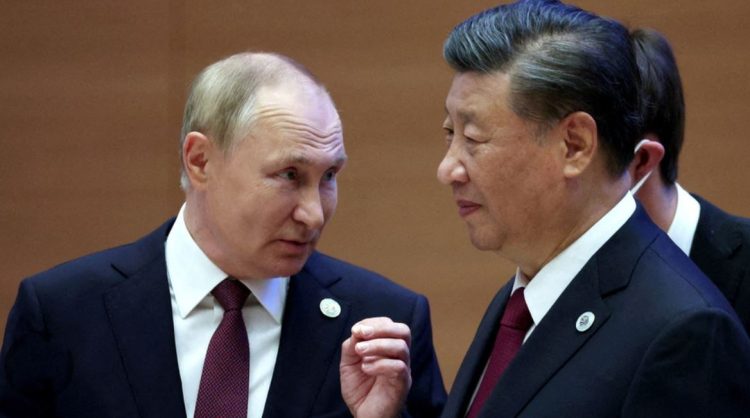
In February 2022, as the Beijing Winter Olympics came to a close, Russian forces massed along Ukraine’s borders. Western intelligence warned an invasion was imminent; Moscow denied it. Inside Ukraine, people went to work. My ex-girlfriend, who grew up in the Donbas, told me the warnings were political theater. In the same week, Vladimir Putin met Xi Jinping in Beijing and announced a partnership with “no limits.” Days later, Russian armor crossed the border.
I answered the call to fight in Ukraine. I write about that decision and what followed in my memoir, War Tourist, which is represented by Writers House in New York. That month was personal in other ways as well: the woman I once called the love of my life ended things via WhatsApp. It was an ordinary, small cruelty layered on top of a larger one; the war did not feel abstract, and neither did the personal losses. Both became the spine of the book.
What followed was more than a territorial invasion. The campaign that began in 2022 tested the post-1945 architecture of deterrence, open markets, and law-based borders. Putin set out to prove that force could still change geography. Xi watched how the United States and its allies responded, measuring endurance against the initial will to resist. The stakes are practical: whether the rules that keep trade flowing, ports open, and finance predictable will continue to hold.
China’s Observation Post
For Beijing, the war in Ukraine has been a continuous research project. Chinese defense institutes have dissected how drones, satellites, and encrypted communications shape modern combat. The People’s Liberation Army has run simulations based on Ukrainian battlefield data for potential operations in the Taiwan Strait.
Chinese analysts focus on three lessons. First, the ability of commercial technology — from Starlink terminals to civilian quadcopters — to alter a conventional war. Second, the strain of sanctions on a major economy and how alternative trade routes can soften the impact. Third, the limits of democratic endurance: how debates over budgets and elections slow support for an ally under fire. Every observation feeds a larger conclusion that Western unity is real but time-bound.
A Division of Labor
Since 2022, Russia and China have built a working partnership grounded in necessity. Russia provides manpower, resources, and willingness to absorb losses. China provides liquidity, logistics, and diplomatic insulation.
Trade between the two reached roughly $260 billion in 2024, an increase of more than 60 percent from pre-war levels. China buys discounted Russian oil and gas, sells vehicles and electronics, and supplies industrial components that sustain Russian production. Much of this commerce uses the yuan instead of the dollar. The arrangement finances Russia’s war while giving China a live rehearsal in sanctions evasion. It is not an alliance of trust but an economic experiment in how to fight a long war under financial pressure.
The Network Around Them
Several other governments have aligned with this loose structure:
- Iran exports drones and ammunition; the Shahed-136, used against Kyiv and Odesa, is now manufactured under license in Russia.
- North Korea ships artillery shells to Russia in exchange for grain and satellite technology.
- Venezuela hosts Russian naval visits and sells crude to China, restoring influence in the Caribbean.
- Hamas, supported by Iran, diverts Western resources toward the Middle East, easing strain on Russia’s front.
These states share no ideology. What unites them is an interest in eroding Western leverage and expanding the space for coercion without consequence.
Why It Matters Beyond Europe
A trench near Kupiansk may seem remote from American life, yet its outcome affects daily economics. The post-1945 system functions because investors, insurers, and shippers believe that aggression will be contained. When that belief weakens, risk premiums rise, fuel costs climb, and markets price instability into everything from groceries to mortgages.
The dollar underpins that order. Its dominance allows Washington to borrow cheaply and enforce sanctions through control of the global financial system. If BRICS countries expand yuan- or ruble-denominated trade, even modestly, the dollar’s reach narrows. That shift would raise U.S. borrowing costs and feed inflation, reducing the economic margin that funds both domestic programs and defense.
Already have an account? Sign In
Two ways to continue to read this article.
Subscribe
$1.99
every 4 weeks
- Unlimited access to all articles
- Support independent journalism
- Ad-free reading experience
Subscribe Now
Recurring Monthly. Cancel Anytime.
The System China Is Building
China’s Belt and Road Initiative has tied more than 140 countries into infrastructure and loan agreements, many secured by ports, railways, or data networks. These arrangements extend Beijing’s influence across Africa, South Asia, and the Middle East. The debts are often denominated in yuan, making repayment dependent on Chinese banks.
Beijing also dominates key supply chains: rare earths, batteries, and the lower stages of semiconductor production. Dependency becomes a policy lever. Nations that rely on Chinese components temper their foreign policy accordingly. The system Beijing promotes is not one of equal partners; it is a hierarchy sustained by debt and access.
The War’s New Dimensions
Ukraine’s battlefields show what large-scale war looks like in the twenty-first century. Drones conduct reconnaissance, direct artillery, and strike armor columns. Artillery, still decisive, is now linked to digital targeting networks. Cyber operations and electronic warfare shape the tempo as much as terrain.
In 2024, I spent several months in Kyiv. At night, the city’s rhythm changed when Shahed drones arrived. Their engines were slow and uneven, and they came in groups of five or six. Anti-aircraft guns traced orange arcs above the skyline. Sometimes they intercepted them; sometimes they did not. The same design now appears in the Middle East and the Red Sea, attacking refineries and cargo ships. The logic is consistent: persistence over precision, mass over cost.
Modern war is inexpensive to start and expensive to end. It is fought in factories, supply chains, and information systems as much as in trenches. Every delay in Western production or delivery tells aggressors that endurance is their strongest weapon.
Sustaining the Line
Ukraine’s defense remains the most direct way to uphold deterrence. Support should be steady, transparent, and measured against clear objectives. Long-range artillery and integrated air defense have imposed the highest cost on Russian operations. The goal is not endless escalation but a sustainable stalemate on terms that deny Moscow advantage.
A frozen conflict favors the aggressor’s recovery. A defended line that drains his capacity discourages repetition elsewhere. That outcome, achievable with consistent support, is the strategic minimum for the United States and Europe.
Shared Responsibility
Backing Ukraine is not a matter of ideology. It is a matter of structure. The United States does not need to manage every conflict, but it cannot ignore the system that keeps its economy viable. If borders can be changed by force and the dollar becomes optional, the United States pays the price through weaker deterrence and higher living costs.
The debate in Washington often divides along party lines, yet the underlying issue is bipartisan: how to preserve a world where rules, not coercion, set the boundaries of power.
The Test Ahead
The war that began with a handshake in Beijing has become a measure of Western endurance. Ukraine’s survival will not guarantee stability, but its fall would accelerate the decline of the institutions that built it.
Deterrence has to be demonstrated, not declared. The drones over Kyiv, the shifting trade routes, and the parallel economies forming under BRICS are all signs that a global contest is already in progress. The outcome depends less on rhetoric than on persistence.
Ukraine’s defense is the West’s immediate line in that contest. The longer it holds, the longer the principles of the modern world hold with it.










COMMENTS