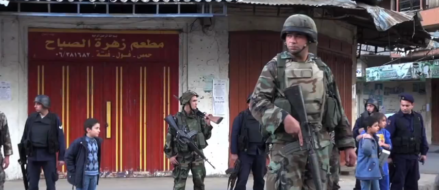
Watch: U.S. Spec Ops alongside Syrian Kurdish police in Manbij, Syria
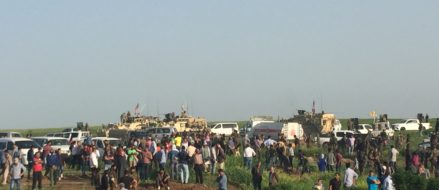
U.S. Special Operation Forces are helping the Syrian Kurdish police known as Asayish in their task to provide security to the newly liberated town of Manbij.
Loading video...
U.S. Special Operation Forces are helping the Syrian Kurdish police known as Asayish in their task to provide security to the newly liberated town of Manbij.
“And then he like, literally photo bombed his friends.” – Paris Hilton
A number are heard shouting “Allahu Akbar” as they flee.
The U.S. military is in principle all about metrics and assessments. Here at West Point, we have binders full of metrics on every cadet, from their physical training prowess to their math scores. Yet strangely in Iraq and Afghanistan we lack basic feedback mechanisms to determine whether our spending has the desired effect on the ground.
As an evidence-based approach to stability and reconstruction operations, tactical economics seeks to measure the impact of economic programs, in a manner similar to the “impact evaluations” that the international development community began employing over the past decade. If a program is not producing results, rapid assessment of the data can allow the resources to be conserved so military units can try a different approach.
The Ranger training program, led by Company A, 1-502nd, is one of the multiple building partner capacity missions the around 1,800 member strong task force leads in Iraq.
“This program is important because it lays the foundation for an elite Iraqi unit,” said Capt. Peter Jacob, commander of Company A. “Students start at day one as an individual and come away at the end of this course as part of a team.”
What began as a desperate, stopgap campaign by Iraqi leaders to stem Islamic State forces from overrunning Baghdad and other major cities in the country is now fueling a new era of sectarian violence, as a formidable array of Shiite militias casts a dark shadow over the Iraqi military’s recent battlefield successes.
American commanders have become increasingly wary that the more integral the militias become to the battle plan, the weaker Baghdad’s ability will be to rein in the paramilitary force — which now numbers over 120,000 fighters.
One of the extremists who had communicated online with Aaron Driver, the would-be suicide bomber killed by police in Strathroy, Ont., on Aug. 10, was a British 15-year-old, he said. The youth has since been convicted for his role in a terror plot in Australia.
Juvenile terrorists are not new. Four members of the Toronto 18 terrorist group, arrested in 2006 for plotting bomb and gun attacks in Ontario, were minors. But Cabana said the trend has worsened over the past two to three years.
Across the Islamic-majority countries there has been an ongoing struggle between modernization and Islamism. Riyadh views modernization as the vehicle through which the Saudi state, at long last, can confront and defeat extremism, foster a dynamic private sector and master the looming economic challenges. The Saudi program includes:
New limits on the ability of the religious police to arrest dissidents.
Purges of extremists from the government and greater efforts to monitor their influence in security institutions.
The appointment of new religious leaders to counter Islamic extremism on theological grounds.
The transformation of the world Muslim League—a key Saudi arm for supporting Islamic movements abroad—by the appointment of a new leader and a decision to stop supporting Islamist madrassas abroad.
The U.S. and other Western nations view the U.N.-backed government in the capital as the best hope for unifying Libyans and defeating the extremist group. Libyan forces loyal to the U.N.-backed government are currently battling a powerful Islamic State affiliate in the central city of Sirte with the help of U.S.-led airstrikes. Martin Kobler, the U.N. envoy to Libya, expressed concern over the general’s seizure of the terminals. He later called for a cease-fire and recognition of the U.N.-brokered government.
Three Americans volunteered for combat alongside Kurdish militia; repatriation was a complicated affair.
Americans don’t need a visa to enter Iraqi Kurdistan, but their passports are stamped there before they are driven into Syria through YPG-controlled border checkpoints. The volunteers don’t get Syrian government visas.
When fighters die in Syria, getting them home is a far more complex affair, and an expensive one. Representatives of the Rojava government paid $43,600 dollars for the cost to return the remains of all three men this time, according to Lucy Usoyan, a Washington-based representative of a Kurdish group that helped organize the return.
“If you have [the Islamic State’s] No. 3 in the crosshairs and he’s using human shields, would we be able to strike him or not?” the officer asked. “This is an important debate. But are we fighting a war or are we not? They are clearly waging a war against us. Are we waging a war, or are we conducting a police action?
“How do you ‘advise and assist’ someone when you are not allowed to go into combat with them?” the officer added.
“It’s like after the Afghanistan war in the 1980s,” said Neumann, citing the period after Soviet troops withdrew in 1989 and legions of foreign fighters formed a diaspora of radicalized veterans that subsequently fueled the rise of al-Qaeda. “They’ll be asking themselves, ‘What’s next?’ “
IDF Special Forces in combat actions against Hamas while operating in the Gaza Strip.