
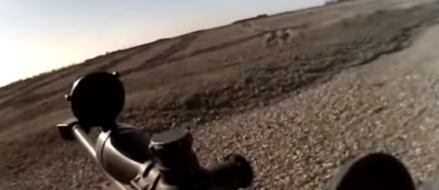
Watch: ‘F**k it…I’m gettin’ the Barrett.’ – A US SOF conflict resolution strategy
Helmet cam footage of U.S. SOF under fire.
The Barrett is retrieved.
They lose one vehicle and regroup . . . no injuries.
Problem solved, problem staying solved.
614 articles
Latest updates tagged Special Operations on SOFREP.
Helmet cam footage of U.S. SOF under fire.
The Barrett is retrieved.
They lose one vehicle and regroup . . . no injuries.
Problem solved, problem staying solved.
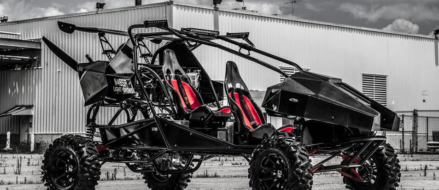
“[Military officials have] actually come to Shreveport multiple times and helped us think through the design,” Mr. Hamel told Fox News Thursday. “We redesigned this on probably 80 percent of their feedback. Whether we got the contracts or not, look, it’s a very patriotic place for us to play. Look, the military, if we can save American soldiers’ lives, they’ve got all of our resources behind it.”
The 3-year-old company told Business Insider Tuesday that he has a “verbal commitment” from the U.S. special operations forces community.
“The shocks [are what] won this particular group over,” SkyRunner consultant Mike Mitchell told the website. “Going off of a loading dock four to five feet tall … with such a soft landing was a big plus in their eyes.”
The company said its vehicle would likely be used for surveillance or recovery missions, but would not give specifics on its commitment from the U.S. military.
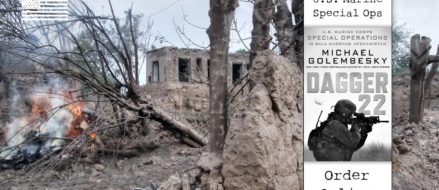
Dagger 22 follows the author, SSgt Michael “Ski” Golembesky, and his team of Marine Raiders (MSOT 8222) on their 2009-2010 deployment to Bala Murghab, Afghanistan. In Golembesky’s first book, Level Zero Heroes, he highlights how MSOT 8222 made the best of a deployment where the rules of engagement forced them to regularly be on the […]
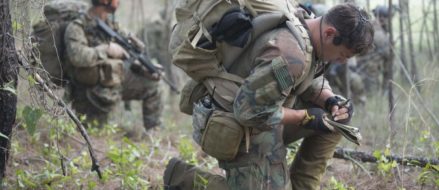
Special Operations Forces (SOF), such as the Navy SEALs and Delta Force, may soon get a new type of technology that gives them additional eyes on the ground, make airstrikes more accurate, and help them better discern enemy fighters from civilians.
Using this new technology, troops will be able to livestream video back to command, see through each-other’s eyes, track targets, and call in air strikes—using just their smartphones.
The new technology could roll out soon. The company that develops it, CrowdOptic, received a rapid prototyping request from SOFWERX, which is a partnership between Doolittle Institute and U.S. Special Operations Command. Under the request, which CrowdOptic received on Sept. 8, they are expected to have a working prototype available by Sept. 30.
According to CrowdOptic CEO Jon Fisher, the technology works on just about any device with a sensor, from smart glasses to drones, but they’ll be starting with smartphones since troops with SOF use personal phones as their main communication devices while on the field.
“It’s the phones first because that’s what’s everywhere for the military,” Fisher said.
The technology works by linking data between multiple devices and finding common information between them. It can also detect the direction a device is facing, and Fisher noted “with that type of content you can do some incredible things.” This opens many doors for new technology that Fisher said could benefit anyone from warfighters to firefighters, and in industries from police work to entertainment.
The technology has been framed before as a tool that lets you “see through walls.” This is partially true, since by using smart glasses and syncing them with cameras fixated in various locations, a wearer can look in the directions of different cameras to see what they see. The CrowdOptic technology is being used this way by San Francisco Zoo’s wolf exhibit.
Since the technology can sync multiple devices and find common information, it can also be used to interconnect what various people are looking at through smart glasses. The Denver Broncos are using CrowdOptic technology, for example, to detect where fans are looking on the field, and to use this data to find the best camera angles of the action.
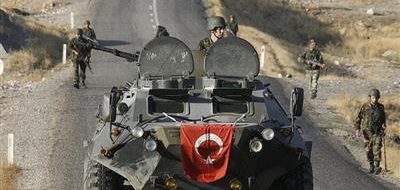
Northern Syria has always been the more difficult and violent section of Syria in the civil war. Aleppo and other cities have seen the most devastation. They’ve also witnessed the most fluid situation of occupants running the gamut of groups in Syria. According to Barbara Starr, who tweeted “US Special Operations Forces in Northern Syria […]
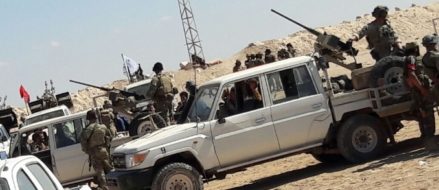
In April, the White House authorized up to 300 Special Operations troops in Syria. According to a U.S. defense official speaking on the condition of anonymity to discuss ongoing operations, the new detachment of U.S. forces with the Turks was requested by Defense Secretary Ashton B. Carter and was approved by President Obama. It is unclear whether the new detachment of troops alongside the Turks will increase the overall number of Special Operations forces in Syria.
In the past, the Pentagon has insisted that the troops are not on the “front line” and have instead remained in an advisory role, helping local forces call in airstrikes and assisting them plan operations. In August, Syrian Democratic Forces backed by heavy U.S. and coalition airstrikes, took the key town of Manbij. Although no U.S. troops have been killed in Syria, several have been wounded.
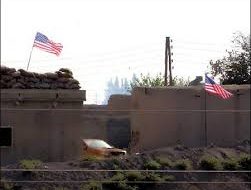
“I know in the past we’ve — as we’ve said, we would call on our partner forces not to fly the American flag on their own, certainly. And so, I — I would imagine that that would be communicated if indeed that’s taken place in this instance.”
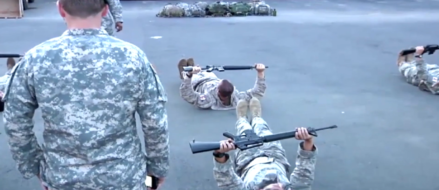
Soldiers faced many challenges at a Special Forces Readiness Evaluation held by members of B Company, 1st Battalion, 20th Special Forces Group in Albemarle, N.C.
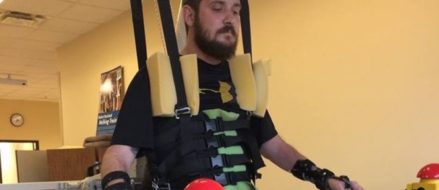
In looking into Brumit’s case and his disability benefits, the Army had conducted a “Line of Duty” probe to determine the circumstances of his injury. Their determination that he was reckless increased the likelihood he would face an other-than-honorable discharge and potentially lose benefits.
For now, those medical expenses are paid for. Brumit lives at his parents’ place in Georgia and has had seven surgeries to date. A denial of benefits could leave the family facing millions in lifetime medical costs, though some charity efforts have been launched.
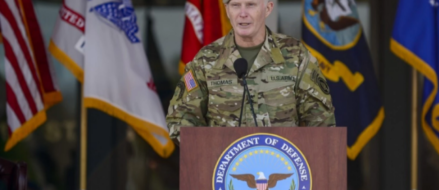
While much of the press surrounding Special Operations forces have centered around a relatively small component of it — the SEALS — Thomas said the issue of unwelcome publicity is spread across the various components of his command.
“Enforcing it isn’t exclusive to one camp of special operators,” Thomas said. “We’re hurting ourselves with this gratuitous release of movies, books and whatnot.”
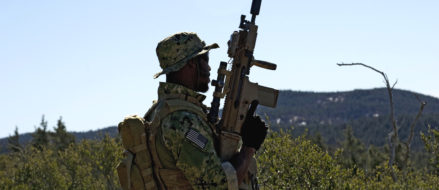
“If you have [the Islamic State’s] No. 3 in the crosshairs and he’s using human shields, would we be able to strike him or not?” the officer asked. “This is an important debate. But are we fighting a war or are we not? They are clearly waging a war against us. Are we waging a war, or are we conducting a police action?
“How do you ‘advise and assist’ someone when you are not allowed to go into combat with them?” the officer added.

Former MARSOC team member Michael Golembesky has published his second book titled, “Dagger 22” and it goes on sale September 20th. Dagger 22 gives readers a “grittier feel; more aggressive, with a deeper personal story-line” from Ski’s deployment in Afghanistan with his MARSOC team. Below is a Q&A with Michael Golembesky: 1) You mention in the author’s note at the beginning of Dagger 22, […]

Hywell is a premium gear brand specializing in heavy-duty Merino wool boot socks for blue-collar professionals and outdoorsmen. Backed by an ironclad 10-Year Warranty.

Praesidus builds rugged, American-assembled watches inspired by historic military timepieces. Designed for accuracy and tested for endurance, each watch is made for outdoor explorers, everyday adventurers, and anyone who needs reliability when it matters.

SIG Sauer is a world-class firearms manufacturer trusted by military, law enforcement, and responsible civilian shooters, delivering precision-engineered weapons, optics, and training systems while maintaining a strong commitment to veteran hiring, American manufacturing, and the professionals who rely on their gear when it matters most.

FightCamp is an at-home boxing and kickboxing training system built around real technique, structured programming, and measurable performance. Members train with fighters and professional coaches while using connected punch and kick trackers that record volume, speed, and power in every round. The result is training that builds conditioning, skill, discipline, and resilience — all from home, on your schedule.

Essential Provisions Field Fuel® meals [ready-to-eat] & sports nutrition products have been developed with the cleanest, high-quality nutrient and energy-dense ingredients available. Research has shown that the whole food nutrients contained in our products have the ability to help.

Have you ever tried to wear a fleece hoodie in bad weather? We don’t recommend it. That’s why we founded BÆRSkin in 2019 – to create the world’s best outdoor gear that’s just as comfortable at home as it is durable outdoors. “Bad fitting, bulky, and boring” is how we felt about 1000’s of regular fleece hoodies we tested.

If you’re 21 or older and use nicotine or tobacco, charge ahead with Black Buffalo, America’s only credible smokeless tobacco alternative. Black Buffalo dips just like the real thing without the tobacco leaf or stem. Find Black Buffalo in Wawa, Circle K, Sheetz, Love’s, Pilot, Racetrac, and many more retail locations across the United States.

Stay Locked In. No Matter What. NEORON is a brain-boosting beverage built for the mission: sugar-free, crash-free, and engineered for clean, tactical focus through long hours and high-stakes operations. Made for those who grind, stay sharp under pressure, and refuse to fold—if failure isn’t an option, NEORON has your six.