

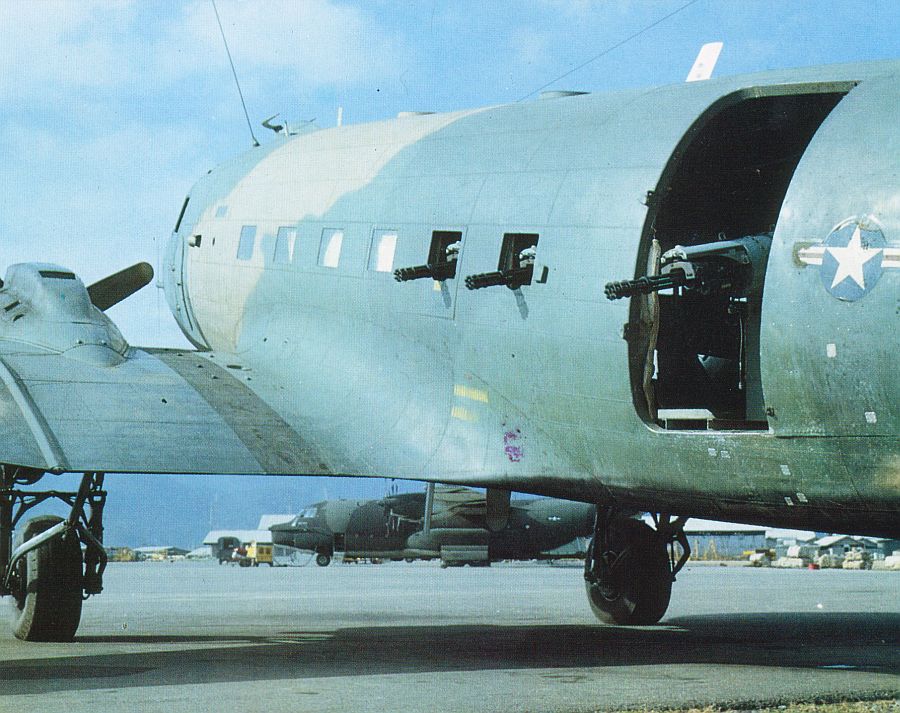
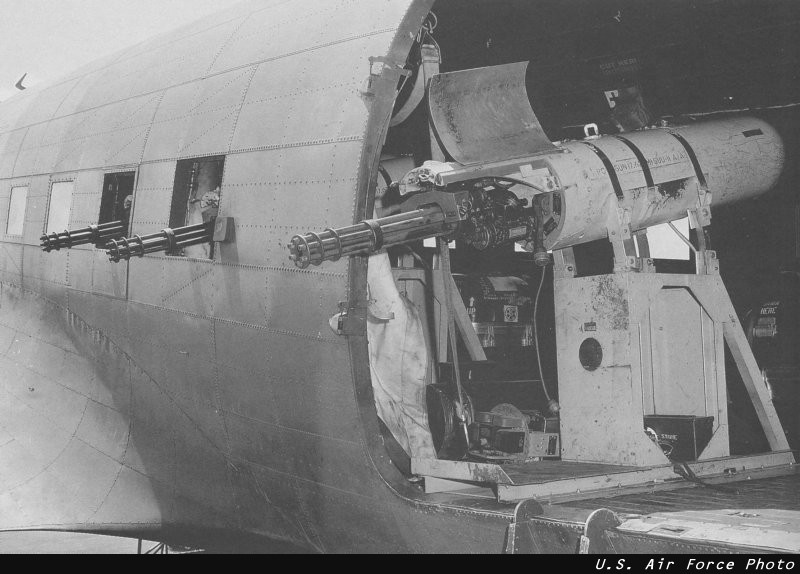
Each minigun was capable of firing 6,000 rounds per minute. They were mounted in pods on the plane’s left side, two firing through portholes and one firing out the cargo door. In addition, 24,000 rounds were carried to feed the guns, which were aimed by the pilot looking through a sight fixed to his left. The trigger was a button on the control wheel that, when pressed, sent a swath of fire the size of a football field that could be held and adjusted as long as the pilot stayed in his turn.
The result, as its new crews found, was absolute carnage in tests, often leaving targets torn asunder in tiny pieces on the wind. Most of those on the ground who saw it at work were often rendered speechless. Confidence was high among all that this could be a game changer.
Would it?
Two six-man crews and the plane, designated AC-47, were assigned to the 1st Air Commando Squadron, when action came on the night of December 23. A radio call crackled from the Tran Yenh Special Forces outpost for immediate fire support. Arriving just thirty seven minutes later, the crew could hear the urgency and desperation on the radio. The outpost was under a major Vietcong attack and was in danger of being overrun. Below the C-47, massive flares swayed, dropped by another C-47 acting as a flare ship. As the plane began dropping its own flares, the pilot radioed the outpost, asking if they wanted him to fire. Hearing only the motors of another C-47 overhead the radio operator replied “Ah… Yes.”
The AC-47 started its bank and a stream of fire leaped from the sky to the ground, surprising the defenders and annihilating the attackers, who never saw how the judgment rained down to tear a path through their ranks and the jungle itself. With such a high rate of fire and every fifth round a tracer, it seemed a massive red tornado started to swirl outside the camp’s perimeter, sweeping all before it into dust.
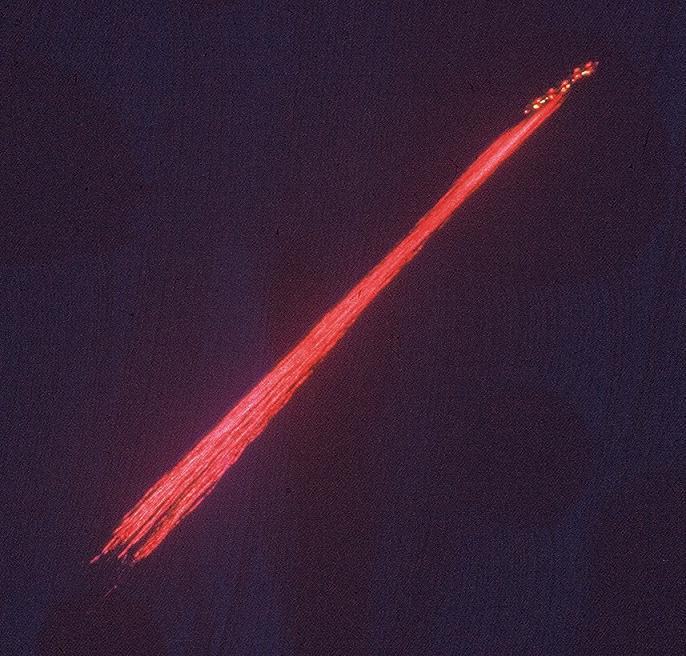
The AC-47 continued its slow trek in a great circle, as more tracers by the hundreds ricocheted skyward after hitting the ground, making it appear as if Hell itself was pushing its way to the surface and the earth was giving way. Nothing of flesh survived its onslaught. And when the firing stopped a few minutes later, a haze smelling of gunpowder settled over the night. The outpost was safe. Not even the plaintive cry of a wounded guerrilla was heard.
4,500 hundred rounds had been expended.
The saved men offered profuse thanks before a call came from another outpost known as Trung Hung, twenty miles away. A few minutes later, and new witnesses watched in amazement as the sky sent another red tongue to the earth to feed off the blood of more unsuspecting attackers.
Once the AC-47 returned to base, it wasn’t long before the destruction it had wrought that night began making rounds. In the days that followed, more requests came, and the bird cranked up and winged off to do its duty, never failing to break up an attack, no matter if it took hours.
It came to be during one of these night missions to protect a hamlet on the Mekong Delta in early 1965, another witness to its power, a Stars and Stripes reporter watched in awe and wrote how the stream of tracers reminded him of a dragon’s breath. After reading the story, the commanding officer of the wing said, “Well I’ll be damned, Puff the Magic Dragon,” referencing a children’s song made popular by the folk group Peter, Paul and Mary.
That was all it took, forever more, the solitary AC-47 and those that joined it later, carried the call sign ‘Puff.’ Even the Vietcong got in on the action, believing that the monster was real, and that shooting at it would only make it angry. It did.
On February 8, 1965, Puff located hundreds of Vietcong on a hillside firing at it and let loose, staying on station for four hours and firing over 20,000 rounds to leave the place bereft of trees and stalk. Maybe it was necessary to cover the body parts of the 300 plus enemy that had been gathering for an offensive.
Three years later, it was during in the siege of Khe Sanh in 1968 that the AC-47s, now expanded and operating countrywide using the call sign ‘Spooky’, gave its greatest and lengthiest service. Also it might be said, it proved to be the slow demise for the 47s used by the U.S. in the gunship role.
Khe Sanh was a remote Marine hilltop outpost in the northwest part of Vietnam. Situated near the Laotian border, the North Vietnamese had brought it under siege with the start of the Tet offensive on January 31st, 1968. President Johnson became so worried and obsessed with its fate that he demanded hourly updates on it as the mightiest warplanes in the U.S. inventory, including the B-52, unloaded thousands of tons of ordnance and literally changed the topography day-to-day around the site.
When dusk came, the NVA emerged from their deep tunnels and moved closer to the perimeter, only to have an AC-47 massacre them each time. This act was replayed countless times during the siege, and planes relieved each other making sure there was always a gunship orbiting the base. They stayed night after night for months on end until the siege was broken.
With this in mind, though the B52 may have been the airborne star of the event, an equal case could be made for the AC-47, who kept the enemy reeling when they were considered ‘danger close,’ and kept them from storming the base using one of their favorite weapons.
Night.
After 1968, the AC-47s slowly began to be supplanted and replaced by both the Lockheed AC-130 Spectre (Project Gunship 2) and AC-119 Stinger (Project Gunship 3). Once numbers of these aircraft were in theater, the AC-47s ranks grew smaller still until just a handful were serving into the 1970s, when they were withdrawn in favor of the Spectre. Variants of the AC-47 still serve today as gunships in South America, though without the miniguns that gave it its characteristic moniker.
Historians and fans need not be dismayed though, as whenever a Spectre goes into orbit over hostile lands, the ghost of Puff will continue to breath fire wherever groups of brave men find themselves outnumbered and needing an angel on their shoulder.








COMMENTS