
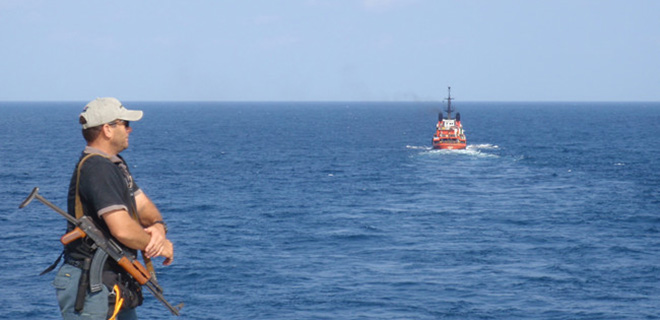
The official word is that piracy is on the downswing off the coast of Africa, while others are far more skeptical. While the official numbers from the Office of Naval Intelligence on Somalian piracy report that 51 vessels were hijacked in 2010, 27 in 2011, 7 in 2012, and 0 in 2013, it seems short sighted to claim that piracy is over in the Gulf of Aden and around the Horn of Africa. As long as the root causes of piracy, namely extreme poverty and illegal fishing in Somalian territorial waters, persist, there will always be a market for pirates to ply their trade with.
Meanwhile, a new front for piracy and counter-piracy is opening up in West Africa. While the Somalian pirates are largely seen as amateurs who display lackadaisical tactics, the Nigerian pirates come to the trade with a background as trained fighters in various civil wars. Rather than just using AK-47s, their gun boats roll out with DShK heavy machine guns, with gunners who know how to operate them. The line between pirate and rogue sailor blurs further as Naval ships from Togo and Nigeria are also known to partake in the spoils. Another key difference is that the Somalians found their main income in ransoming off the crew and their ship, while the West Africans are primarily concerned with looting the cargo hold.
The Nigerian situation is also different in that most of that action is in STS, or Ship to Ship, transfers in which a small ship pulls up alongside a larger ship to pump oil out of it’s hold, and then continue on to their final destination on the coast or even up the Niger river to deliver the goods. This makes for much shorter trips for those doing maritime security and, as dodgy as this sounds and is, this is where the contractors are usually unarmed, due to Nigerian laws.
Another maritime choke point is the Malacca Straights between Singapore and Indonesia. Pirates in this region board ships, but are mostly concerned with breaking into the captain’s safe rather than ransoming off the ship and its crew, often times more like a maritime stickup than anything. But piracy does exist in this area. The straights are so narrow that pirates have in the past been able to run a cable across them while staying low in dugout canoes. Stealing tugboats is also a popular pastime in this area. As always, piracy intersects with other forms of crime as well.
When the Somalian pirates hijack and ransom a ship, it is all done in international waters. Around the Malacca Straights, ships that get stolen have to be docked somewhere. These types of operations are controlled by crime syndicates, with the host nation not just turning a blind eye, but probably with skin in the game as an active participant.
In the South China Sea, things get more interesting as the Chinese Navy has been known to conduct boarding operations, a military-sounding term that conceals their true activities, namely, stealing stuff. The Chinese sailors have been caught in the past boarding ships and making off with their loot, usually electronics for re-sale on the mainland.
The future of the maritime security industry is anything but certain. Wages are slipping, many of the maritime security companies have gone bankrupt and many more will follow in 2013. The shipping industry itself is in turmoil, with many companies already operating in the red. Just as the Somalian pirates see their activities as a tax for using their waters, Maersk now charges a piracy surcharge to clients whenever they have to go through high-risk waters.
Maritime security will always exist to some extent, but it is not stable work and is not a viable career choice for young men leaving the military and looking for steady work. At some point, the shipping industry and insurance companies will have to find some sort of equilibrium with security contractors, but the market will be fragile into the foreseeable future.
As many contractors will tell you, their job is not nearly as cool, sexy, or exciting as many are led to believe. This is true for maritime security contractors as well. Kevin Doherty, the owner of Nexus Consulting reports that in the course of about 450 transits, his contractors have fired warning shots at pirates twice. That’s it. Otherwise you are staring at the big blue ocean for days on end.








COMMENTS