

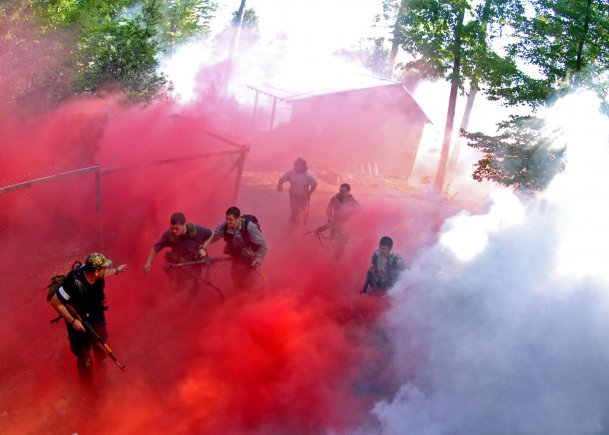

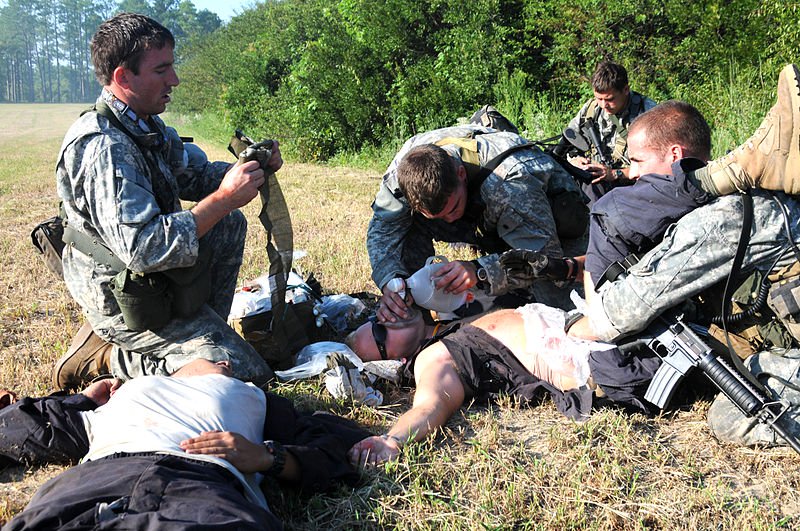
During their final instruction in Unconventional Warfare prior to infiltration of Pineland, the SF candidates will study guerrilla warfare, sabotage, intelligence, and subversion. The detachment enters “isolation” which is a planning and preparation phase. They conduct mission analysis and plan their infiltration, linkup plan, and subsequent activities.
No one is allowed in or out without being mission cleared during isolation. At the end of isolation, the team presents a brief back to the command element to show that they’re ready to complete the mission. It is in no way like the Operations Orders given by conventional units prior to an operation as each team member will take part.
The teams will infiltrate the denied area of Pineland usually by an airborne operation, but sometimes by helicopter or truck movement if the weather does not cooperate. After infiltration, there is always a long foot movement over rough terrain to test navigational skills and moving under a heavy load. The team will have to move hard and fast to make the time arranged to contact the guerrilla band.
Using their contact plan developed while in isolation, the students must affect link up with the G-Force. Once that has been accomplished, they proceed to establish rapport with the guerrilla band leaders that we referenced above, which was referenced above.
The student A-Teams must assess the overall security of the operational area and the guerilla basecamp, assess the training and support requirements of the resistance, and then… usually, after a brief and awkward ceremony welcoming them to the resistance, proceed with training and employment of the resistance group.
The training requirements are often challenging. In a real-world resistance movement, the guerillas would no doubt be hardened and used to living on the ground. The guerrillas assigned for the exercise usually have to be taught much of the basics that field soldiers take for granted. Many have never carried a rucksack other than a time or two in basic training. This is a great time to build a real rapport with the G-Force.
In my experience, most of our 45-man G-Force came from one unit, all were clerk typists, finance clerks and similar MOS’. But their leaders bought in right away, and the young soldiers, although completely out of their element became very willing and motivated participants. It made our job much easier and more enjoyable. One of the young men, had his eyes opened, he eventually re-enlisted to get reclassified and go thru SF. Some of the other student detachments weren’t so fortunate.
As the training progresses with the guerrillas, they’ll be tasked with a few softer DA (Direct Action) targets. Raids, ambushes, and some reconnaissance. The missions get harder as the timing gets accelerated. There will frequently be a couple of missions on-going at any given time. Each of the students will rotate through a leadership position of the team and will be evaluated under the stress of leading a half-trained guerrilla band.
Upon completion of Robin Sage, the students give back to the communities in the area by doing a day of Civic Action work. It may be as simple as cutting and stacking firewood for some of the families, adding a porch or in our case, repairing a roof as well as a host of other activities. Those small gestures of goodwill make for the continuing work the SF community has in the area such a success.
Normally the team will work with not only the guerrillas, the armed band of the resistance but the auxiliary and the underground, which are key components to the resistance and very valuable tools for the prospective SF soldiers.
Special Forces‘ bread and butter is the working with and building rapport with indigenous forces. Nearly every other mission that SF is tasked with will have that as a key component. Therefore, language and cross-cultural communications are very important. Robin Sage is the culmination of the entire Special Forces Qualification Course as it prepares the prospective Special Forces operator for a variety of missions and most importantly how to work with indigenous forces.
Everything they will face in Robin Sage will be just the tip of the iceberg that they’ll face in the real world. Special Forces is the premiere UW fighting force in the world. The lessons the soldiers are learning go all the way back to the hard-earned and difficult days of WWII and the OSS. Upon completion, it is back to Ft. Bragg where they’ll join the regiment and don the Green Beret for the first time.
Free Pineland.
Photo courtesy US Army
This article was originally published on SpecialOperations.com and written by








COMMENTS