
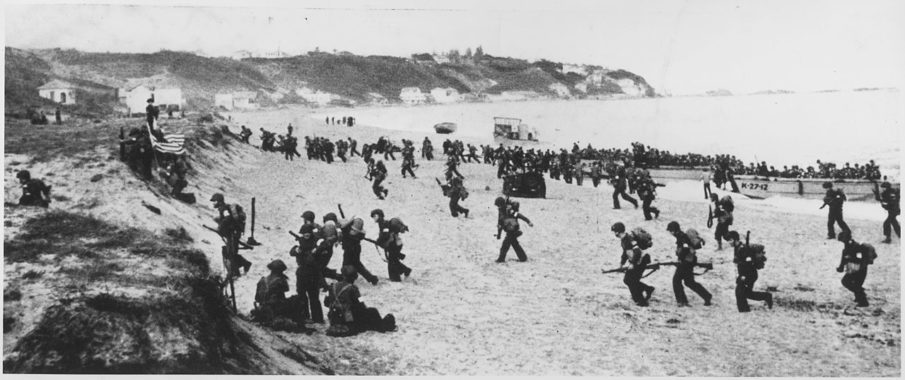
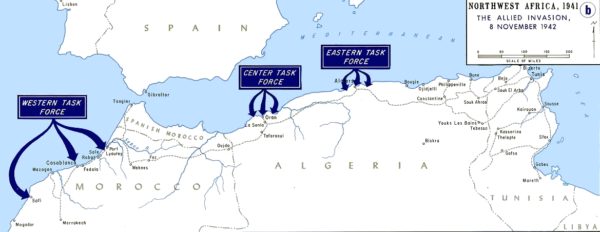
At Port-Lyautey, the landing troops were delayed. This gave the French defenders time to organize resistance, and the remaining landings were conducted under artillery bombardment. However, with the assistance of air support from the carriers, the troops pushed ahead, and the objectives were captured.
After the landings at Fedala, the port of Casablanca was surrounded. It was the principal French Atlantic naval base. The naval engagement resulted from a sortie of French cruisers, destroyers, and submarines opposing the landings. A cruiser, six destroyers, and six submarines were destroyed by American gunfire and aircraft. The incomplete French battleship Jean Bart—which was docked and immobile—fired on the landing force and the battleship USS Massachusetts with her one working gun turret until she was knocked out of action by the Massachusetts’ 16-inch guns, the first such heavy-caliber shells fired by the U.S. Navy anywhere in World War II. Two U.S. destroyers were damaged.
At Oran in the Central Task Force, the opposition was much tougher but was quickly brought under control due to superior planning on the part of the British Navy and Terry Allen, Commander of the US 1st Infantry Division. Allen’s troops landed on target and on time and they swept aside any resistance and captured the port and city in a double envelopment.
The U.S. 1st Ranger Battalion landed east of Oran and quickly captured the shore battery at Arzew. A bold attempt was made to land U.S. infantry at the harbor directly, in order to quickly prevent the destruction of the port facilities and scuttling of ships. The operation failed, as two sloops were destroyed by crossfire from the French vessels there. The Vichy naval force tried to break out from the harbor and attack the Allied invasion fleet but its ships were all sunk or driven ashore.
Operation Torch was the first major airborne assault carried out by the United States. The 2nd Battalion, 509th Parachute Infantry Regiment flew all the way from Britain, over Spain, intending to drop near Oran and capture airfields at Tafraoui and La Sénia, respectively 15 miles (24 km) and 5 miles (8 km) south of Oran.The operation was hampered by weather, navigational and communication problems. Poor weather caused the formation to scatter and forced thirty of the 37 aircraft to land in the dry salt lake to the west of the objective.The few drops that did occur were wildly scattered. However, the 509th captured both airfields.
One interesting footnote of the airborne operation concerned Pvt John Thomas (Tommy) Mackall. Mackall was assigned to Company E, 2nd Battalion, 509th Parachute Infantry Regiment. During the airborne segment of Operation Torch, he was mortally wounded in an attack by French Vichy aircraft on his aircraft as the aircraft landed near Oran. Seven paratroopers died on the C-47 and several were wounded, including Mackall. He was evacuated by air to a British hospital at Gibraltar where he died on November 12, 1942.
The Special Forces Training Facility in North Carolina now sports Mackall’s name. During WWII Camp Mackall was a huge airborne training base preparing paratroopers for combat duty.
At Algiers, there was a coup staged by nearly 400 members of the Jewish Resistance Fighters kicked off. They seized key targets, including the telephone exchange, radio station, governor’s house and the headquarters of 19th Corps.
The landings took place on three beaches, two west of Algiers and one east. Although some landings of the 34th Infantry Division took place on the wrong beaches, they quickly pushed inland due to the paucity of the French resistance. The coastal artillery batteries had been put out of action by the Jewish Resistance Fighters. On another beach, there was no resistance as the French commander welcomed the Americans as they landed on shore. Two British destroyers boldly raced into the harbor to unload 250 American Rangers who were tasked with seizing the facilities before they could be scuttled. One destroyer unloaded the Rangers, the other was forced back by heavy gunfire. General Juin, Commander of the Vichy French troops, surrendered the city at 1800 hrs on November 8.
The Germans Respond: Due to the lack of Vichy French resistance to the Allies landing in North Africa, the Germans didn’t trust the French any longer. As a result, the Germans overran the remainder of Southern France which had been left under Vichy control after the French surrender of 1940.
The German raced to the port of Toulon where the French had a sizable fleet there, to take control of those ships. But the French scuttled the fleet in the harbor, denying the Germans the use of those, which turned out to be a significant loss.
The Americans and British drive on Tunisia but the Germans, retreating from Montgomery’s Eighth Army, reached there first. Later in the spring of 1943, Rommel would decisively rout the American II Corps under Fredendall at the Kasserine Pass. That would move Eisenhower to replace him with Patton. It wasn’t until mid-May 1943 that the last of the Germans surrendered in Tunisia. The Allies would invade Sicily in mid-July, Churchill’s so-called “soft underbelly” of Europe.
The amphibious landings didn’t go well, but the green Americans would learn the hard lessons that would serve them well before they finally invaded the French coast on June 6, 1944. That experience and the enhanced cooperation with the naval forces would make the largest invasion force in history less than two years later.
Photos Courtesy: Wikipedia








COMMENTS