
Rappel Into Laos
The helicopter took the three-man recon team to approximately 200 meters from the site where they could see the piece of rope the Cobra pilot had spotted earlier in the day. As they had practiced on many occasions previously, the three Green Berets briskly got out onto the chopper’s struts. As soon as the chopper hovered over the triple-canopy jungle, the trio jumped off the struts and rappelled downward on their separate ropes, but came to a startling realization: Their ropes weren’t long enough for them to reach the jungle floor. They were too far above ground to release from the rope. Shorten signaled a distress motion to the door gunner and the pilot began lowering deeper into the jungle slowly, cutting down some of the jungle vegetation in the process. “We finally reached the ground,” Shorten said. “We unhooked and immediately started climbing up the hill.”
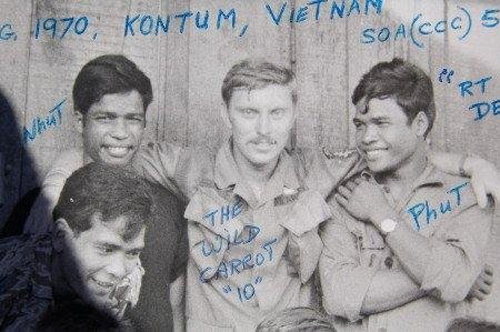
As they started to move out, a Cobra gunship radioed Shorten, using his code name “Wild Carrot.” “‘Wild Carrot, this is Playboy. Do you read me?’’’
“I answered that I could hear him loud and clear,” Shorten said. “Then he told me to ‘follow him’ as he flew overhead.” In a short period of time, the pilot led them to the rope hanging in the tree and “just as he predicted, I could see the rope hanging there. We got to the area he directed us to and we found the soldier half buried in the ground. We secured his remains, hooked his rig and called the helicopters to lift us out.” Then the Cobra pilot radioed Shorten with bad news: “‘Wild Carrot, you’ve got approximately 350 enemy coming up the hill after you! You’re going to have to work fast.’”
Shorten called for the Cobra gunship to make gun runs down the hill from his three-man team’s location. In short order, he directed the fixed wing, single-engine, propeller-driven A-1 Skyraider to follow the Cobra with Cluster Bomb Unit (CBU) rocket strikes. The CBUs had canisters packed with small, explosive packets that would detonate when they hit enemy troops or the ground, shooting out hundreds of deadly fleshettes or darts. On occasion, the CBUs would be primed to explode several feet off of the ground, thus raining death on any living creature below its detonation. Shorten didn’t know which variety of CBUs the fearless Skyraider pilots used, but as soon as the fixed-wing war bird made its last run, Shorten called in the extraction helicopter, which quickly dropped the ropes the team used earlier to rappel into the Laotian, triple-canopy jungle.
Shorten hooked up the dead soldier first to one rope, then he and the other two Green Berets hooked up with the remaining three ropes. Shorten hand-signaled for lift off and called into the radio at the same time. Then, the three SOG recon men and their Montagnard comrade-in-arms entered into another terrifying, sometimes deadly transition: As the chopper slowly lifted them off of the ground and upwards through the trees, the door gunners on both sides of the Huey opened fire on the ever-increasing number of enemy soldiers who emerged from the jungle, trying to kill the Americans while the Special Forces trio was just hanging there attached to the ropes, as sitting targets. “The chopper just keeps rising and rising, agonizingly slow. The crew doesn’t want to drag us through the trees, but, at the same time, I look down and through the bare spaces in the vegetation I can see the enemy firing up at us. I let go of the dead soldier for a moment to turn my rifle towards the enemy and let loose with a full magazine” from his CAR-15. During that brief, agonizing period of time, Shorten remembers saying to himself: “Dear God. Get us out of here,” as he reloaded, fired again, then gripped the dead Montagnard soldier.
Finally, the helicopter raises the team out of the triple canopy and begins to gain air speed moving away from the enemy ground fire. When the recon men were approximately 1,000 meters above the jungle, Shorten observed an A-1 Skyraider fly beneath them, releasing another CBU rocket. He could see the white smoke as the rocket was fired from the aircraft, then as it was halfway to the ground, he saw orange smoke as it exploded with the fleshettes, raining death upon the NVA soldiers below. They were followed by Cobra gunships firing 40 mm rounds and mini-gun 7.62 mm rounds at the enemy with follow-up gun runs.
Then, the surviving Green Berets transitioned from the hot apocalyptic hell of Laos to the bone-chilling ride dangling beneath the Huey at 4,000 feet returning to the Dak To launch site – a trip that took approximately 40 minutes, where the blood and sweat from the fire fight now felt like ice as their bodies dangled perilously from the 150-foot ropes. When they finally arrived at Dak To, glad to be alive, they were greeted by their teammates who helped them stand up and begin to walk slowly, after losing most circulation to the legs – a phenomenon of momentary paralysis after landing and removing the harness due to their legs falling asleep from the lack of blood flow.
As to Shorten, being an avid aviator himself, he inspected the helicopter that inserted him and found that it had seven enemy bullet holes in it and some of the metallic skin on the rotors were peeled back from chopping away at the triple-canopy jungle as it descended slowly in order for the SF soldiers to reach the ground without injuring themselves on the rescue mission. Then the team loaded up for the return flight to CCC base in Kontum, where they were greeted by many fellow recon men. The tradition of a large greeting of men returning from a mission was established years earlier in the secret war at that base because they knew how dangerous Bright Light missions were and those at the base always greeted the returning soldiers with cold beers and promises of hot steaks and chow. And, by 1970, Shorten said CCC casualties exceeded 100 percent; several of the recon men had been wounded more than once on SOG recon missions across the fence. Some, like SFC Robert Howard, had accumulated eight Purple Hearts by the end of 1968, when he was submitted for the Medal of Honor stemming from a SOG mission into Laos.
For Shorten, a Montagnard soldier visited his room and presented the Green Beret with a Montagnard bracelet. “He said to me, ‘Thank you for risking your life to bring my brother-in-law back home. Thank you.’ That meant a lot to me because the Montagnards were good men. They were fearless soldiers and they would give their lives in a heartbeat to save an American.” Needless to say, Shorten slept well that night.
[Part 2: Two weeks later, Shorten would run another Bright Light mission – the mission that has compelled him to work with Joint POW Accounting Command and now Defense POW/MIA Accounting Agency, returning to Cambodia to help find the remains of an Air Force pilot who crashed and burned supporting a SOG recon team. A mission he hopes will take him back to Cambodia in 2018 to rescue “the only man I ever left behind,” said Shorten.]
Featured image courtesy of Jim Shorten








COMMENTS