
Lawmakers say accountability is required if the attack intentionally targeted survivors.
US Navy Cites Communication Failures and Training Gaps in USS Truman Deployment Mishaps
US Navy investigators found that poor communication, limited operator knowledge, and gaps in integrated training contributed to four major accidents during the USS Harry S. Truman’s (CVN-75) eight-month deployment across Europe and the Middle East.
The mishaps, which occurred between December 2024 and May 2025, included a near-catastrophic collision with a merchant vessel, two aircraft lost overboard during an evasive maneuver, a Super Hornet crash linked to arresting-gear issues, and a friendly-fire incident involving the carrier’s strike group.
The deployment involved heavy combat operations, including extensive strikes against Houthi and Islamic State targets.
Crews embarked on USS Carl Vinson (CVN 70) and USS Harry S. Truman (CVN 75) resupply at sea and operate 24/7, targeting Iran-backed Houthi terrorists within Houthi controlled areas of Yemen.#HouthisAreTerrorists pic.twitter.com/TgT1dKEVcr
— U.S. Central Command (@CENTCOM) May 2, 2025
Investigations concluded that each event was avoidable and cited multiple breakdowns in communication and procedure across ship, air, and command teams.
The Navy issued dozens of recommendations and noted that changes made since the incidents aim to reduce risk and improve readiness.
The New York Times Sues Pentagon Over Rules That Bar Major Media from Access
The New York Times filed a federal lawsuit challenging new Pentagon credentialing rules imposed by Defense Secretary Pete Hegseth that have pushed most mainstream news outlets out of the building.
The newspaper argues the policy violates First Amendment and due process protections by giving Hegseth unilateral authority to ban reporters, a condition the Times and others refused to accept.
The Pentagon press room is now dominated by conservative outlets that agreed to the rules, while major organizations such as the Times, Associated Press, Washington Post and CNN have been denied access to briefings.
Breaking News: The New York Times sued the Pentagon, arguing that new reporting restrictions infringed on the rights of its journalists. https://t.co/9nwoUWZJhK
— The New York Times (@nytimes) December 4, 2025
The Times says the restrictions chill reporting and could spread to other agencies, citing Pentagon press secretary Kingsley Wilson’s comment labeling legacy media “propagandists” as evidence of viewpoint discrimination.
The lawsuit names the Defense Department, Hegseth, and chief spokesman Sean Parnell as defendants and seeks restoration of open access for credentialed press.
FBI Arrests Virginia Man in Long-Running Probe of Pipe Bombs Placed Before Jan. 6
The Federal Bureau of Investigation (FBI) arrested Brian J. Cole Jr., 30, of Woodbridge, Virginia, accusing him of placing two pipe bombs outside the Republican and Democratic national committee headquarters on January 5, 2021.
The arrest is the first major breakthrough in a nearly five-year investigation that struggled to identify a suspect and fueled political conspiracy theories. Authorities linked Cole to the devices through purchases of bomb-making materials, cellphone data and license plate reader records.
The FBI says both bombs were capable of killing people. Investigators emphasized that no new tip led to the arrest, describing it instead as the result of renewed analysis of existing evidence.
🚨 BREAKING: Attorney General Pam Bondi just announced alleged DC pipe bomber Brian Cole Jr. has been charged with use of an explosive device
“This cold case languished for FOUR YEARS until Kash and Bongino came to the FBl,” Bondi said pic.twitter.com/m7Ccj86qWT
— Nick Sortor (@nicksortor) December 4, 2025
Key questions remain, including Cole’s motive and whether the act had any connection to the Capitol attack the following day.
The affidavit outlines years of investigative work that included reviewing thousands of videos, subpoenaing tech companies for location data and tracking purchases of components similar to those used in the bombs.
New Orleans Immigration Sweep Sets 5,000-Arrest Goal as Locals Question Feasibility
Trump administration officials launched a two-month immigration crackdown in New Orleans with a goal of making 5,000 arrests focused on violent offenders, a target local leaders say is unrealistic given the region’s relatively small immigrant population and record-low crime levels.
Federal agents from Customs and Border Protection and Immigration and Customs Enforcement began operations Wednesday under “Catahoula Crunch,” making arrests across immigrant neighborhoods and prompting reports of widespread detentions of workers and families.
City officials and advocates argue there are nowhere near 5,000 violent offenders to justify the target and warn the effort will sweep up noncriminal immigrants, as seen in a recent Chicago operation where most arrestees had no criminal record.
Homeland Security says agents are pursuing immigrants previously arrested for violent crimes and claims early arrests include individuals with serious charges, though no numbers have been released.
The Department of Homeland Security confirmed that it started a sweeping immigration crackdown in New Orleans.
The News Hour has confirmed that Border Patrol, not Immigration and Customs Enforcement, is primarily running the New Orleans operation. The Trump administration has… pic.twitter.com/bNV0zGFVSZ
— PBS News (@NewsHour) December 3, 2025
The operation has sparked protests at City Hall and intensified debate over immigration enforcement across Louisiana, where an estimated 110,000 residents are living in the country illegally.
Israel Mourns Fallen Officer as Last Hostage Remains Held in Gaza
Israel now considers only one hostage still in Gaza, the remains of 24-year-old police officer Ran “Rani” Gvili, who was killed fighting Hamas militants during the October 2023 attacks.
Gvili’s body was taken into Gaza after he helped defend Kibbutz Alumim, where residents credit him with saving lives by leading counterattacks against militants.
Israel has recovered or received the remains of other hostages through ceasefire exchanges, but Gvili’s have not been returned. His family fears a prolonged ordeal similar to past cases in which soldiers’ bodies were held for years.
When Master Sgt. Ran Gvili heard of the attack on Oct 7th, despite a shoulder injury, he headed to the border to help anyone in his path. Ran saved people fleeing Nova but was murdered while fighting terrorists. His body was dragged into Gaza. Ran is a hero and must come home now pic.twitter.com/zVDNeKCiCR
— Prime Minister of Israel (@IsraeliPM) December 3, 2025
The retrieval of his remains would complete the first phase of US President Donald Trump’s 20-point ceasefire plan, which also includes the release of Palestinian detainees and expanded humanitarian aid for Gaza.
Subsequent phases call for international security forces, the disarmament of Hamas and a temporary Palestinian administration.
Gvili’s relatives continue to press for his return, honoring him as both a hero and a beloved son, brother and friend.
Putin Rejects Parts of US Peace Plan as Heavy Russian Strikes Continue in Ukraine
Russian President Vladimir Putin said elements of a US proposal to end the war in Ukraine remain unacceptable, signaling that negotiations driven by US President Donald Trump face significant obstacles.
Putin described his five-hour talks in Moscow with Trump’s special envoy, Steve Witkoff, and son-in-law Jared Kushner as useful but difficult, noting that the revised 27-point plan includes items Russia cannot support.
US officials were scheduled to brief Ukraine’s delegation later Thursday in Florida.
Russian President Vladimir Putin said parts of the U.S. peace plan were unacceptable and Russia would take Ukrainian land through military or other means. https://t.co/TcKTiZXIfc
— The Washington Post (@washingtonpost) December 4, 2025
While Trump said the envoys believed Putin wants a deal, the Russian leader stressed that it is premature to specify what Moscow would accept and reiterated Russia’s goal of taking all of Donetsk.
European leaders, excluded from Washington’s direct diplomacy, questioned Putin’s intentions.
As the political talks continued, Russia launched another wave of attacks across Ukraine, striking Kryvyi Rih, Odesa and Kherson, killing civilians, damaging infrastructure and forcing the shutdown of the Kherson Thermal Power Plant.
2/ Russian forces achieved the tactical breakthrough northeast and east of Hulyaipole in mid-November 2025, likely in part by concentrating and committing a force grouping comparable in size to the one operating in the Pokrovsk-Dobropillya direction.
This significant force… pic.twitter.com/SjhuN28n7O
— Institute for the Study of War (@TheStudyofWar) December 4, 2025
Ukraine also carried out drone strikes in Russian-occupied territory, killing two people, according to Moscow-installed officials.
UK Sanctions Russia’s GRU After Inquiry Links Putin to 2018 Novichok Attack
Britain sanctioned Russia’s GRU military intelligence agency and summoned Moscow’s ambassador after an official inquiry concluded that Russian President Vladimir Putin authorized the 2018 nerve agent attack targeting former Russian spy Sergei Skripal in Salisbury.
The Novichok poisoning sickened Skripal, his daughter and a police officer, and later killed Dawn Sturgess, who unwittingly sprayed the discarded nerve agent from a perfume bottle.
Inquiry leader Anthony Hughes found the assassination attempt was approved at the highest level and that Sturgess died as an unintended victim.
The UK charged three GRU officers over the attack but cannot extradite them.
🗣️ “I’ve concluded that the operation to assassinate Sergei Skripal must have been authorised at the highest level, indeed by President Putin,” says Lord Hughes, public inquiry chairman of the assassination attempt on a former Russian spy.https://t.co/I2JfwwmGE9
📺 Sky 501 pic.twitter.com/WS3iwN4lP9
— Sky News (@SkyNews) December 4, 2025
New sanctions also target eight GRU-linked cyber officers accused of previously attempting to hack Yulia Skripal.
UK Prime Minister Keir Starmer said the findings underscore Russia’s ongoing hostile activity and the need for vigilance against its threats.
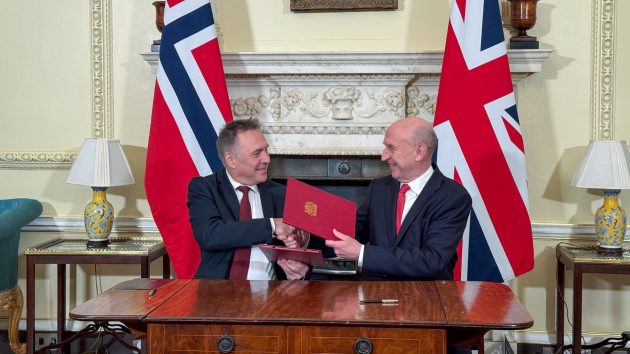
UK and Norway Sign Pact to Boost Surveillance and Anti-Submarine Operations in North Atlantic
The United Kingdom and Norway signed a bilateral defense pact to intensify efforts against Russian undersea activity in the North Atlantic, with a focus on the GIUK gap, a key route for Russia’s Northern Fleet.
The agreement strengthens joint anti-submarine operations, expands surveillance and commits both nations to protecting critical undersea infrastructure such as communications cables and pipelines. It also advances NATO’s push for autonomous maritime systems, with both countries leading development and integration efforts.
The deal builds on Norway’s purchase of British Type 26 frigates and includes cooperation on naval strike missiles, Sting Ray torpedoes and new uncrewed-system motherships.
Today, the UK and Norway signed a major new defence pact, fortifying 75 years of @NATO partnership.
The Lunna House Agreement will deepen industrial collaboration between our nations, support skilled jobs and enhance warfighting readiness.
Full story: https://t.co/U8yI2YBWKc pic.twitter.com/cxt1zKWHpv
— Ministry of Defence 🇬🇧 (@DefenceHQ) December 4, 2025
The pact follows a reported rise in Russian maritime activity and aligns with broader NATO moves to bolster defenses in the High North, including Iceland’s recent decision to expand a NATO fuel facility to support surveillance operations.
India Finalizes $2 Billion Deal to Lease Nuclear-Powered Submarine from Russia
India reached a roughly $2 billion agreement to lease a Russian nuclear-powered attack submarine for ten years, completing a deal that stalled for nearly a decade over pricing.
Indian officials visited a Russian shipyard in November, and the vessel is expected to arrive within two years, though delays are possible due to technical complexity.
The lease, timed with Russian President Vladimir Putin’s visit to New Delhi, reinforces long-standing defense ties as Prime Minister Narendra Modi seeks to balance relations with Russia, China and the United States.
Under the terms, India cannot use the submarine in combat, but it will train crews and support development of India’s own nuclear-powered attack boats.
India is set to lease a nuclear-powered attack submarine from Russia for around $2 billion, a deal finalized after a decade of talks. The vessel, larger than India’s current subs, will be used for training over the next 10 years and is expected to arrive within two years. pic.twitter.com/TbDameDbyb
— Polymarket Intel (@PolymarketIntel) December 4, 2025
The move comes as India expands its nuclear-capable submarine fleet and reduces reliance on Russian arms while still depending on Moscow for key platforms. Interest in nuclear-powered submarines is rising across the Indo-Pacific as regional militaries pursue stealthier and longer-range capabilities.
Pakistan Appoints Field Marshal Asim Munir as First Chief of Defense Forces
Pakistan confirmed Field Marshal Asim Munir as the country’s first chief of defense forces, a new post created to tighten coordination across the army, navy and air force.
Pakistan’s Prime Minister Shehbaz Sharif forwarded the appointment for presidential approval, and President Asif Ali Zardari signed off on a five-year term that Munir will hold alongside his role as army chief.
The government also granted a two-year extension to Air Chief Marshal Zaheer Ahmed Babar.
President Asif Ali Zardari approved the appointment of Field Marshal Syed Asim Munir as COAS concurrently as CDF for 5 years, and a 2-year extension for Air Chief Marshal Zaheer Ahmad Babar Sidhu from 19 March 2026. The President conveyed his best wishes to both. pic.twitter.com/RrIJNCC7I5
— The President of Pakistan (@PresOfPakistan) December 4, 2025
Munir’s elevation follows Pakistan’s claim earlier this year that it repelled India in a brief four-day conflict, which ended under a Trump-brokered ceasefire. His promotion to field marshal months earlier made him only the second officer in Pakistan’s history to receive the title.
A new law passed last month allows Munir to remain in uniform for life and grants him immunity from arrest, a move criticized by former prime minister Imran Khan’s party as undemocratic.
South Korea Approves Largest Defense Hike in Years to Counter Regional Threats
South Korea will boost defense spending by 7.5 percent to $44.8 billion next year, its largest increase since 2019, as Seoul strengthens capabilities against threats from North Korea, China and Russia.
The plan is part of a nearly $500 billion national budget passed after bipartisan negotiations. About $13.6 billion will go toward force improvements, including research and development, artificial intelligence, drones and upgrades to South Korea’s three-axis deterrence system.
Funding will also support preparations for transferring wartime operational control from the US to South Korea, a long-term goal affirmed by US President Donald Trump and South Korean President Lee Jae Myung in October.
Seoul aims to raise defense spending to 3.6 percent of GDP “as soon as possible” and has pledged major investments in US weapons and support for US Forces Korea.
South Korea unveils nearly $45 billion defense budget, expands 3-axis deterrencehttps://t.co/PNFoUHQb3N
— Stars and Stripes (@starsandstripes) December 4, 2025
The expanded budget reflects ongoing pressure from Washington for allies to spend more and South Korea’s effort to adapt to a shifting security landscape.
Sources: News Agencies
—
** Editor’s Note: Thinking about subscribing to SOFREP? You can support Veteran Journalism & do it now for only $1 for your first year. Pull the trigger on this amazing offer HERE. – GDM








COMMENTS