Ukraine’s Drone War Puts More Women on the Front Line
Ukraine’s drone war is pulling more women onto the pointy end, and it is not a feel-good recruiting poster. It is a battlefield adaptation. As of January 1, 2025, Ukraine’s Defense Ministry says more than 70,000 women are serving in the armed forces. That is about a 20 percent jump since 2022. Over 5,500 of them are in frontline roles. Units are actively recruiting women because the fight has changed, and they need trained operators more than they need another body to haul ammo cans.
The big driver is tech. FPV drones, bomber drones, and loitering systems are now a core part of how Ukraine kills Russian troops, vehicles, and trench networks. If you can fly a drone, read a map, and keep your head, you are considered combat effective. You do not have to be built like a linebacker to put steel on target from five to fifteen kilometers away. That reality is opening doors fast.
One example is Monka, 26, who walked away from managing a restaurant overseas to come home and fly short-range FPV strike drones. She is part of a wave of recruits who skipped the old “rifleman first, everything else later” track and went straight into unmanned systems. Another is Imla, a former pro hockey player who thought she would be a paramedic but ended up as a full-time drone pilot. First flight was shaky. Then reps kicked in and she started stacking effects. Yaha’s story is the same pattern. She started in admin, spent off time studying drone manuals, and pushed her way into bomber operations.
Not every lane was smooth. Chibi, a 20-year-old FPV tech with dyed hair, got hit with the usual “you sure you can do this?” treatment. She proved the answer the only way that counts in a war, by being good at her job. Her point hits the nail on the head. Add more women who perform, and attitudes change. Nobody argues with results.
Ukraine’s Unmanned Systems Forces are leaning into this, running campaigns to bring in 15,000 new people for drone and support billets. Their spokesperson, Olha Meloshyna, also makes it clear this is not a safe desk job. Russian forces hunt drone crews hard. If you are lighting up targets all day, they will try to return the favor. Tech reduces risk, but it does not erase it.
Already have an account? Sign In
Two ways to continue to read this article.
Subscribe
$1.99
every 4 weeks
- Unlimited access to all articles
- Support independent journalism
- Ad-free reading experience
Subscribe Now
Recurring Monthly. Cancel Anytime.
Bottom line: Ukraine is fighting a war where brains and hands on a controller are as valuable as boots on the ground. Women are stepping into that role because the mission needs it and because the battlefield is letting skill trump stereotypes. In today’s fight, whoever runs the drones runs a big chunk of the war, and Ukraine’s women are proving they are ready to do exactly that.
Secretary of War Pete Hegseth holds three fingers back, resisting the urge to knife-hand the press pool. Image Credit: Andrew Harnik/Getty Images
Hegseth Tells Industry to Rebuild America’s Arsenal of Freedom
Secretary of War Pete Hegseth is stepping onto the stage at the Reagan National Defense Forum in Simi Valley today, and he is not coming to pass out participation trophies. RNDF is the annual meet-up at the Ronald Reagan Presidential Library where Congress, senior brass, defense industry, and the policy crew take a hard look at how to keep America dangerous in a world that is not getting friendlier. This year’s lineup includes OMB (Office of Management and Budget) Director Russell Vought and Chairman of the Joint Chiefs Gen. Dan Caine in fireside chats, with Hegseth headlining the main event.
Hegseth’s message is the same one he has been driving for weeks under the “Arsenal of Freedom” banner. He wants America’s defense industrial base acting like it is on wartime footing, because in a lot of ways it is. In a pre-speech video posted on X, he toured California defense facilities and laid down the challenge in plain terms: the people building the gear are part of the fight, whether they wear a uniform or a badge.
We are rebuilding the Arsenal of Freedom. pic.twitter.com/gPTTsoWJee
— Secretary of War Pete Hegseth (@SecWar) December 6, 2025
He is also swinging a hammer at how the Pentagon buys weapons. The push is to stop getting stuck with one vendor, loosen the grip of a few giant contractors, and move away from slow deals that pay folks more when they drag their feet. Pete wants gear built with parts you can swap out, real competition on price and performance, and new tech getting to troops fast instead of dying in paperwork for ten years. The goal is simple: speed up buying, keep designs flexible, and make sure U.S. factories can crank out weapons in bulk when the fight kicks off.
That counts for the folks downrange. Hegseth keeps framing this as a factory and supply-chain fight tied directly to the warfighter in bad places. If American factories can’t outproduce and out-innovate China and Russia, then American troops will pay the price later. The message isn’t subtle. We’re in a global production race, and failing to step up is how you lose a war.
The forum comes at a good time for the White House. President Trump’s team wants U.S. factories turning out more weapons, faster, and with fewer delays. Allies in the Middle East and Europe are also asking for more American gear, so the administration is leaning into those relationships. Vought is there to cover the budget and production side. Hegseth is there to spell out what industry needs to deliver.
Bottom line: Pete Hegseth is telling industry to stop acting like vendors and start acting like a reserve component for the national arsenal. Build faster. Build more. Because the next fight will not wait for your quarterly earnings report.
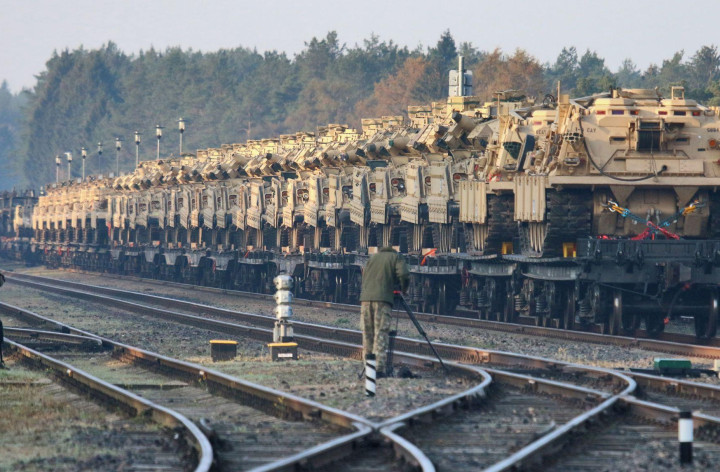
The transfer of 250 Strykers. Image Credit: US DoD
Poland Set to Get 250 U.S. Strykers for $1 each
Poland is about to get a nice hand-me-down from Uncle Sam, and this one actually fits. Warsaw is looking at taking roughly 250 used U.S. Stryker armored vehicles for a symbolic $1, pending final approval and inspections. Poland’s General Staff has already backed the move after sending teams to look over the vehicles’ condition. The offer was confirmed publicly by Polish defense officials this week.
The logic is simple. The U.S. is reshuffling parts of its ground footprint in Europe, and moving Strykers back across the Atlantic costs money. Handing them to a NATO ally sitting on Russia’s front porch is cheaper, and keeps combat power where it is needed. For Poland, it is a chance to bulk up mechanized capacity without waiting years for new builds. “Free” gear still needs maintenance and training, but that is a better problem to have than an empty motor pool.
These Strykers are expected to come from U.S. stocks already in Europe, very likely tied to units that have rotated through or are based in the region. Some reporting points to the 2nd Cavalry Regiment (the Dragoons) as a likely source, since they are the main U.S. Stryker outfit in Europe. That has not been formally confirmed by either government, so call it “likely,” if not exactly gospel.
❗️The 🇺🇸United States has offered to sell 🇵🇱Poland 250 used Stryker armored personnel carriers from the stocks of U.S. Army units that are planned to be withdrawn from Europe, for a symbolic price of $1. pic.twitter.com/gFf7WLfWNc
— 🪖MilitaryNewsUA🇺🇦 (@front_ukrainian) December 5, 2025
On capability, a Stryker is a proven 8×8 armored troop carrier that has done time in Iraq, Afghanistan, and Europe rotations. It is mobile and reliable by Army standards. Most versions carry a remote weapon station with a .50 cal or Mk19. Some Strykers in Europe are the Dragoon variant with a 30mm cannon, and a smaller number are ATGM carriers. So the right way to say it is: Poland may get a mix of variants, some with 30mm and some built for anti-armor work, depending on what the U.S. is handing over.
Poland is already deep into modernization. It has over 900 Rosomak 8×8 IFVs in service and is fielding the new Borsuk tracked IFV to replace older Soviet-era platforms. The Strykers are not a replacement for domestic gear. They are a cheap way to fill gaps, expand training fleets, and add ready vehicles while Poland keeps building its own force.
Strategically, this is a clean NATO win. The U.S. lightens its logistics load without shrinking deterrence, and Poland gets more armored hulls on the eastern flank for pocket change. The final count and variant mix will depend on inspections and paperwork, but if you are Poland, you take this deal every day and twice on Sunday. When a neighbor is rattling sabers, extra Strykers in your driveway beats wishful thinking.
—
** Editor’s Note: Thinking about subscribing to SOFREP? You can support Veteran Journalism & do it now for only $1 for your first year. Pull the trigger on this amazing offer HERE. – GDM