Something fundamental has snapped inside the American war machine, and for the first time in decades it is a good thing. The tired priesthood of forever war architects is losing its grip, and you can hear the grinding of teeth echoing through the Pentagon as old doctrines collapse under their own weight.
The era of massive footprints, endless rotations, and wars fought for process instead of victory is finally being dragged out back and shot, Inshallah.
In its place is a leaner, colder strategy built on Special Operations, precision strikes, and decision makers who understand that winning fast and leaving beats occupying forever. This shift is not subtle, and it is not accidental. It is a long-overdue rejection of failure disguised as tradition
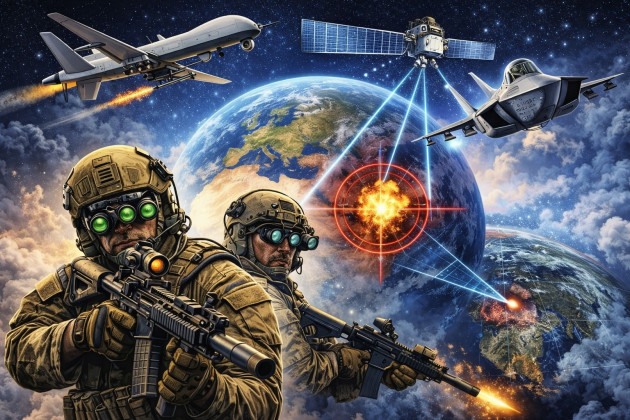
Let me paint this for you in reality rather than the often misguided narratives you see in most news media. The age of rolling up Humvees and setting up outposts with nicknames is fading. The new era we are looking at is equal parts brain, guts, and titanium-delivered fire. U.S. strategy is evolving into something smarter, more survivable, and frankly more lethal in a disciplined way that spares American lives while smashing enemy intent like a hammer on a piñata.
Before we get into the weeds, let me be clear about where I stand. Asymmetric warfare and Special Operations are finally being used the way they were meant to be used, not as elite door kickers duct taped onto a bloated conventional strategy, but as the main effort.
For the first time in a long time, it feels like the old guard mindset is being pushed out of the decision-making rooms, kicking and screaming alongside the big, slow defense dinosaurs that only know how to build wars measured in decades and invoices measured in billions. The era of mass formations, permanent bases, and PowerPoint-driven combat appears to be dying at the policy level, replaced by speed, precision, intelligence, and trust in operators who understand what it takes to operate in challenging environments better than any committee ever could.
This is not evolution by accident, it is long overdue correction.
Take the recent strikes against Islamic State targets in Syria under what the Pentagon calls Operation Hawkeye Strike. In retaliation for the brutal ambush that killed two U.S. soldiers and a civilian interpreter, American and allied jets delivered precision firepower on multiple IS targets across Syria, coordinated with partner forces close to the ground. These weren’t big boot deployments, they were targeted effects to disrupt enemy infrastructure and deter future attacks.
Now look at Iran. Strategic analysts are already dissecting the broader impact of U.S. actions against key nuclear sites and air defenses that were designed to throttle Tehran’s regional threat without sending legions of ground troops back into the sandbox. These strikes were calibrated, timed with intelligence, and shaped geopolitics more efficiently than a decade of conventional presence could ever hope to do.
In Iran right now, the streets are boiling and the ayatollahs are sweating.
Mass protests against economic collapse and political repression have forced millions into the streets, and the Supreme Leader’s grip is showing cracks the size of missile craters. Some analysts argue that a smarter, targeted use of U.S. military power might amplify the pressure on the ruling clique by striking the regime’s command infrastructure or key Revolutionary Guard Corps facilities that coordinate internal repression, without launching a full invasion.
Already have an account? Sign In
Two ways to continue to read this article.
Subscribe
$1.99
every 4 weeks
- Unlimited access to all articles
- Support independent journalism
- Ad-free reading experience
Subscribe Now
Recurring Monthly. Cancel Anytime.
Such precision options could sap Tehran’s ability to crush demonstrators while empowering the internal uprising already shaking the Islamic Republic to its core. It falls squarely in line with this new strategic playbook of surgical force over sprawling occupations and could force the regime to divert assets from quelling dissent to defending itself, creating political space for domestic forces clamoring for change.
Then there is the Caribbean Sea and the Venezuelan quagmire. The U.S. has been striking drug trafficker-linked vessels around Venezuela and the Eastern Pacific in operations labeled as part of fighting narcoterrorism, targeting hostile sea traffic with air assets rather than committing battalions ashore. That is a strategic axis shift that pushes out Russian and Chinese influence in America’s backyard.
These are not war game exercises on a General Staff whiteboard. They are living, breathing operations that show how the U.S. military is reducing footprint while maximizing effect.
This plays right into America’s inherent strengths. We have a command and control culture that trusts warriors at the NCO and junior officer level to make decisions at the edge.
That same agility is baked into doctrine. American warfighters are taught mission command, decentralized execution, and initiative at the tactical edge. That is a stark contrast to China and Russia, whose militaries are famously top heavy, slow to adapt in the fight, and often handcuffed by centralized decision loops and corruption.
The old model of building huge bases, occupying provinces, and trying to manage local politics with a battalion advisory team has not exactly set the world on fire. In fact it’s left strategic objectives half-met and national resolve exhausted.
What we are seeing now is warfare shaped to keep Americans safe, project power, and avoid grinding forever wars that suck the life out of our force and our taxpayers.
This approach does not mean we ignore civilian harm. Far from it. Every planner worth his salt knows that protecting noncombatants is an ethical and legal imperative. But we are not building sandcastles here. We are protecting freedom and democracy in ways that do not require building outposts that become sitting ducks for the next bad guy looking for a headline.
And Trump and Hegseth deserve some credit whether you like them or not.
And if anyone thinks this strategy cannot be applied elsewhere, consider this. If the United States wanted to run a high precision, low-footprint campaign against Putin’s malign moves just like it has against Maduro and ISIS with calibrated strikes and partnered pressure, it would be possible.
And the idea alone probably keeps the ex KGB up at night, clutching his pearls and muttering to himself late at night.
Let’s embrace this smarter way of defending freedom. It is lethal when needed, careful when required, and decisively American in execution.









COMMENTS