On January 25, 2020, an MH-60S Seahawk assigned to Helicopter Sea Combat Squadron 12 “Golden Falcons” went down in the Philippine Sea during routine operations from the USS Blue Ridge (LCC-19), roughly 170 kilometers east of Okinawa.
The aircraft, Bureau Number 167832, ditched rapidly and sank to approximately 19,075 feet, nearly 3.6 miles below the surface. That depth alone placed the incident into rare territory. Very few military aircraft have ever been recovered from that kind of pressure environment.
All five crew members survived. Three were rescued by Japan Air Self-Defense Force UH-60s and transported to Naval Hospital Okinawa. Two were recovered by another MH-60S from Blue Ridge. No fatalities. No missing personnel. That fact alone made the outcome remarkable.
The helicopter, however, was gone.
At nearly 6,000 meters below sea level, the airframe settled into a crushing-pressure environment that destroys most conventional salvage options. For more than a year, the wreck remained on the ocean floor while the Navy weighed the risks, cost, and technical feasibility of a recovery.
They decided to go get it.
In March 2021, the Navy’s Supervisor of Salvage and Diving partnered with Phoenix International to execute one of the deepest aircraft recoveries ever attempted.
Operating from a Guam-based salvage vessel, the team deployed the CURV-21, a remotely operated vehicle designed for extreme depths.
First came side-scan sonar mapping to pinpoint the debris field. Once located, CURV-21 descended nearly four miles to visually confirm the wreckage and assess structural integrity. At those depths, water pressure exceeds 8,000 pounds per square inch. Any lift plan had to account for compromised airframe strength and the risk of structural collapse during ascent.
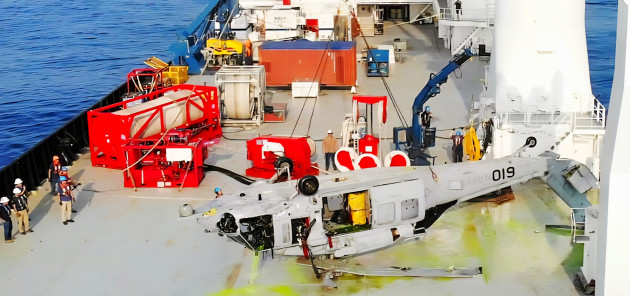
Rigging lines were attached remotely by the ROV. Inflatable lift devices were not an option at that depth. Instead, a controlled mechanical lift began on March 19. The ascent took approximately nine hours.
As the helicopter broke the surface, fluorescent green dye flushed from waterlogged search-and-rescue bags inside the aircraft, creating the now-famous image of neon green streaking across the sea.
Already have an account? Sign In
Two ways to continue to read this article.
Subscribe
$1.99
every 4 weeks
- Unlimited access to all articles
- Support independent journalism
- Ad-free reading experience
Subscribe Now
Recurring Monthly. Cancel Anytime.
It was trapped emergency marking dye finally escaping.
The recovery set a Navy record, exceeding the previous deepest aircraft retrieval by more than 250 feet.
So why spend the money and time to recover what was already a total loss?
Because the aircraft still held answers.
The Naval Safety Center required physical evidence to complete the Aviation Mishap Board investigation. Cockpit instruments, flight control components, gearbox assemblies, and system switches all provide hard data. In deep-water crashes, electronic logs are often lost or corrupted. Mechanical components tell the story.
The airframe was transported to Yokosuka for forensic examination. Findings contributed to fleet-wide safety updates and operational refinements. While the final mishap report was not publicly detailed in full technical form, the recovery ensured the Navy did not rely solely on speculation or partial telemetry.
There was also a strategic message.
Recovering sensitive equipment from extreme depth denies potential adversaries access. The Philippine Sea is contested space. Leaving advanced aviation systems on the seabed indefinitely carries risk.
This operation proved something else: the Navy can reach nearly four miles down and bring its equipment home.









COMMENTS