An MH-60 Black Hawk helicopter from the 160th Special Operations Aviation Regiment crashed during a training mission near Summit Lake, Washington, on September 17, 2025, resulting in a wildfire that complicated rescue efforts. The Army is investigating the incident, with no details on the crew's condition or identities released yet.
Key points from this article:
The crash occurred near Summit Lake, approximately 35 miles west of Joint Base Lewis-McChord, during a routine training mission involving four service members from the 160th SOAR(A).
How the wildfire ignited at the crash site hindered initial rescue efforts, forcing responders to retreat due to extreme heat from the flames.
Why the investigation is critical, as the 160th SOAR(A) has faced scrutiny following a previous crash in November 2023, and understanding the causes of this incident is essential for future safety in Army aviation.
Updating summary...
Army Night Stalkers Crash Near Summit Lake, Washington
Guy D. McCardle
Speed
1x
Listen
COMMENTS
Night Stalkers don’t get the luxury of easy nights—their training flights cut low and fast through blacked-out timber, where one wrong move can turn a routine drill into a headline.
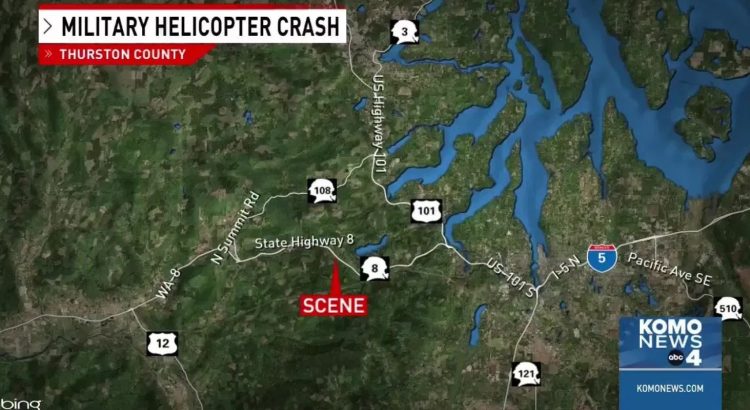
A map of the general crash area. Image Credit: KOMO News
An MH-60 Black Hawk from the 160th Special Operations Aviation Regiment (Airborne) crashed during a routine training mission near Summit Lake, west of Joint Base Lewis-McChord (JBLM), at about 9 p.m. PT on Wednesday, Sept. 17, 2025. Four Night Stalkers were aboard. A one-acre wildfire ignited at the site, slowing rescue efforts. The Army says the situation is active and under investigation; no crew identities or conditions have been released.
Advertisement
Where It Happened—and Why That Matters
Summit Lake sits in timbered country roughly 35 miles west of JBLM, a familiar corridor for low-level, night-vision training flights that let crews practice terrain masking and time-on-target navigation without buzzing neighborhoods. Deputies and firefighters pushed toward the wreckage after reports of an explosion; heat from the burning terrain forced them to back off temporarily. King County’s Guardian One helicopter joined the response as military and local crews coordinated to get back in.
What We Know About the Aircraft and Unit
The aircraft is identified as an MH-60 Black Hawk, the Night Stalker-modified version of the Army’s utility helicopter, equipped for special operations with specialized navigation, sensors, and comms. The crew belonged to the 160th SOAR(A)—the Night Stalkers—whose 4th Battalion operates out of JBLM alongside battalions at Fort Campbell, Kentucky, and Hunter Army Airfield, Georgia.
Advertisement
Who Was On Board—and What They Were Doing
The Army confirms four service members assigned to the 160th were on board. Officials describe the flight as a routine training mission. There’s no public detail yet on the exact profile—route, altitude, or training objective—and no names or statuses pending next-of-kin notification and formal releases. Anything beyond “training” at this stage is speculation, and the Army isn’t feeding rumor mills.
The Immediate Aftermath
Thurston County deputies located what they believed to be the scene on Wednesday night, but the fire pushed temperatures high enough to overheat boots and halt initial rescue attempts. By Thursday morning, the wildfire footprint was estimated at about one acre. Aviation weather around Olympia at the time was clear with 10-mile visibility and winds 15 mph gusting 19—context, not cause. The investigation is underway, and rescue/recovery actions remained the focus into Thursday.
Advertisement
What Comes Next: The Investigation
Army aviation mishaps are investigated by the U.S. Army Combat Readiness Center, which typically dispatches a team to the crash site to examine maintenance records, flight data where available, human factors, and environmental conditions. That process rarely moves at headline speed. Expect weeks before preliminary findings, and longer before a public summary with causal factors and corrective actions. For now, officials have not attributed the crash to mechanical failure, weather, or crew actions.
Recent History, Same Regiment
Context matters: the 160th lost five Night Stalkers in November 2023 during an MH-60 training evolution over the eastern Mediterranean, a separate tragedy that led to high-visibility safety scrutiny across Army aviation. That case involved aerial refueling; nothing released so far ties those factors to Washington’s crash. Keep any comparisons cautious until investigators speak.
MH-60 160th SOAR crash in Washington last night. 🙏
Per AP: TACOMA, Wash. (AP) — Four service members were aboard a U.S. Army MH-60 Black Hawk helicopter that crashed near Joint Base Lewis-McChord in Washington state, the Army said in a release Thursday. The Army did not… pic.twitter.com/uX5TmZp7US
The 160th SOAR (A), known as the “Night Stalkers,” is the Army’s premier special operations aviation regiment. They provide the world’s most elite helicopter support to U.S. and allied special operations forces. Their reputation is built on missions few others can handle, from deep reconnaissance insertions to hostage rescues in the dead of night.
They are perhaps best known publicly for their role in Operation Neptune Spear—the 2011 raid on Osama bin Laden’s compound in Abbottabad, Pakistan. That mission, and countless others still classified, highlight the razor’s-edge skill set required of every Night Stalker aviator and crew member.
What We’re Watching
Crew status and identities: to be released after notifications.
Mission specifics: profile, airspeed/altitude regimes, and training objectives.
Causal factors: maintenance history, environmental data, crew timelines, and any relevant cockpit/mission systems recordings.
Looking Forward
Night Stalkers train at the edges because real missions demand it—low, fast, and in the dark over broken terrain. That’s how you build crews who can thread a needle on a moonless night. Training risk is managed, not eliminated.
Until the Combat Readiness Center speaks, discipline beats rumor.
Advertisement
What readers are saying
Generating a quick summary of the conversation...
This summary is AI-generated. AI can make mistakes and this summary is not a replacement for reading the comments.










COMMENTS