

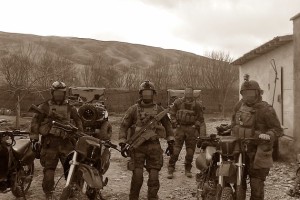
It was late December 2009 and our 14-man Marine Special Operations Team (MSOT) was tasked with conducting a Joint/Combined operation to seize a key piece of terrain in Bala Morghab River Valley.
Our partner for this mission was a squad of 82nd Airborne Paratroopers and a small detachment of Afghan National Army Soldiers. Our objective was a hilltop located on the eastern side of the BMG valley. It was the first piece in cutting off the Taliban’s freedom of movement from north and south through the valley. Bala Morghab had been a Taliban stronghold since the war began in 2001.
I was the only Scout Sniper from the team that was present for the mission. My specific task was to secure the southwest corner of the hilltop. This mound of dirt was was named “Objective Pathfinder” and we were Team Pathfinder.
(Continue reading this story of Marine Special Operations in Bala Morghab River Valley.)
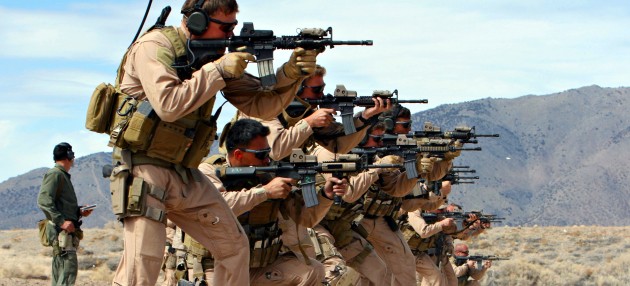
MARSOC 101 Brief
Marine Corps Special Operations Command (MARSOC) train, organize, equip and deploy task organized, scalable and responsive Marine Corps special operations forces worldwide in support of combatant commanders and other agencies.
The potential participation of the Marine Corps in SOCOM has been controversial since SOCOM was formed in 1986. At the time, Marine Corps leaders felt that their Force Reconnaissance units were best kept in the Marine Corps’ MAGTF command structure, and that the detachment of an “elite” Marine Special Operations unit from the Marine Corps would be to the detriment of the Marine Corps as a whole.
A re-evaluation following the 11 September attacks and the War on Terrorism, along with new policy established by Secretary Rumsfeld and then-Commandant Gen. James L. Jones at The Pentagon, caused the Marine Corps to work towards integration with SOCOM.
(Continue reading Marine Special Operations MARSOC 101 Brief.)
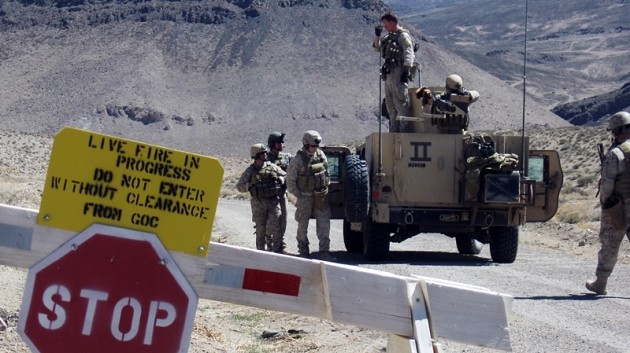
MARSOC Team-Level Cohesion and Preparation
What is deployment familiarization training (DFT) for Marine Special Operations Company (MSOC) and teams (MSOT)? A DFT is one phase (about 30-45 days) of the pre-deployment work-up that is conduct by even MSOC prior to deployment in support of the global war on terrorism. The DFT portion of the work-up is unique in the fact that it is usually the first time that a MSOT has the opportunity to meet and work alongside the collective members that will deploy on the team.
Up to this point, many of the members of the team have been off conducting individual training in preparation for deployment i.e. breacher, sniper, SERE and SSC course to name a few. This also includes the special operation critical skills (SOCS) members i.e. EOD, JTAC and Intelligence Marines. These individuals are assigned from the Marine Special Operation Regiment (MSOR), which retains these collective elements for training and proficiency purposes.
(Continue reading about Marine Special Operations team-level cohesion and preparation.)
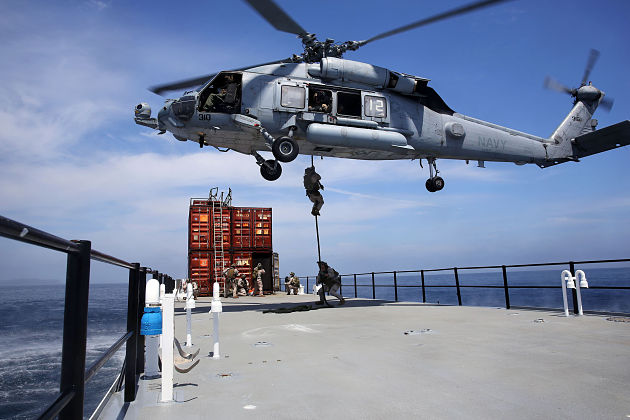
Is There Room for MARSOC’s Seafaring Ambitions?
Recently, elements of MARSOC have taken to the sea, getting back to their amphibious roots, if you will. A handful of MSOTs (Marine Special Operations Team) have taken on the kind of training typical of a Force Recon Platoon, conducting a pre-deployment workup for an MEU (Marine Expeditionary Unit). This development has many speculating what this will mean for MARSOC and Force Recon.
For those not familiar with the functions of an MEU, it’s a floating quick reaction force, poised to respond to any global crisis. It is the hallmark of the Marine Air-Ground Task Force (MAGTF). Equipped with a reinforced infantry battalion and air assets, the MEU can strike fast and sustain itself until a larger force can support its efforts. Enhancing the MEU’s Ground Combat Element is a reconnaissance section. Within the reconnaissance section is a Force Recon platoon. Their primary duties are Direct Action (DA), Special Reconnaissance (SR) and maritime interdiction missions, referred to as VBSS (Visit, Board, Search and Seizure).
Force Recon conducts VBSS with 26th MEU. Many have questioned MARSOC’s motives for returning to the sea. Why the sudden push to double-down on the ‘cool guy’ capabilities of the MEU? And how will this effect Force Recon?
(Continue reading about Marine Special Operations and sea training.)
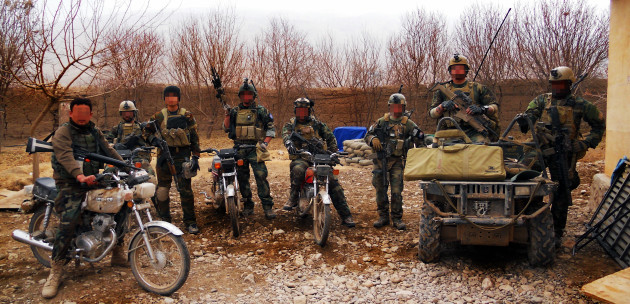
MARSOC Motorcycle Gangs in Afghanistan
SOF Operators take to two-wheels in the hunt for Taliban in remote regions of Afghanistan.
If you are the Taliban, this is your worst nightmare come true.
A ten-man element of U.S. Spec Ops shooters armed with precision fire weapons and night vision optics, weaving through rolling hills along goat trails on blacked-out motorcycles in the middle of the night.
(Continue reading about Marine Special Operations units ruling the night on motorcycles in Afghanistan.)
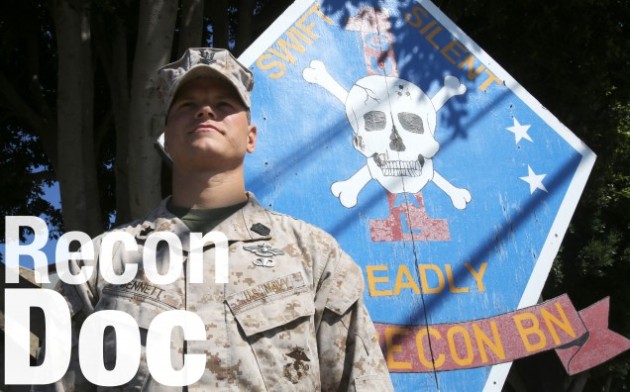
Warrior Healers: The Navy SARCs of MARSOC
Medics. Corpsmen. Whatever the name, every combat unit has them. Their name carries special meaning for those who’ve called for them in panic and desperation. I’ve been one of those men who had no choice but to put my life into their hands. It’s not for personal validation that I’m sharing this. It’s just that I want my words to carry the weight of a man who would’ve been dead if it weren’t for my medic (To be fair, my JTAC is equally responsible for me not being a corpse but that’s for another day).
So while I can’t speak for every Corpsman, I can speak for mine.
My time finally came and I found myself badly wounded. In a Taliban controlled valley, encircled by monstrous peaks, I got to experience the other side of the violent life we all embrace. After applying self-aid, I made my way back to my medic. He took charge and immediately started treatment. When I asked him if I would keep my appendage, he was honest.
When I asked for the Ketamine, he was merciful.
(Continue reading this post about Marine Special Operations and Navy Corpsmen.)
What’s a Mar Sock?
Everybody wants to know what sets MARSOC apart from USASOC and NSW. It’s a complicated question to answer. What’s more revealing and easier to address is: what traits does MARSOC share with USASOC and NSW? I’d like to focus on MSOT structure, CSO skill sets and mission profiles. By analyzing these three criteria, I would like to paint a clear picture of MARSOC and how it is similar to SOF organizations in the other branches.
(Continue reading about Marine Special Operations structure, skill sets and mission profiles.)
The State of Marine Recon
The Marine Reconnaissance community has been through a lot in the last ten years. Some of it has gone for the better. A lot of it has not.
At the beginning of the war in Iraq, 1st Recon Bn was pushed into a mechanized role it wasn’t prepared for. The men took the mission and did what they could with it, pushing ahead of 1st Marine Division on the way to Baghdad, securing important sites and looking for Iraqi forces. 1st Force, augmented by platoons from 3rd and 4th Force, was out on the flanks, supporting I MEF on the march up.
But when they redeployed, 1st Recon Bn found itself holding battlespace. Recon Marines were put in the role of regular grunts. Even after Recon stopped holding ground in 2005, we regularly found ourselves in similar situations, just not tied to a particular area. Conventional Marine commanders had no idea how to employ a Reconnaissance unit.
Some of this was due to a lack of understanding. Some of it was, and is, willful ignorance.
(Continue reading about the state of Marine Special Operations Recon.)
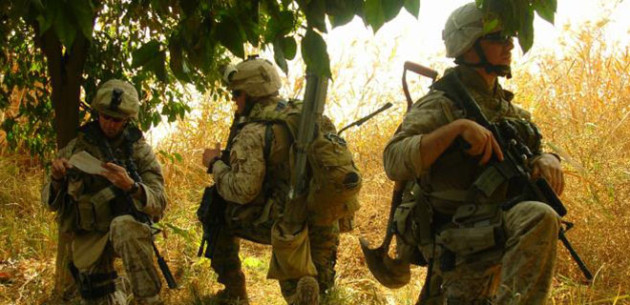
What a USMC Recon Team Looks Like
Dirty, tired, camouflage-painted, trousers ripped, armed to the teeth, and overloaded.
Okay, so that’s what the guys on the Recon team look like most of the time. The team itself has evolved a bit due to operational requirements, equipment limitations, and force protection requirements established by higher. Over the years since Vietnam, the Recon team has ranged from four-man Force Recon Stingray teams to entire Recon platoons going out as one.
The basic, by-the-book Recon team consists of six men. Up front is the Pointman. He’s supposed to be the lightest-loaded man in the team, because he’s going to cover the most ground, finding the route often by trial and error. It’s one thing to plan a route on a map and sand-table, it’s something else when you’re walking the ground with a rucksack that weighs 90-120lbs, at 0300.
(Continue reading about what a Marine Special Operations Recon team looks like.)
A Brief, Recent History of Force Recon and MARSOC
There have been some questions lately as to what exactly the difference is between Force Recon and MARSOC. Aside from the fact that Special Operations Marines now have their own MOS, a lot of it comes down to recent history.
In 2003, MCSOCOM Detachment One was stood up, commanded by a former commanding officer of 1st Force Recon Company, Col Robert Coates. Detachment One was a pilot program to see if Marines could make a worthwhile contribution to USSOCOM. As part of the program, the 81 Marines and 5 Navy Corpsmen went through NSW certification, then deployed to Iraq in 2004 with NSW Squadron One.
While there was some friction with the Navy side of the house, it was determined by JSOC that the Marines were quite capable of conducting Special Operations missions, specifically Direct Action and Special Reconnaissance.
(Continue reading about Marine Special Operations Force Recon and MARSOC.)
Marine Corps Test Unit 1
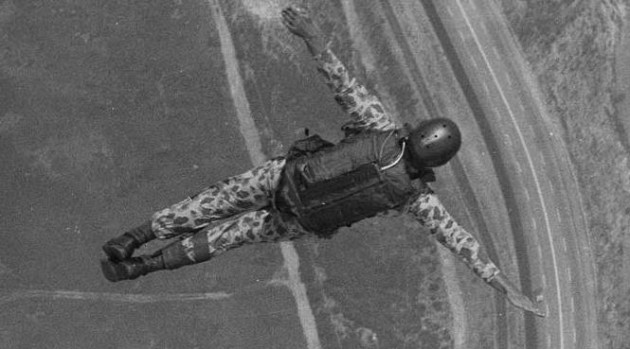
While Marine Recon got its start in World War II, with the Raiders and the 1st Marine Division’s Amphibious Reconnaissance Company, much of what Recon is today is thanks to Marine Test Unit 1.
After the nuclear bombing of Hiroshima and Nagasaki, most of the US military started trying to shift their doctrine to a model of a nuclear battlefield. At the time, it was assumed that nuclear weapons would become an integral part of warfare, much like gas had in WWI. As a result of this shift in doctrine, the services started looking at how to operate in a nuclear environment.
In 1946, Col. Robert Cushman (later to become Commandant of the Marine Corps) authored a staff report to the Commandant, Gen. Vandegrift. In this report, Col. Cushman argued that the kind of mass amphibious landings of WWII were no longer viable on the nuclear battlefield–the massed amphibious formations moving into a relatively small beachhead would be easy targets for tactical nuclear weapons. He presented the idea that the Marine Corps had to broaden its focus to a dispersed area of operations up to 200 miles deep, spreading its units around so as to make smaller and harder to hit targets. In this way, a single nuke couldn’t take out the better part of a Marine Division.
At the time, Col. Cushman’s concepts for increased mobility and dispersion weren’t within the Marine Corps’ capabilities. It wasn’t until the helicopter operations in Korea in 1951 that it began to look like it was possible.
(Continue reading about the recent history of Marine Special Operations.)








COMMENTS