The Battle of the Coral Sea, fought from May 4 to May 8, 1942, marked a crucial turning point in the Pacific War, showcasing the dominance of aircraft carriers in naval warfare. This battle prevented Japanese forces from capturing Port Moresby, ultimately altering the course of the war in favor of the Allies.
Key points from this article:
The Battle of the Coral Sea was the first naval engagement where opposing fleets never directly saw each other, relying entirely on aircraft for combat.
How the US Navy's intelligence advantage, particularly codebreaking efforts, allowed Admiral Chester W. Nimitz to anticipate Japanese plans and thwart their advance towards Australia.
Why the inability of Japan to secure Port Moresby significantly hindered their expansion efforts in the Pacific, marking a shift in momentum towards the Allies.
Updating summary...
The Battle of the Coral Sea: The Turning Point That Shaped the Pacific War
SOFREP News Team
Speed
1x
Listen
COMMENTS
The Battle of the Coral Sea changed naval warfare forever, halting Japan’s advance and setting the stage for Allied victory in the Pacific.
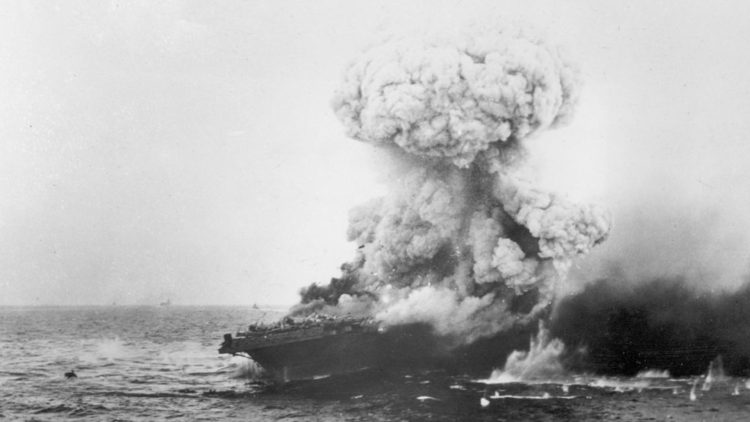
A mushroom cloud rises after a heavy explosion on the USS Lexington (CV-2), May 8, 1942. (Wikimedia Commons)
The Battle of the Coral Sea, fought from May 4 to May 8, 1942, was a pivotal moment in the Pacific War that changed the course of history. A clash that took place far from the headlines of Europe, it would prove to be a turning point, offering a glimpse of the new age of warfare, where aircraft and carriers, not battleships, would lead the charge.
Advertisement
The backdrop to this battle was one of desperation. After the Japanese had scored a series of victories in the Pacific, the Allies needed to shift the tide. It wasn’t just another naval engagement—it was a strategic gamble for both sides. The Japanese sought to capture Port Moresby in New Guinea, which would give them a direct path to Australia.
The United States and its Australian allies weren’t about to let that happen. Their goal was simple: stop the Japanese advance at all costs.
The New Face of Naval Warfare
What made Coral Sea so significant wasn’t just the stakes; it was the way it was fought.
Advertisement
For the first time in history, the opposing fleets never directly saw each other. This battle was entirely conducted by aircraft. The days of steel-hulled behemoths engaging in close-range artillery duels were over. The future of naval combat was in the sky. The Battle of the Coral Sea was the first battle where aircraft carriers faced off, launching strikes from hundreds of miles away without ever firing a shot at each other.
Both sides had their fleet carriers at the ready, but the US Navy had one crucial advantage: intelligence. Codebreakers had deciphered Japanese messages, giving the Americans a significant leg up.
Advertisement
Admiral Chester W. Nimitz, despite being outnumbered, knew the Japanese plan. The key to victory lay in denying Japan access to Port Moresby—something the American and Australian forces couldn’t afford to lose.
The Clash of Titans
The battle began on May 4, with Japanese planes attacking the US and Australian ships. The US aircraft carrier Lexington (CV-2) was struck by Japanese bombs, but it was the dive bombers from Yorktown (CV-10) that found their mark. With precision, they hit the Shoho (or Shōhō), sinking it before it could strike back. The Lexington didn’t fare as well. Though it initially survived the attack, it would ultimately be scuttled after taking multiple hits. Yet the Japanese couldn’t claim total victory, as the Yorktown and its planes struck a decisive blow against the Japanese fleet.
On May 7 and 8, both sides were engaged in cat-and-mouse aerial assaults, launching planes from their carriers while dodging enemy attacks. The Japanese lost the aircraft carrier Shokaku (or Shōkaku), a blow that would have lasting effects on their operational capabilities.
Advertisement
Meanwhile, the US Navy’s victory came at a cost—losing the Lexington and sustaining damage to the Yorktown.
But the strategic picture was clear: the US Navy had checked the Japanese expansion, at least temporarily. The battle did not stop the Japanese juggernaut entirely, but it crippled their momentum. More importantly, it stopped them from securing Port Moresby and from further encroaching on Australia’s defenses.
The Coral Sea was not a victory of annihilation—it was a strategic check, and a crucial one.
The Power of the Aircraft Carrier
The Battle of the Coral Sea solidified the aircraft carrier’s role as the dominant force in naval warfare.
In many ways, this battle set the stage for what would come in the months ahead, most notably the Battle of Midway, where the carriers would again play a decisive role. But where Midway was a battle of revenge, Coral Sea was about survival. The US Navy proved it could fight back against a much larger fleet with a nimble, modernized force, proving that carrier-based airpower was the future.
While the battle’s immediate impact was felt on the front lines of the Pacific Theater, its influence would be far-reaching. It shattered the myth of Japanese invincibility. Their inability to secure Port Moresby meant that they would never reach Australia, and the path to the Solomon Islands would become far more difficult.
Looking back, the Battle of the Coral Sea serves as a reminder of the importance of adaptability and intelligence. The battle wasn’t won with sheer firepower—it was won with foresight, precision, and the willingness to take risks. It was a defining moment in the Pacific War, but it was also the dawn of a new kind of warfare, one where speed and technology mattered more than ever before.
And while the war would rage on for three more years, the Battle of the Coral Sea had already marked the beginning of the end for the Japanese expansion in the Pacific. The Allied forces, battered but resolute, were now on the offensive. The tide had turned.
For the men who fought in the Coral Sea, the lessons learned on those blood-soaked decks would echo across every battle to come, and the world would never be the same again.
Advertisement
What readers are saying
Generating a quick summary of the conversation...
This summary is AI-generated. AI can make mistakes and this summary is not a replacement for reading the comments.










COMMENTS