

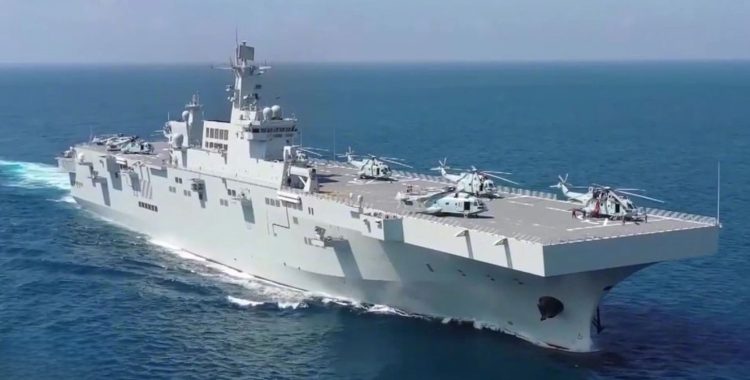
“Compared with destroyers and frigates that can operate alone, an amphibious assault ship must work in a group. The Hainan carries air-cushioned landing craft, armored vehicles and helicopters, and can coordinate with destroyers, frigates and other military services and branches in missions,” Zhang said in the article.
US Amphibious Ready Groups and Marine Expeditionary Units are increasingly capable of “dis-aggregated,” yet securely networked operations. While initial configured for closely group operations, technological breakthroughs in networking and surveillance have enabled US amphibs to expand concepts of operation and enable more separate, disaggregated, independent operations for big-deck amphibs, Amphibious Transport Docks and Dock Landing Ships. This has been made possible by advanced antennas, networking connectedness and greater amounts of aviation and command and control built into smaller support ships such as LPDs and Dock Landing Ships. This greatly expands an operational envelope for amphibious operations while not decreasing any ability to operate in closer-in groups.
China Type 075 Amphibs vs USS America-class amphibs
The People’s Liberation Army – Navy has in recent years been taking new steps to prepare its new class of Type 075 amphibious assault ships for networked, multi-domain combat landings which integrate air, land and sea units.
The PLA-Navy focus on amphibious warfare continues to heighten amid growing tensions over Taiwan, as China has been conducting amphibious assault landing drills, surface-t0-helicopter-t0-aircraft connectivity and practicing maritime warfare maneuvers.
Type 075 Hainan
China’s first of its new fleet of Type 075 amphibious assault ships, called the Hainan, is expanding its ability to conduct multi-domain operations, a move which clearly seems to parallel ongoing work by the Pentagon’s Army-Navy multi-domain task forces training in the Pacific.
The surface-to-air attack networking ability of these new Chinese amphibs is greatly strengthened by the addition of the Z-18J early warning helicopter, Z-9 anti-submarine helicopter and Z-8C transport helicopter, according to a Chinese Communist Party-backed newspaper called the Global Times.
This integrated air-surface, multi-domain tactical connectivity was recently put to the test in assessments of the new Chinese amphibious assault ship, the Chinese paper said. The emphasis of the exercise was to refine air-surface joint operations.
“As we practiced more over the past few months and adjusted our approach, we have now achieved a significantly higher [helicopter] sortie rate,” Zhang Yupeng, commander of an aviation detachment on board the Hainan, was quoted by CCTV as saying, according to the Global Times.
Ship to shore amphibious landings were also featured heavily in the assessment, as the Hainan launched air-cushion landing craft and amphibious assault vehicles to prepare for combat operations. Technological and tactical progress has now enabled the PLA-Navy to greatly reduce the loading and sortie time for equipment being used in an amphibious assault.
China appears to have plans to build an entire new class of these kinds of integrated amphibious vessels, as any actual “on-land” takeover of Taiwan will likely rely upon the successful execution of an amphibious landing.
US Navy’s Amphibious Attack Ability
Chinese amphibious assault capability, however, does suffer from a significant limitation when compared to the US Navy’s amphibious attack ability. The PLA-Navy has no vertical take-off-and-landing built-in, integrated 5th-generation air capability similar to the US F-35B.
An amphibious assault, therefore, would need to rely upon land or carrier-launched 5th-generation close air support, making it much more difficult to achieve air supremacy in any kind of amphibious attack.
Each US Navy America-class amphibious assault ship, for example, can operate as many as 15 F-35Bs, a scenario which weaves an organic, built-in 5th-gen air support capability for amphibious missions.
A Chinese amphibious assault, therefore, would need to rely upon land launched J-20s or carrier-launched J-31s. This would make it much more difficult for a Chinese amphibious attack to operate with close-in 5th-generation air support.
China may be building a new class of amphibious assault ships modeled upon or at least quite similar to the technological and strategic intent for the US Navy’s fast-emerging America-class amphibious assault ship.
The US Navy’s first in class USS America has now been operational for several years and is now joined by the USS Tripoli. Each of these first two America-class amphibs were engineered specifically to support expanded air operations including the F-35B 5th-generation aircraft, V-22 Osprey and other vital air assets.
The ships do not have a well deck and instead were built with extra hangar space for aircraft and modified with a reinforced landing deck to withstand the heat associated with a vertical landing of an F-35B.
The third America-class amphibious assault ship features the return of the well deck to support ship-t0-shore amphibious operations. Overall, the US Navy’s strategy with the America class appears to involve an effort to build-in a multi-domain, aviation and maritime-capable amphibious assault force designed to achieve an optimal blend of integrated air and sea attack operations.
This US Navy effort to architect distinct, yet closely integrated air-and-sea focused elements of amphibious attack appears to now be being copied by China.
Chinese Amphibious Attack Warships
The new Chinese class of amphibious attack warships include both the Type 075 ships with a heavy aviation focus as well as a maritime-oriented Type 071 amphibious landing ship.
Both of these new Chinese Navy variants were included in a capability assessment, according to a report in the Communist party-backed Global Times newspaper. The Type 071 ships, which were assessed in joint operations alongside the Type 075 ships, were operated with air-cushioned landing craft to prepare for ship-to-shore attack. The PLA Navy has launched at least three Type 075s and plans to add more Type 071s as well.
The Global Times quoted a Chinese military expert saying the blend of the two amphibs could help deter Taiwan independence.
“A task force consisting of the Type 075, the Type 071 and an aircraft carrier will serve as a tremendous deterrent to “Taiwan independence” forces, and these warships will play a leading role in striking targets in the east side of the Taiwan island if the occasion comes to that,” the expert says in the paper.
How many of these amphibious assault ships will the PLA Navy build? Is it a clear effort to mirror or copy the US Navy’s America class in terms of configur ation, force structure and concepts of operation? Certainly seems possible.
More CHINA WATCH From Warrior Maven
Can China’s Modernized Amphibious Assault Ships Rival U.S. Navy Assault Ships?
War of Amphibious Assault Ships: China’s New Type 075 Amphib vs US Navy America-class
China’s 2nd “Operational” Type 075 Amphibious Assault Ship Threatens & “Breaks” Japan’s First Island Chain
China’s New Next-Gen “Hainan” Amphibious Assault Ship vs US Navy America-Class
China Debuts New Amphibious Warfare Attack Systems
China Plans To Launch Stealthy GJ-11 Attack Drone from Amphibious Assault Ships








COMMENTS