If you’re wearing Navy blues and holding the keys to an information warfare command right now, you’d better sleep light, keep your box packed, and make damn sure your emails don’t end up in the wrong inbox.
Read the full article for more on:
Important insights and detailed analysis
Expert commentary on current events
Breaking developments and updates
Updating summary...
The Navy’s Information Warfare Command Crisis: A Third Commander Fired
Guy D. McCardle
Speed
1x
Listen
COMMENTS
If you’re wearing Navy blues and holding the keys to an information warfare command right now, you’d better sleep light, keep your box packed, and make damn sure your emails don’t end up in the wrong inbox.
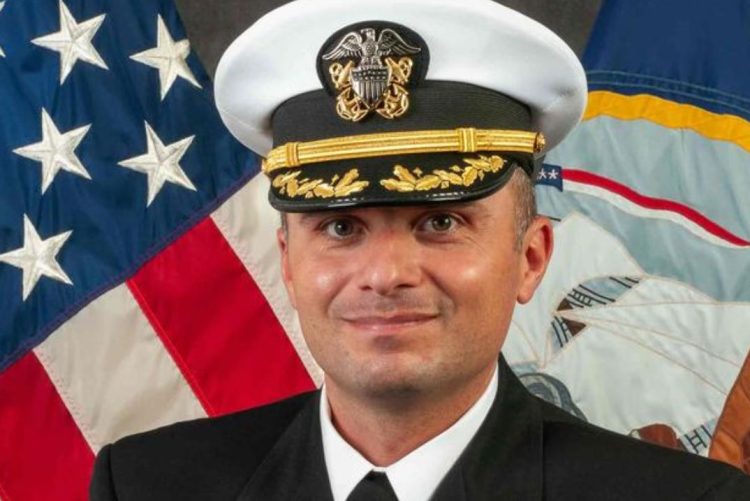
Commander Christopher D. Johnson, recently relieved of command at NIOC Colorado, pictured here before becoming the third Navy information warfare leader ousted in six months. Image Credit: US Navy
If you are a Navy information warfare officer these days, chances are you are about as nervous as a long-tailed cat in a room full of rocking chairs.
Advertisement
The axe had has come out again, and this time, it was used to relieve Commander Christopher D. Johnson of his duties as the commanding officer of the Navy Information Operations Command (NIOC) Colorado. This marks the third such dismissal of a leader within the Navy’s information warfare commands in the past six months, raising eyebrows and questions about the underlying currents within this critical sector of naval operations.
The Fall of Commander Johnson
According to military.com, Commander Johnson, a Michigan native and University of Michigan alumnus with a Bachelor of Science in Physics, took the helm of NIOC Colorado in May 2023. His career has been filled with significant roles, including serving as the U.S. 7th Fleet Director of the Offensive Maritime Information Operations Center aboard the USS Blue Ridge and as the cryptologic resource coordinator for Carrier Strike Group Nine aboard the USS Theodore Roosevelt. His qualifications are that of an Information Warfare Officer, Surface Warfare Officer, and Naval Aviation Observer, and his accolades include the Meritorious Service Medal and the Air Medal.
The Navy‘s official statement cites a “loss of confidence in his ability to command” as the reason for his removal. This has become a catchall phrase meaning essentially nothing. They may have well just said, “he needed to go.” The specifics remain undisclosed, leaving room for speculation and concern.
Advertisement
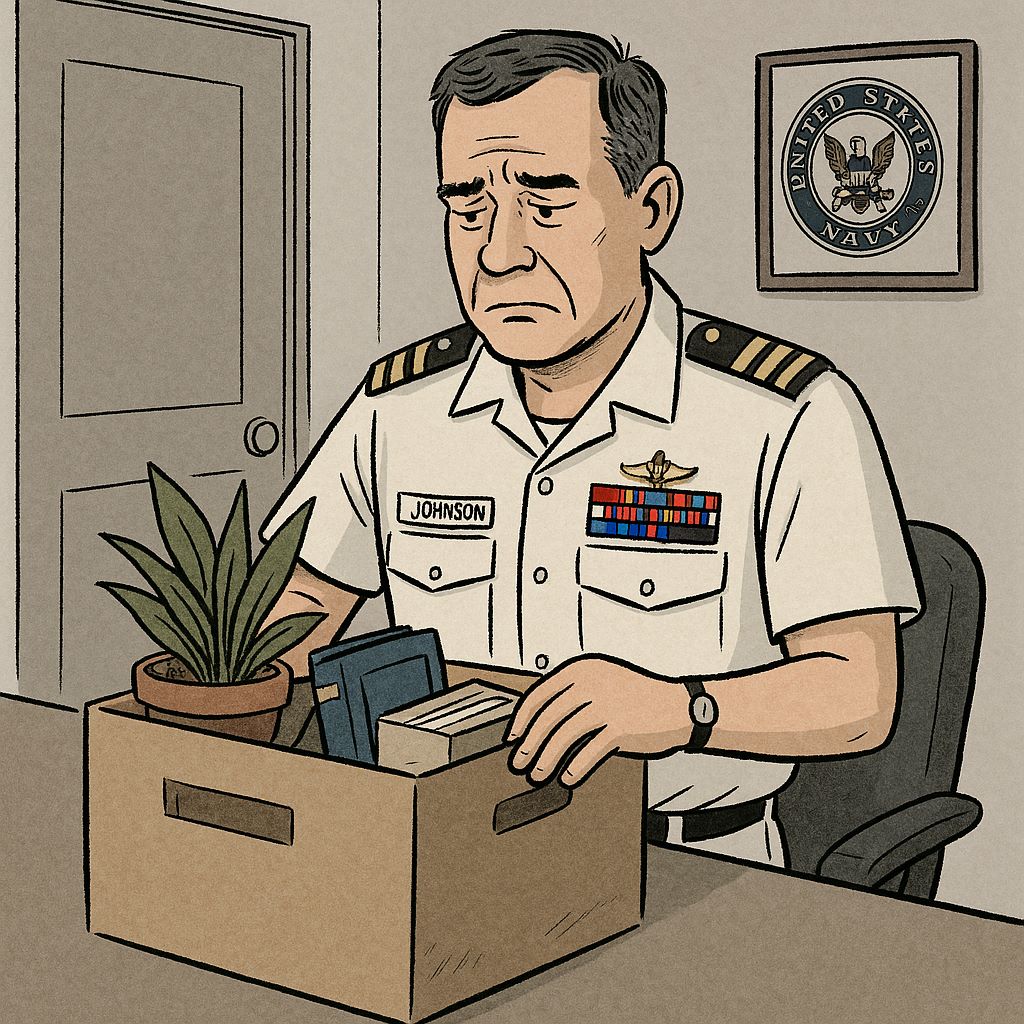
It proved exceedingly difficult to locate additional images of Commander Johnson, so we created this image of what his dismissal might have looked like. It’s tough to be fired, and we wish the Commander the best of luck in the future.
A Troubling Pattern in Information Warfare Leadership
Commander Johnson’s dismissal is far from an isolated incident. In January, Commander Sarah M. Quemada was relieved from her position as the commanding officer of the Naval Information Warfare Training Group Norfolk. Similarly, in November of the previous year, Commander Cayanne McFarlane faced removal from the Naval Information Warfare Training Group San Diego. Both cases were attributed to a “loss of confidence.” Again, this phrase is not exactly fair to the person being let go as it invites speculation. Chances are the reasons may not be as juicy as one conjures up in one’s head.
Advertisement
This series of firings within a short timeframe points to a potential systemic issue within the Navy’s information warfare commands.The pattern suggests not just individual lapses butpossiblydeeper organizational challenges that warrant scrutiny.
The Silent Storm: Implications and Speculations
The Navy’s hesitancy in divulging detailed reasons for these dismissals fuels a firestorm of speculation. In the world of information warfare—a domain characterized by secrecy and strategic subterfuge—the sudden and repeated upheavals at the top echelons are particularly disconcerting. When we step back and look at the numerous recent firings of members of the National Security Council and National Security Agency, it makes one wonder exactly what is going on here and why.
Is there an internal power struggle? Are these commanders scapegoats for broader operational failures? Or is this a purge aimed at recalibrating the direction of naval information warfare? The absence of transparency leaves sailors and analysts alike navigating a fog of uncertainty.
Advertisement
The Ripple Effect on Morale and Operations
Leadership instability can have a corrosive effect on the morale of the rank and file. For the sailors serving under these commands, the abrupt changes at the top can lead to a sense of disorientation and mistrust. In the high-stakes arena of information warfare, where precision and confidence are paramount, such disruptions can have far-reaching operational consequences. Subordinate leaders may wonder who they can trust and if they will be next.
Moreover, the pattern of dismissals may deter talented officers from pursuing leadership roles within the information warfare community, fearing the precariousness of such positions. This could lead to a talent vacuum, further exacerbating the challenges faced by these commands. It’s a serious problem.
The Navy must address this leadership crisis with urgency and transparency. While operational security is vital, providing a clearer rationale for these dismissals could help mitigate the rumor mill and restore confidence among the rank and file.
Furthermore, an internal review of the culture and expectations within the information warfare commands may be necessary. Identifying and rectifying any systemic issues could prevent future leadership casualties and ensure that the Navy’s information warfare capabilities remain robust and reliable.
Wrapping Up: Navigating Uncharted Waters
The successive firings of commanders within the Navy’s information warfare sector signal turbulent waters ahead. As the Navy grapples with these internal storms, the broader implications for national security and operational readiness cannot be ignored. It is imperative that the service steadies its ship, addresses the undercurrents of discontent, and sets a clear course toward stability and effectiveness in its information warfare endeavors.
Advertisement
What readers are saying
Generating a quick summary of the conversation...
This summary is AI-generated. AI can make mistakes and this summary is not a replacement for reading the comments.










COMMENTS