

And the men running that machine? Many of them never should have been there. As the war dragged on, career soldiers rotated out or retired. In their place came waves of draftees. The educated middle class found ways to avoid service… college deferments, medical exemptions, connections. What remained was a talent pool that military officials themselves described as inadequate. Lieutenant William Calley, the man who led the massacre at My Lai, was an unemployed college dropout who somehow graduated from Officer Candidate School. Investigators later said that if the draft had pulled from a broader cross-section of society, a man of Calley’s emotional and intellectual capacity would never have been issuing orders to anyone.
So, here’s the picture. A war being lost but reported as winning. A metric that rewarded killing over winning. Drafted men under leaders who shouldn’t have been leading. A population back home being told things were going well. And a system that, when the inevitable atrocity occurred, reported it as a success.
It took 20 months for the truth to surface. And it didn’t come from the military. It didn’t come from Congress. It didn’t come from the White House.
It came from a broke freelance journalist named Seymour Hersh.
A soldier named Ron Ridenhour had been writing letters to the president, the Pentagon, the State Department, and multiple members of Congress, detailing what he’d heard from members of Charlie Company. Nobody acted. Eventually, word reached Hersh through a tip from an anti-war attorney. Hersh floated the story past a general, who slammed his hand on his desk and accidentally gave up a name: Calley.
Hersh borrowed money to fly to Salt Lake City to meet Calley’s lawyer. He read the Army charge sheet upside down across the attorney’s desk… 109 counts of premeditated murder of “Oriental human beings, whose names and sex are unknown.” He then tracked Calley to Fort Benning by finding his name in an outdated base phone book. The two stayed up late drinking beer while Calley told him everything.
The story ran in 35 newspapers through the Dispatch News Service. Hersh won the Pulitzer Prize. And the response from parts of the government and the public was not gratitude. A congressman said this was “no time to cast aspersions on our fighting men.” A prominent columnist asked whether the massacre should even be reported, since it “helps the enemy.”
Twenty-six soldiers were charged. Only Calley was convicted. Sentenced to life in prison. Served three and a half years of house arrest after Nixon intervened. He went into the insurance business.
There’s one more person in this story who matters.
Warrant Officer Hugh Thompson was flying a reconnaissance helicopter over My that morning. He and his crew started noticing bodies. Everywhere. Infants. Toddlers. Women. Old men. No draft-age males. No weapons. He later said, “We kept flying back and forth, and it didn’t take very long until we started noticing the large number of bodies everywhere.”
Thompson landed his helicopter between the soldiers and the remaining villagers. He ordered his door gunner to open fire on American troops if they advanced. He then evacuated civilians to safety.
For this, the Army awarded him a Distinguished Flying Cross with a fabricated citation describing a rescue from “intense crossfire.” There was no crossfire. Thompson threw the medal away.
Thirty years later, in 1998, the Army finally gave Thompson and his crew the Soldier’s Medal for heroism. The citation acknowledged what actually happened: they saved lives during “the unlawful massacre of non-combatants by American forces.”
It took three decades for the truth to replace the lie on an official piece of paper.
Three years after My Lai, Daniel Ellsberg leaked the Pentagon Papers, a 47-volume classified study that confirmed what many had suspected: the U.S. government had systematically lied to the public and to Congress about every aspect of the war. Five consecutive administrations misled the American people about the scale, the progress, and the purpose of the conflict.
Ellsberg later summarized it simply: “Truman lied. Eisenhower lied. Kennedy lied. Johnson lied and lied and lied. Nixon lied.”
After Vietnam, the military didn’t fix the problem. They fixed the messaging. “We don’t do body counts” became official policy… not because counting was wrong, but because it had become embarrassing. The lesson learned wasn’t “don’t inflate the numbers.” It was “don’t let the public see the numbers.”
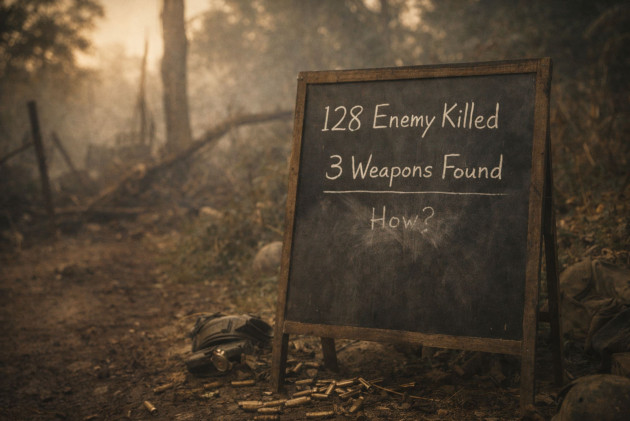
And yet. The metrics always come back. Different language, same architecture. Targets struck. Assets destroyed. Capability degraded. Percentages declined. The vocabulary changes. The function doesn’t. Progress is still reported in the language of destruction, and the question of what’s actually being achieved… the question nobody asked when the report said 128 enemy killed and three weapons found… still has a way of going unanswered until someone like Hersh or Ridenhour or Ellsberg decides they can’t stay quiet anymore.
Years later, Hersh reflected on the people he’d reported on. He said he’d “exploited these poor dumb suckers who were there fighting a war they didn’t understand, for reasons they didn’t understand.”
He was just being honest. Charlie Company had been in-country for 11 weeks. They’d lost men to snipers and mines without ever seeing the enemy. They were angry, traumatized, and poorly led. The night before the massacre, they held a memorial service for a fallen friend. The briefing that followed told them tomorrow they’d finally meet the enemy face to face.
They walked into that village expecting a fight. Found women and children instead. And somewhere between the fear, the grief, the months of invisible enemies, and a leadership structure that measured success in corpses… the line disappeared.
That doesn’t excuse it. Nothing excuses it. But it traces the line.
And tracing the line is how you make sure it doesn’t happen again. Or at least… how you know to ask when the numbers don’t add up.
128 enemy killed. Three weapons found.
Ask.
—
About the Author
I don’t try to change minds… just deepen them. – Tegan Broadwater
Tegan spent 13 years with the Fort Worth Police Department, including two years assigned to the FBI working deep undercover inside a violent Crip organization. That operation, detailed in his book Life in the Fishbowl, resulted in 51 convictions. He has since founded Tactical Systems Network, an armed security & protection firm primarily staffed by veterans, is a creative writer and musician, and hosts The Tegan Broadwater Podcast. All book profits benefit children of incarcerated parents. Learn more at TeganBroadwater.com








COMMENTS