

The aircraft picture reinforces the same point. Damage to refueling aircraft and the loss of multiple platforms in a compressed air-defense environment speak to pressure on the system as a whole. Tankers extend reach; when they are hit, even temporarily, the range and tempo of operations tighten. Friendly fire incidents point to a crowded, fast-moving airspace where identification and coordination are under strain. This is friction generated largely by density, not just incompetence.
Taken together, the pattern is clear. Iran has not broken U.S. military power in the region, but it has demonstrated a credible ability to contest it at the margins and to impose cost in the rear areas that were once treated as secure. That does not end the fight. It changes its character.
Economic Targets and Energy Pressure
Iran’s retaliation has focused less on destroying infrastructure than on disrupting the flows that sustain it. The target set is consistent across the Gulf: LNG export terminals, refineries, and supporting industrial hubs tied to U.S. partners. The objective is economic pressure delivered through uncertainty; interrupt supply, raise risk, and let the market carry the shock outward.
The center of gravity is Qatar. Strikes on Ras Laffan Industrial City and associated facilities have forced production halts, triggered force majeure declarations, and disrupted a significant share of global LNG supply. Fires and structural damage have been confirmed by satellite imagery, but the longer-term impact remains unclear. What is clear is the immediate effect. Buyers in Europe and Asia have been pushed back into the market at once, driving sharp price spikes and exposing how little slack exists in global gas supply.
Elsewhere, the pattern repeats at lower intensity. Drone strikes and intercepts around Kuwaiti refineries and Saudi facilities have caused localized fires and temporary disruptions without sustained shutdowns. In the UAE, threats to gas fields and industrial zones have prompted precautionary halts and evacuations. These are not decisive blows. They are cumulative pressure points applied across a network that depends on steady throughput.
The maritime picture amplifies that pressure. Shipping through the Strait of Hormuz has slowed under threat of missile, drone, and naval harassment. Traffic has not stopped, but risk premiums have surged, insurance costs have climbed, and some operators have diverted or delayed transit. That friction alone is enough to tighten supply without a single tanker being sunk.
The result is a familiar but sharpened dynamic. Energy markets are reacting to disruption as much as to destruction. Prices have surged, volatility has returned, and downstream effects are already visible in fuel costs and inflation expectations. For Gulf states, the damage is not only physical; it is temporal. Every interruption compounds lost revenue, deferred shipments, and strained contracts.
The broader meaning sits just beneath the surface. Iran has shown it can reach into the economic infrastructure of U.S. partners and impose cost without needing to hold ground or achieve battlefield dominance. The effect is indirect but real. The war expands outward, from bases and airspace into markets, contracts, and supply chains.
What the Economic Strikes Mean
The economic dimension of this war has opened a second line of effort alongside the military campaign. By targeting energy infrastructure and the shipping routes that sustain it, Iran has expanded the conflict outward into markets and supply chains. The effect builds through accumulation. Disruption at key nodes forces adjustments across the system, and those adjustments carry strategic consequences.
Strategically, these strikes give Iran a way to impose cost without seeking control of territory. Pressure is applied through reach rather than occupation. Energy infrastructure links local damage to global effect; a disrupted LNG terminal or refinery constrains supply, alters pricing, and forces external actors to respond. That connection keeps Iran relevant in the conflict even as it absorbs military losses.
Economically, the impact appears as tightening supply and persistent volatility. Energy markets react quickly to uncertainty, and even limited disruptions have pushed prices upward. Those conditions reward producers that can maintain steady exports. Russia falls into that category. Higher prices increase revenue per barrel and ease fiscal strain under sanctions, a pattern that has repeated across previous energy shocks.
Diplomatically, the pressure reshapes incentives for U.S. partners in the Gulf. States hosting American forces now operate under sustained exposure to retaliation against their own infrastructure. That exposure introduces friction into their decision-making. Security cooperation with Washington remains essential, but the costs of alignment are more immediate and visible. The result is a more cautious posture, as governments balance external commitments against internal stability and economic risk.
A Personal Assessment
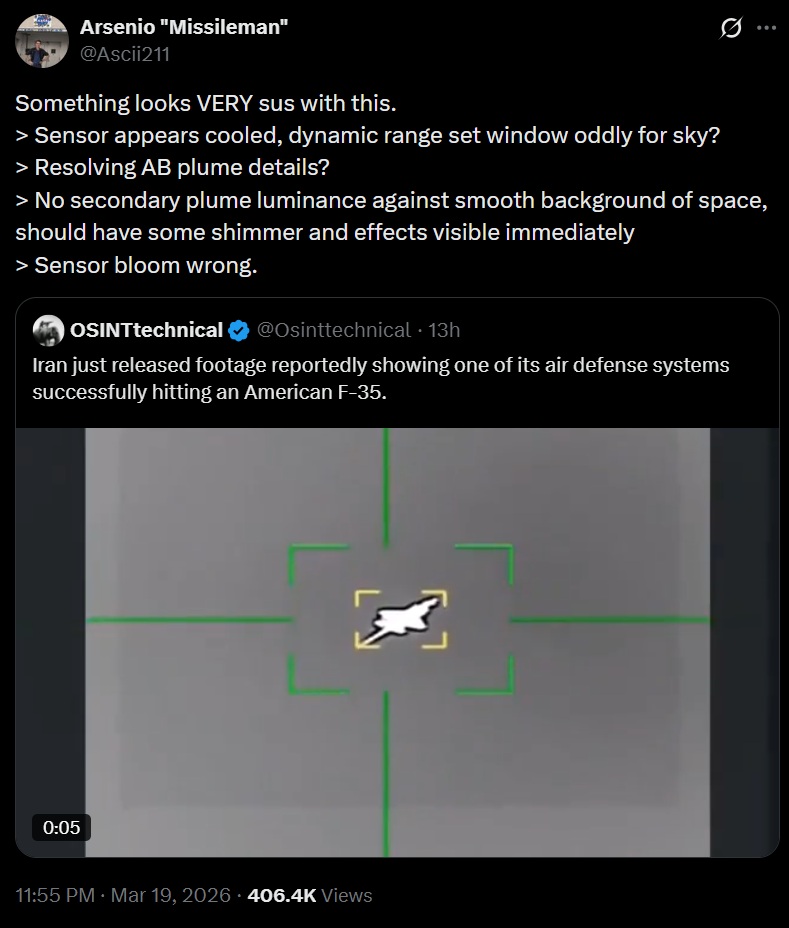
As I move into a fourth week of tracking the war in Iran, the pattern feels familiar. Ukraine taught a simple lesson early: treat every narrative with skepticism. That applies more heavily to Iranian claims, but it applies to ours as well. I watched the information space in Ukraine degrade in real time. Early in the war, footage circulated as evidence of battlefield success that later proved to be lifted from video games like War Thunder and Arma. The tools have improved since then. Fabrication has not disappeared; it has become more convincing. AI-generated video is entering the same space, and verification tools remain unreliable. False positives are common. The technology will improve faster than the systems designed to police it. Expect the problem to get worse before it gets better.
Social media has become part of the battlespace. It shapes perception, compresses timelines, and rewards certainty over accuracy. In a polarized political environment, most audiences approach the war with conclusions already formed. That dynamic feeds the spread of overstated claims and premature judgments. The safest course is restraint. Content built around urgency and exclusivity tends to trade accuracy for speed. It is better to let events settle before drawing conclusions, even if that means accepting temporary uncertainty.
At the tactical level, the question of cost and exchange rates remains central. Iranian unmanned systems like the Shahed-136 are inexpensive and produced at scale. Intercepting them with high-end air defense missiles places pressure on inventories and budgets. That imbalance has been visible in Ukraine, and it is emerging again here. There are signs of adaptation. U.S. forces have employed AH-64 Apache helicopters to engage drones with 30mm cannon fire, a practical adjustment that mirrors Ukrainian improvisations. In Ukraine, crews used platforms like the Yakovlev Yak-52 to hunt drones at low cost. The transfer of Ukrainian experience to the Middle East, including the deployment of counter-drone specialists, suggests that some lessons are being absorbed in real time.
The political layer introduces its own constraints. Sustained military operations require continuity. In practice, American foreign policy often operates on shorter cycles, shaped by domestic competition and shifting priorities. That tension affects planning and execution. I saw it in Ukraine when political decisions slowed or constrained support at critical moments. U.S. adversaries operate under different conditions. They face internal pressures, but their wartime decision-making is less exposed to rapid swings in public debate. That difference does not determine outcomes on its own, but it shapes the tempo and consistency of action.
The economic dimension will define the outer limits of this conflict. Energy markets have already reacted to disruption and uncertainty. Prices have risen, volatility has returned, and the effects are moving outward into fuel costs, inflation expectations, and industrial planning. For the United States and its partners, the question is durability. Public tolerance for higher costs is finite. The same applies to allied governments balancing security commitments against domestic pressure. The longer the disruption persists, the more it constrains policy options. These pressures do not end wars, but they narrow the range of acceptable choices.
What Comes Next
The next phase of this campaign will not be defined by a single decisive event, but by continued pressure across multiple domains.
In the near term, U.S. forces will be forced to adapt their posture across the region. Expect increased dispersal of aircraft and personnel, greater reliance on hardened and redundant infrastructure, and a shift toward rapid repair and mobility to offset continued strikes on fixed sites. Airspace management will remain compressed and contested, increasing the risk of friction incidents, including further friendly fire.
Iran is likely to continue targeting the systems that enable U.S. operations rather than attempting to destroy forces outright. Radar, communications nodes, and support infrastructure will remain priority targets. These attacks do not need to be decisive to be effective; cumulative degradation will continue to narrow the operational picture and slow response times.
The economic dimension will intensify. Energy infrastructure and shipping routes will remain under intermittent pressure, sustaining volatility in global markets. Even limited disruptions will continue to drive price instability and strain allied economies, particularly in Europe and Asia.
Regionally, partner nations hosting U.S. forces will face increasing pressure to balance security cooperation with economic and domestic stability. This will not result in a break with Washington, but it will introduce hesitation and caution into future decisions, particularly if infrastructure damage continues.
Unless the scope of the conflict changes dramatically, the war will continue as a contest of endurance. The United States retains overwhelming military capability in the region, but Iran has demonstrated an ability to impose cost and disruption without seeking direct confrontation. That dynamic favors persistence over resolution, with neither side achieving a clean, decisive outcome in the near term.
Every war is different; every war is the same. A man trains with a rifle, goes to war, then comes home and tries to live like it ended. It didn’t. Twenty-three years after Iraq began, we are still in the desert.








COMMENTS