

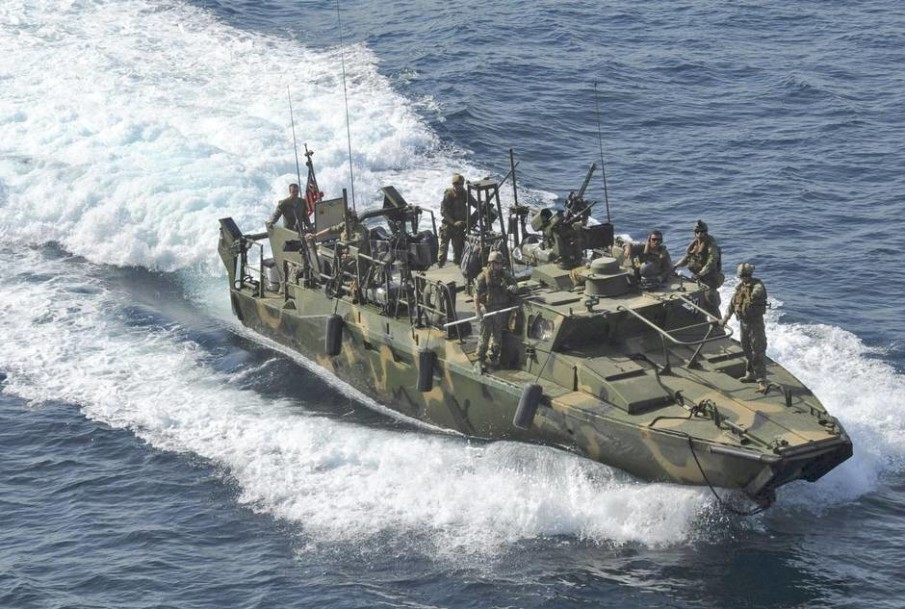
Due to problems getting their communications gear to work, the sailors set off from Kuwait three hours late. The late start put pressure on the sailors as they tried calculate how long before they would need to refuel in daylight and the optimum speed for their boats, according to a second person familiar with the sailors’ accounts.
The boat crews asked that a refueling tanker meet them before nightfall, as they were not trained for refueling in the dark. Arranging a rendezvous proved difficult because the sailors had no direct communication with the tanker and had to relay messages through a U.S. operations center in an undisclosed location in the region. As the boats sought to meet up with the refueling tanker, they mistakenly ventured into Iranian territorial waters, just west of tiny Farsi Island.
The U.S. sailors were using a GPS device to navigate, but Farsi Island is so small that it did not appear on their screen when it was zoomed out to a wider view. As they drifted within sight of land, the Americans did not even know that it was Farsi Island, said the person familiar with the sailors’ account.
Throughout the cruise, the positions and direction of the two boats were automatically relayed to the operations center every 30 minutes via an electronic tracking device, the U.S. official said. But for reasons that remain unclear, commanding officers or others at the operations center did not inform the boat crews that they were headed in the wrong direction.
Traveling at a swift pace, the two U.S. vessels might have passed through the area without encountering any Iranian patrol craft. But one of the American boats — the one that needed repair back in Kuwait — broke down. As the sailors worked to revive the boat’s engine near Farsi Island, two IRGC patrol boats showed up, weapons pointed at the Americans. One American sailor waved a wrench in the air, to signal they had engine trouble and had no hostile intent. But the Iranians showed no interest in helping out: Soon another Iranian vessel arrived at the scene, followed by a fourth ship that was larger and more heavily armed.
As the Iranians encircled the boats, the U.S. sailors managed to repair the faulty engine. Now the Americans had a choice. With 50-caliber machine guns and GAU-19 miniguns on their boats, they outarmed the Iranians. And their RCBs were bigger than the Iranian patrol craft. But escaping would mean opening fire on the Iranian forces or ramming their vessels — actions that could lead to a wider conflagration. The young officer in charge, Nartker, opted to cooperate.
In the tense encounter, there was one comical moment. As the Iranians searched through gear and equipment, they held up an iPhone 6 charger with an accusatory air. It took some time for the U.S. sailors to convince the Iranians that it was merely a charger, featuring a new design for the latest iPhone, and not a hi-tech weapon.
After being ordered to kneel with their hands on their heads, the Americans were taken to nearby Farsi Island and questioned one by one. They were served meals. At one point, the food was removed and served again so the scene could be recorded for the camera. Although the sailors were blindfolded and used as propaganda for Iranian state television, the Americans said they were not physically abused or otherwise mistreated.
Meanwhile, back at the U.S. operations center, commanders saw that the tracking device for the riverine boats had put them in Iranian waters near Farsi Island. The U.S. commanders ordered a cruiser, the USS Anzio, a U.S. Coast Guard cutter, and a British naval ship to head over to the boats and lend them assistance. But the timing of the response — and whether commanders were aware that the American boats had encountered Iranian patrol craft — remains unclear. By the time the rescue party arrived, the U.S. sailors were already in the hands of the Iranians.
After Secretary of State John Kerry and his Iranian counterpart, Mohammad Javad Zarif, worked out the release of the Americans in a series of phone calls, the sailors were told that they were about to be freed. The Iranians filmed one crew member crying in relief at the news.
Read more at Foreign Policy








COMMENTS