

Fact: The patriots in colonial America were angry with perceived British tyranny, feared the destruction of liberty through taxation, saw a slippery slope toward subjugation, and often spoke of rhetorical slavery to the British Empire. These same ideas were expressed prior to the American Revolution—in England!
The “Country Opposition,” as it was known, was an 18th century British movement that often stressed through pamphlets and speeches that power corrupted, that the government (“court”) was taxing the “country” to build its own wealth, and that eventually the conspiracy to amass power would lead the government to rob the country of its liberty. This opposition was also regularly manifested by objection to all new taxes.
Colonial elites in America in the 1760s read this “Country Opposition” literature and could not help but be influenced by the ideology. The American revolutionaries found in the “Country Opposition” reason to distrust the British Parliament, and to oppose the new taxes that were levied on the colonies. They found an English intellectual inspiration, in other words, for their American Revolution.
Myth 3: The American Revolution was solely about liberty, freedom, and self-government.
Fact: This one is sometimes tough for us, as Americans, to debunk for ourselves. We like to think the revolution was a great, patriotic push for liberty for all, and freedom from tyranny and oppression. To some degree, this is true, but other factors also came into play and must be recognized as influential in the run-up to the revolution.
For example, some in the American south supported revolution because they feared that slavery would be outlawed in the British Empire. Slave-owning colonists were nervous that the lack of protection for the institution in English Common Law would lead to its abolition (which it did!), and thus wanted to protect the institution in America. They saw revolution as the best way to do that.
Others supported revolution because it comported with their commercial, political, or social interests, or because they were driven by self-interest to do what was best for themselves and their families. This same drive led others still to support the loyalist cause. After all, ideas such as liberty and self-government are one thing, but so is the protection of one’s own lifestyle, wealth, and family. Those are hard incentives to ignore, and most were probably guided by these factors, just as most of us are today when we make political decisions.
The American Revolution was not only about self-government and liberty.
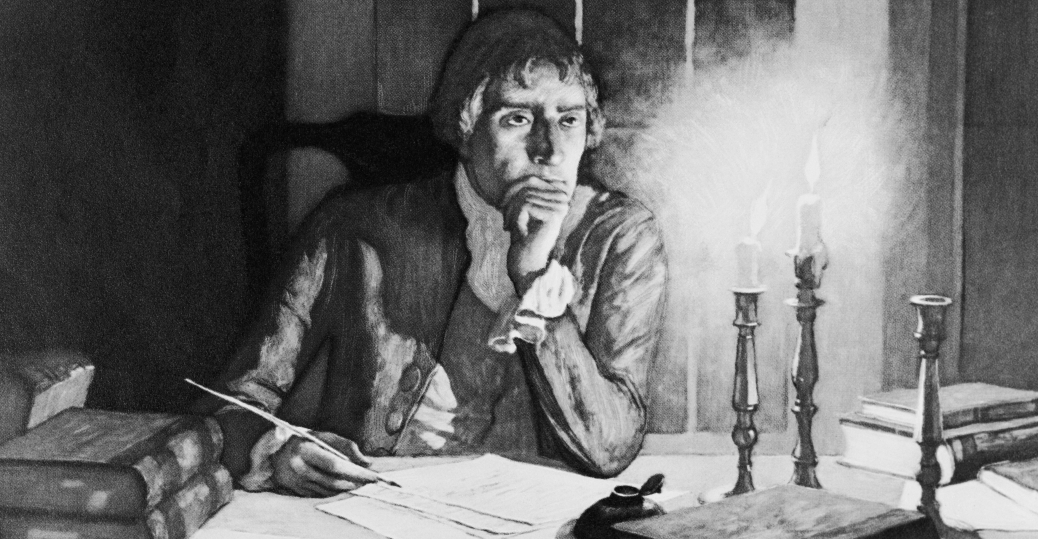
Myth 4: Thomas Jefferson single-handedly produced the American Declaration of Independence.
Fact: Yes, Jefferson was an elegant and masterful wordsmith, who crafted in the Declaration of Independence a document for the ages. However, he did not, nor would he likely claim to have had, come up with all of the ideas in the document all on his own.
Jefferson, in fact, drew on George Mason’s Virginia Declaration of Rights as an inspiration for the Declaration of Independence. Mason’s earlier document drew from John Locke and the English Bill of Rights, and influenced Jefferson and many others in the drafting of critical constitutional documents in the decades after the revolution.
Myth 5: Judicial review in America began in the 19th century, 25 years or more after the revolution.
Fact: Given that we are currently witnessing a slew of important cases before today’s Supreme Court, it is worth noting that the practice of the court ruling on the constitutionality of laws started in Revolutionary America.
The first actual case of judicial review in America dealt with state law and the supremacy of the state constitution over state statute. The year was 1782, before the Treaty of 1783 ended the revolution, and in Commonwealth v. Caton, justice George Wythe, recognized as America’s first law professor, ruled that a written constitution does have legal standing, and that it is superior to statute (laws passed by the legislature).
This was long before Marbury v. Madison, which dealt with the same issue at the federal level, and shows that the supremacy of the written constitution, which we today take for granted, and which is routinely reviewed by the U.S Supreme Court, originated back in America’s revolutionary days.
This last myth underscores for all of us how truly exceptional our American experience is. Our system of government, though not perfect by any stretch, is still the best in the world, and our shared experience, through revolution and growth as a world power, should be significant for all of us.
Although our country, like all others, rests on a historical bed of legend, myth, fact, and sometimes outright fallacy, it is also a history filled with heroism, intellectual achievement, mostly benevolent governance, and even a largely benign and morally upstanding global hegemony. The world, in short, has never before known a country like ours.
Today, on July 4th, and each year and every day hereafter, you should be proud to be an American. You should also take the opportunity, as always, to know your country more profoundly. Only then can you truly love it, and appreciate it for its exceptionalism.








COMMENTS