There is something special happening in a generic office park in an uninspiring suburb near Fort Lauderdale, Florida. Inside, amid the low gray cubicles, clustered desks, and empty swivel chairs, an impossible 8-inch robot drone from an alien planet hovers chest-high in front of a row of potted plants. It is steampunk-cute, minutely detailed. I can walk around it and examine it from any angle.
I can squat to look at its ornate underside. Bending closer, I bring my face to within inches of it to inspect its tiny pipes and protruding armatures. I can see polishing swirls where the metallic surface was “milled.” When I raise a hand, it approaches and extends a glowing appendage to touch my fingertip. I reach out and move it around. I step back across the room to view it from afar. All the while it hums and slowly rotates above a desk. It looks as real as the lamps and computer monitors around it. It’s not.
I’m seeing all this through a synthetic-reality headset. Intellectually, I know this drone is an elaborate simulation, but as far as my eyes are concerned it’s really there, in that ordinary office. It is a virtual object, but there is no evidence of pixels or digital artifacts in its three-dimensional fullness.
Read More: Wired
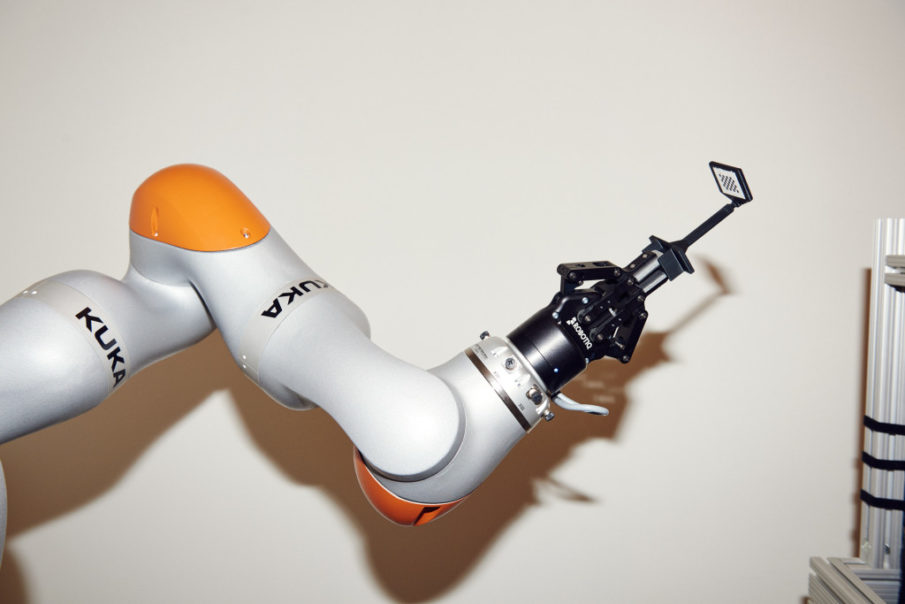
Featured Image: Magic Leap uses a pair of robots named Click and Clack to test and calibrate its prototype hardware.Peter Yang, for Wired.
Already have an account? Sign In
Two ways to continue to read this article.
Subscribe
$1.99
every 4 weeks
- Unlimited access to all articles
- Support independent journalism
- Ad-free reading experience
Subscribe Now
Recurring Monthly. Cancel Anytime.
There is something special happening in a generic office park in an uninspiring suburb near Fort Lauderdale, Florida. Inside, amid the low gray cubicles, clustered desks, and empty swivel chairs, an impossible 8-inch robot drone from an alien planet hovers chest-high in front of a row of potted plants. It is steampunk-cute, minutely detailed. I can walk around it and examine it from any angle.
I can squat to look at its ornate underside. Bending closer, I bring my face to within inches of it to inspect its tiny pipes and protruding armatures. I can see polishing swirls where the metallic surface was “milled.” When I raise a hand, it approaches and extends a glowing appendage to touch my fingertip. I reach out and move it around. I step back across the room to view it from afar. All the while it hums and slowly rotates above a desk. It looks as real as the lamps and computer monitors around it. It’s not.
I’m seeing all this through a synthetic-reality headset. Intellectually, I know this drone is an elaborate simulation, but as far as my eyes are concerned it’s really there, in that ordinary office. It is a virtual object, but there is no evidence of pixels or digital artifacts in its three-dimensional fullness.
Read More: Wired
Featured Image: Magic Leap uses a pair of robots named Click and Clack to test and calibrate its prototype hardware.Peter Yang, for Wired.










COMMENTS