

The military often has an “obsessive-compulsive nature to get everything digital,” he said.
“What happens is we miss opportunities to shape the future. We get consumed with responding to the future,” the general said.
A different way of approaching the future, he said, would be to ask the question, “What puts the U.S. Army at an advantage?”
Staying ‘Two Moves Ahead’
“We don’t do as good a job thinking two moves ahead — especially if we’re successful,” Perkins said about the military. He said success tends to ‘hardwire’ a tactic or technique and make it permanent, but the enemy adapts.
For instance, Perkins said, the U.S. has the best targeting capabilities in the world. So enemies decide not to be a target. Therefore, he explained, the enemy today doesn’t wear uniforms or assemble in large formations — they blend in with the population and go underground.
Any technical innovation is only temporary, Perkins said. The enemy will soon adapt.
“Technology has become the most transferrable of our capabilities,” said Perkins, noting that years ago, to steal a trade secret required taking blueprints and reams of documents.
“Now all you need is a thumb drive,” the general said.
As an armor officer, Perkins said he has long appreciated the protection afforded by the M1 Abrams tank and Bradley Fighting Vehicle. “I’m used to getting my protection from tons and tons of armor,” he said.
Protection for Combat Vehicles
Advanced protection for combat vehicles is one of the capabilities that TRADOC leaders believe will be critical in 2050.
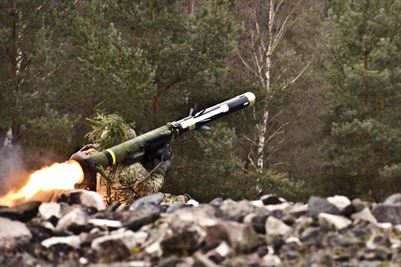
“The problem we’re seeing now is, with the proliferation of [anti-tank guided missiles], chemical-energy munitions, shaped charges, etc., like that — is that the cost curve as well as the physics is working against us,” Perkins said. “It’s much easier to develop new ways to penetrate the armor.”
To change penetrating charges is relatively inexpensive compared to producing new armored vehicles, he said. The adversary can update much quicker and with much less expense.
“The old paradigm of ‘more and more armor’ may be outdated,” he said.
“Better think of a different way to protect,” he said. “What’s needed are capabilities, rather than things,” he said, and challenged the group to avoid some of the “traps” that discussions of the future often fall into.
The Mad Scientist Conference can be watched live Aug. 9 via streaming video here.
Featured Content: DoD
Featured Image – A soldier assigned to 4th Squadron, 2nd Cavalry Regiment, fires a Javelin anti-tank missile at the Grafenwoehr Training Area, Germany, Feb. 24, 2016. The proliferation of anti-tank missiles, chemical-energy munitions and shaped charges may put conventional armor at a disadvantage in the future, Army Gen. David G. Perkins, U.S. Army Training and Doctrine Command commander, said at the Mad Scientist Conference at Georgetown University in Washington, D.C., Aug. 8, 2016. Army photo by Sgt. William A. Tanner –DoD








COMMENTS