

It’s the study of the tiniest particles in the universe, things so small that just looking at them the wrong way can change them.
This quantum realm deals with probabilities, not certainties, where particles can be in multiple places at once, or entangled with others light-years away.
It’s mind-bending, I know, but it’s real.
In the context of this atomic quantum receiver, we’re harnessing these bizarre quantum properties to create something that’s more sensitive, more accurate, and more secure than anything we’ve seen before.
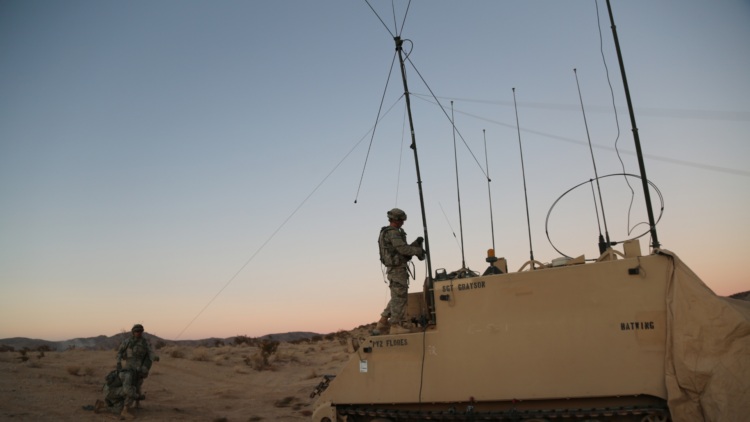
The U.S. Army, working with a startup called Rydberg Technologies, has achieved the world’s first long-range radio communication with an atomic quantum receiver, a breakthrough that could greatly help new jam- or hacker-proof communications, the company announced Thursday.… pic.twitter.com/0VL6SVFQ2R
— Rifnote (@viarifnote) December 22, 2023
It’s like having a superpower where you can hear a pin drop in a hurricane.
This quantum leap isn’t just a step forward; it’s a jump into a new dimension of communication technology.
Quantum Leap in the Field: Testing the Atomic Guts
During a field test that felt more like a baptism by fire, this atomic gizmo showed off its chops, picking up signals over vast distances like it was nothing—think high-frequency chats over mountains and valleys.
The brass at Rydberg is crowing about its selectivity and how it laughs in the face of interference, the kind that would usually turn your precious signals into garbled messes.
“When compared to traditional antennas, Rydberg atomic receivers offer a unique set of characteristics, including high sensitivity, selectivity and wideband coverage using a single atomic detector element,” its press statement read.
This isn’t just about keeping secrets from eavesdroppers or making sure your buddy hears you clear across a battlefield choked with electronic noise.
It’s about redefining the game, about looking into the abyss of future warfare and winking back with something that says, “I’ve got this.”
Imagine drones chatting with jets, ships trading secrets with submarines, all in the midst of a chaotic dance of electronic warfare.
“Rydberg atom devices have the potential to revolutionize RF surveillance, safety, communications and networking capabilities from long-wavelength RF to millimeter-wave and THz bands,” it added.
The Rydberg Atomic Receiver was developed with assistance from the Defense Innovation Unit’s National Security Innovation Capital (NSIC) financing initiative.
The Architects of Tomorrow: Rydberg’s Visionaries
David A. Anderson, the big brain at Rydberg, isn’t just puffing smoke when he talks about ushering in a new era with this atomic marvel.
“The introduction of our atomic receiver prototype and its successful deployment under real-world conditions represents an important step forward in the quantum technology landscape,” Anderson noted.
He’s throwing down the gauntlet, challenging the status quo of military comms, and frankly, it’s about time.
We’ve been playing with the same old toys for too long, and the world isn’t getting any simpler.
“We have demonstrated the smallest ever atomic receiver at frequencies and long-range communication distances that show a clear path for transitioning Rydberg atom quantum technologies from laboratory to real-world applications,” he added.
Riding the Quantum Winds: The Future Unleashed
So here we stand, on the precipice of a new age.
The US Army, with this quantum voodoo, isn’t just stepping up the game; it’s changing the game entirely.
This isn’t just about better communication; it’s about holding the key to a kingdom of uncrackable codes and undetectable whispers, where the shadows talk back, and the silence is full of answers.
As the quantum winds howl and the future beckons with a sly grin, one thing is clear: the realm of military tech will never be the same.
We’re not just watching history unfold; we’re riding shotgun with it, barreling down a road paved with atomic precision and quantum chaos.
Hold on tight; it’s going to be one hell of a ride.
—
You might want to check out:










COMMENTS