

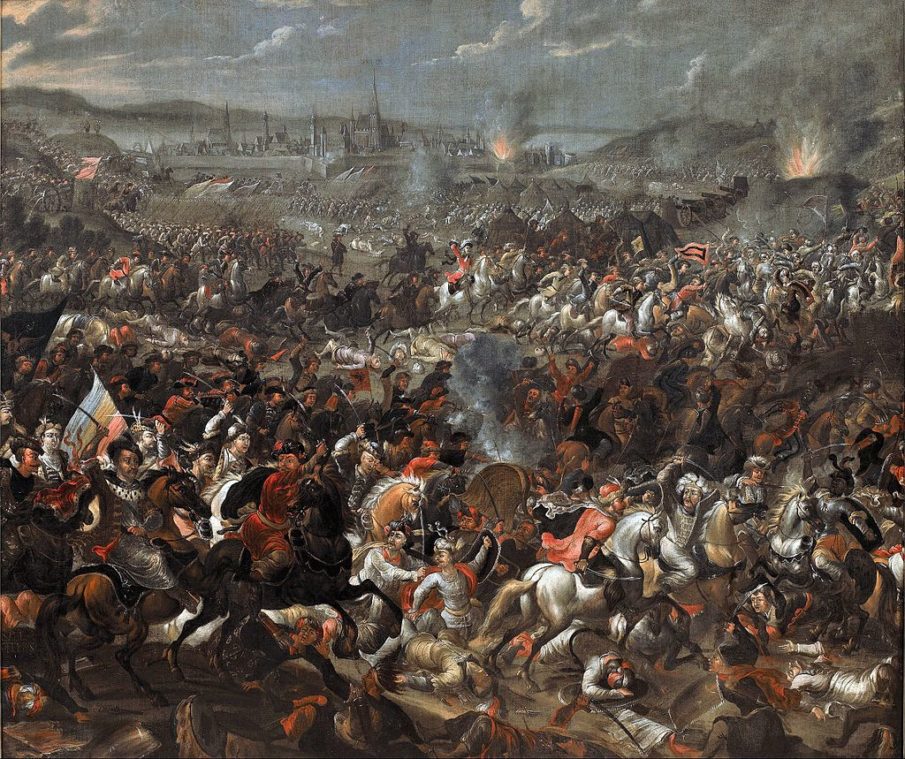
The Austrians stopped the advance of the Ottomans and established a line facing the Nussberg-Karpfenwald. The Ottoman Turks recognized the threat that the advance of the coalition’s forces posed in gaining that position. They attacked viciously. Both times they were repelled, the second time by the timely arrival of dragoons and the elite armored cuirassier heavy cavalry.
By noon, the Ottoman army had suffered considerable losses but the battle was far from over.
Mustafa Pasha launched a counterattack with a large part of his force while he launched a last-ditch attempt to capture Vienna with a smaller force. 10 mines were placed on the walls, but they were found by the defenders and disarmed
Polish infantry moved toward the Ottomans’ right flank and a large engagement started there, but the Ottomans were more preoccupied with capturing Vienna than facing the advance from that side and the Poles made good progress capturing the village of Gersthof that would be the base of the massive cavalry charge that ended the battle.
Fighting since 0400, the Duke of Lorraine wondered if he needed to push or, since the day had gone well for the coalition, to stop, reorganize, and resume the push later. He held a war council with Saxon commanders and they persuaded him to attack. Field Marshal von Goltz said “God is pointing the way to victory… strike while the iron is still hot” and the Duke of Lorraine gave the command for his force to march forward.
While they were engaged with the Ottoman Turks who were pushing them towards Vienna, they saw the Polish and imperial cavalry getting into charge formation. A roar was heard from the Christian lines, cheering on their comrades.
What followed must have been what gave J.R.R. Tolkien his inspiration for the riders of Rohan cavalry charge at the battle of Minas Tirith.
With the cry of “Jezus Maria ratuj” (Jesus Maria help), the whole Polish line rode downhill towards the Ottoman Turks. John III Sobieski was in the head of his 3,000 Hussars that were spearheading the charge followed by 15,000 more allied and Polish cavalrymen in one of the largest cavalry charges in history.
With their head-to-toe glittering polished steel armor, tiger and leopard pelts and the wings on their backs, the leading Hussar units coming downhill at full speed presented a frightening spectacle.
They hit the Turkish line like a tidal wave, dispersing the Turks and capturing their guns.
Mustafa Pasha entered the battle personally at his formation’s center to save the Holy Banner from the hands of the Christians.
With the cavalry charge and the combined advance of the coalition forces in the other flanks, the Ottoman Turks broke ranks and tried to save themselves. The dissolution of their army was such that the Vienna garrison came out to exact revenge on their former besiegers.
This marked the high point of the Ottoman Turk incursion into Europe. The wars between various Christian kingdoms and the Ottoman Empire lasted for some hundred years after that, but the Ottomans never managed to pose such a threat to Europe again.
Unfortunately, the Christian alliance went sour when Sobieski entered Vienna first, in triumphal parade, before the Holy Roman Emperor, something which was considered by many a grave insult. Combined with the fact that Leopold denied the hand of his daughter to the son of Sobieski, Jakob (who fought with his father in Vienna at the ripe age of 14), the relations of the two kingdoms became stained.
But Sobieski was honored by many people for his deeds: the Pope named him Defender of the Faith, and the Viennese erected a church on top of the high ground from where the Christian army made its appearance and saved them that day of September of 1683.








COMMENTS