

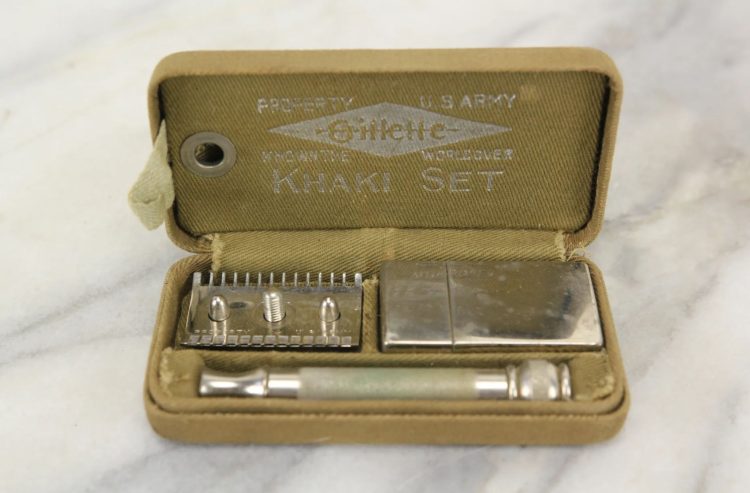
Section II: The Multi-Blade Trap — How Modern Razors Worsened Skin Health
The cartridge razor — often marketed as “advanced” — is a mechanical liability. With 2 to 5 semi-sharp blades stacked in tandem, it doesn’t shave — it tugs, tears, and traumatizes skin.
How It Works — and Why It Hurts
Cartridge razors are designed to pull the hair upward with the first blade, then slice it below the skin with the next. This creates a “close” shave — but at the cost of follicular distortion.
– The hair is cut at a sharp angle.
– It retracts into the follicle creating the sensation of closeness.
– It pierces the follicular wall.
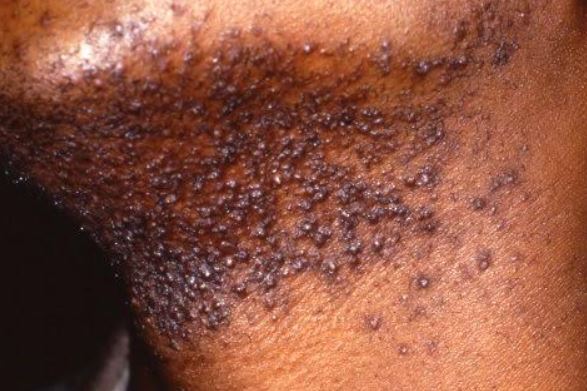
The result: pseudofolliculitis barbae (PFB) — painful ingrown hairs, cysts, inflammation, and scarring [1][2].
Less Comfortable, More Complicated
Multi-blade razors increase friction, require more pressure, and clog easily.
– The blades dull faster.
– The cartridges trap hair and skin debris.
– The shave feels “close” but often ends in irritation, razor burn, and post-shave discomfort.
– For many men shaving is a painful uncomfortable necessity.
A 2024 dermatology study using multispectral near-infrared spectroscopy found that cartridge razors caused significantly more erythema and microtrauma than single-blade safety razors — even 10 minutes post-shave [3].
The Rise in Skin Pathology
Since the widespread adoption of cartridge razors in the 1970s and 1980s, dermatologists have documented a sharp increase in shaving-related skin conditions, especially among men with curly or coarse hair [1][4].
– PFB became endemic in military and law enforcement populations.
– Shaving waivers and topical antibiotics became routine.
– The problem wasn’t the skin — it was the tool and technique.
Historical Contrast — Mid-20th Century Grooming
Look at photographs and movies of African American men from the 1940s through the 1960s — barbershop patrons, soldiers, professionals.
– Their skin is often smooth, clear, and healthy.
– Why? Because they were shaved with single-edge razors, often by trained barbers who understood technique, skin prep, and hair type [5][6].
– The With Grain Pass (WGP) was standard.
– The goal wasn’t baby-butt smooth — it was clean, healthy, and dignified.
The Cartridge Razor Isn’t Progress — It’s a Shortcut
It sacrifices technique and quality for speed– and skin health for marketing.
For men with curly hair, it’s not just ineffective — it’s destructive.
Section III: The Case for Single-Blade Shaving — Why the DE Razor Is Superior
The double-edge (DE) safety razor isn’t just a throwback — it’s a precision instrument built for controlled hair reduction, skin preservation, and operational hygiene. Unlike multi-blade cartridges, which rely on aggressive mechanics and marketing, the DE razor delivers a clean, surface-level cut with minimal trauma.
Mechanical Superiority
A DE razor uses a single, ultra-sharp blade held at a fixed angle. The geometry allows the blade to slice hair cleanly at the skin’s surface — not below it.
– No tugging.
– No distortion.
– No follicular trauma.
This is controlled Hair reduction, not forced extraction and then cutting.
Angle Discipline and Skin Tension — The Forgotten Fundamentals
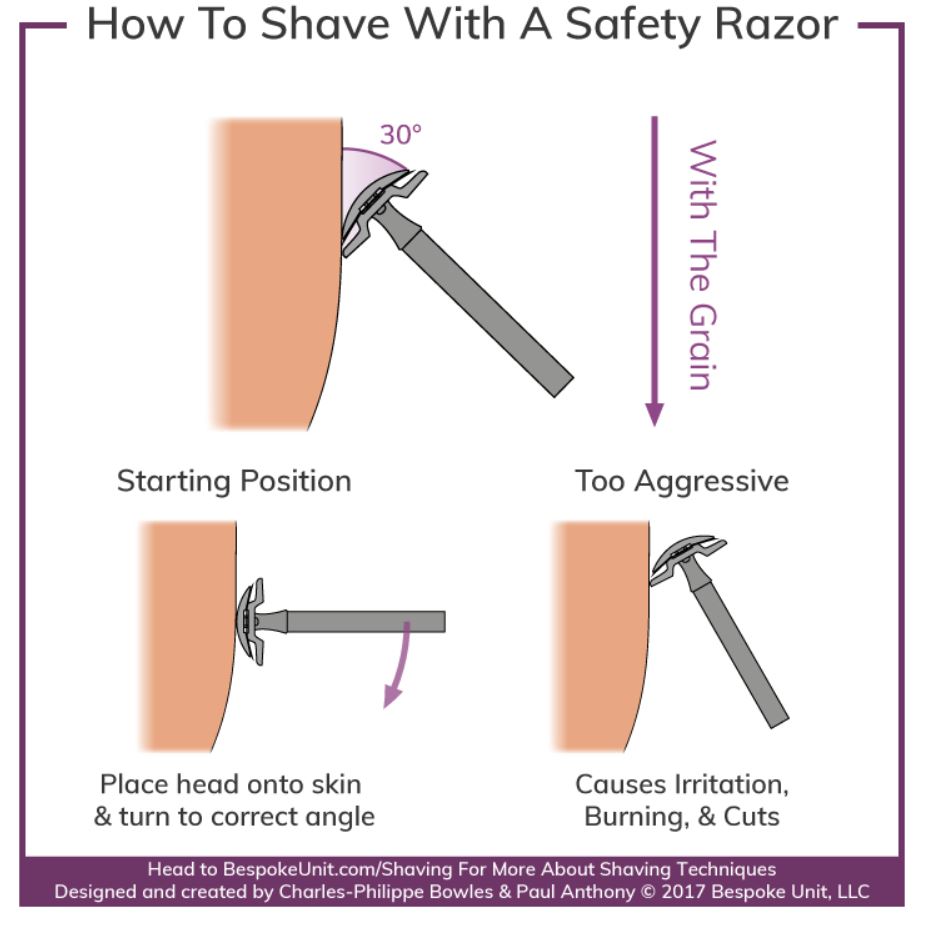
Unlike cartridge razors with pivoting heads, a DE razor demands angle discipline. The razor head and handle must be held at approximately 30 degrees off perpendicular — that is, 30 degrees off a 90-degree angle from the skin. This geometry maximizes blade engagement while minimizing drag, irritation, and trauma. Old-school barbers knew this instinctively: all razors cut best on flat, tensioned skin. Using the fingertips to gently stretch the skin raises the whiskers, flattens the surface, and allows for clean, efficient hair reduction — reducing tugging, dragging, and the risk of ingrown hairs. With a DE razor, short strokes are essential. They maintain blade control, preserve angle discipline, and reduce the risk of skipping, dragging, or overexposure. And just as important: don’t keep going over the same spot. Once the hair is reduced, repeated passes increase friction, strip the skin barrier, and lead to razor burn and irritation. This isn’t finesse — it’s technique.
Why Multi-Blade Systems Fail
Cartridge razors use multiple blades to pull, stretch, and cut the hair below the skin. This creates a “clean close” shave — but at the cost of inflammation, ingrown hairs, and pseudofolliculitis barbae (PFB), especially in men with curly hair [1].
Field Efficiency and Maintenance
DE razors are compact, durable, and field-serviceable and packable.
– No proprietary cartridges.
– They rarely clog with hair or debris because of their design.
– Blades are universal, cheap, and pack flat.
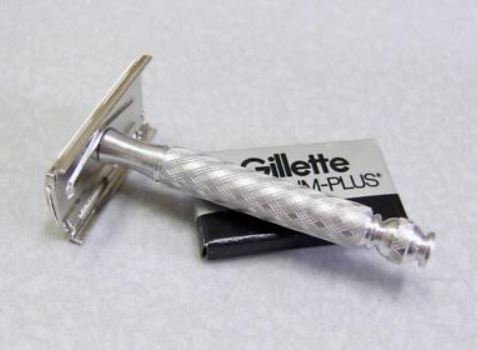
– The razor itself can last decades — many Tech models from WWII are still in use today. My personal daily razor is a 1952 Gillette Tech [10][11].
Resurgence and Relevance
The DE razor is seeing a global resurgence — not just among traditionalists, but among dermatologists, military instructors, and men seeking relief from chronic irritation and PFB.
– It’s medically sound.
– It’s operationally efficient.
– It’s doctrinally correct.
For Men with Curly Hair
The DE razor is often the difference between healthy skin and chronic inflammation. A single blade, used with proper prep and technique, prevents subdermal slicing and preserves the follicular architecture.
– One light With the Grain Pass (WGP) is often enough. You don’t need a baby-butt smooth shave.
– No pressure. No trauma. Just glide.
This isn’t nostalgia — it’s restored discipline. The DE razor belongs in every man’s kit, especially those operating in environments where skin health, mask seal integrity, and grooming standards matter.
Section IV: What Barbers Used to Teach Us
– In the early 1900s, men were often shaved by barbers who taught technique, solved problems, and recommended gear.
– Especially in Black and Latino communities, barbershops were places of shaving mentorship and skin health education [5][6].
– These barbers weren’t just stylists — they were experts in hair reduction and skin care, trained in the geometry of the blade, the physiology of the follicle, and the discipline of daily grooming.
– A single With Grain Pass (WGP) was often enough — preserving the skin and maintaining a clean professional appearance.
– Through experience they recommended a very Mild Razor and smooth blade, and not attempting to get a too close shave.
– That technique still works today — and it’s more than enough to ensure mask seal integrity or pass inspection.
Section V: Historical Doctrine — The British Army’s Shaving Response to Gas Warfare
After chemical weapons entered the battlefield in World War I, the British Army issued razors to every soldier — open or safety — and mandated clean-shaven faces to ensure gas mask seal integrity. Shaving was no longer cosmetic. It became a matter of survival.
Soldiers were trained — often by barbers — in proper technique. Grooming was ritualized: every morning after stand-to, troops were expected to shave. This wasn’t vanity. It was doctrine.
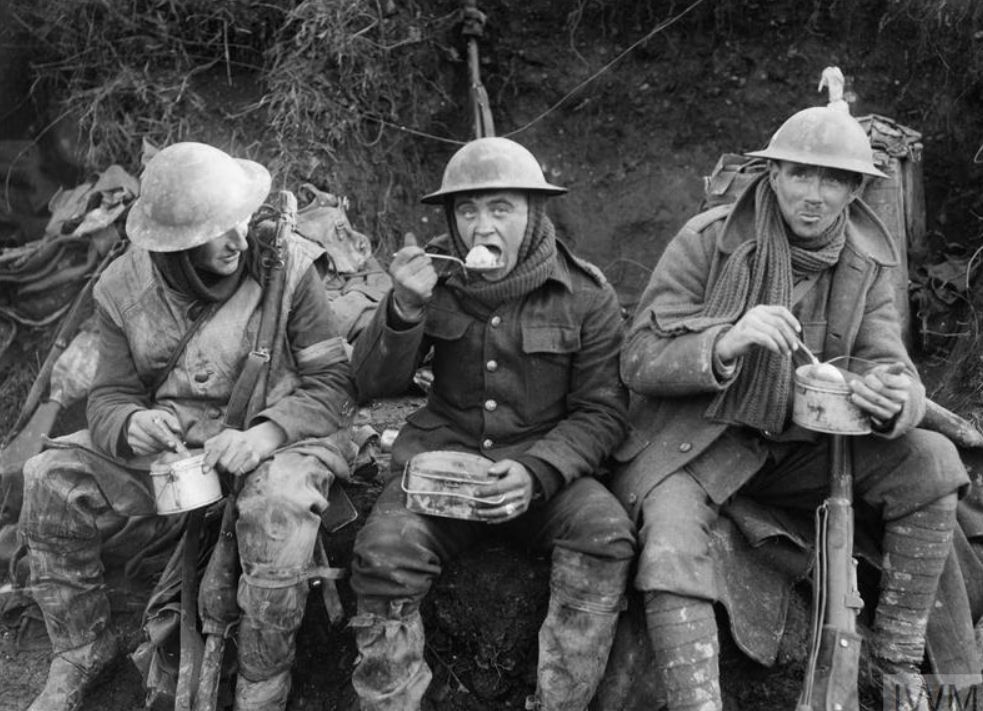
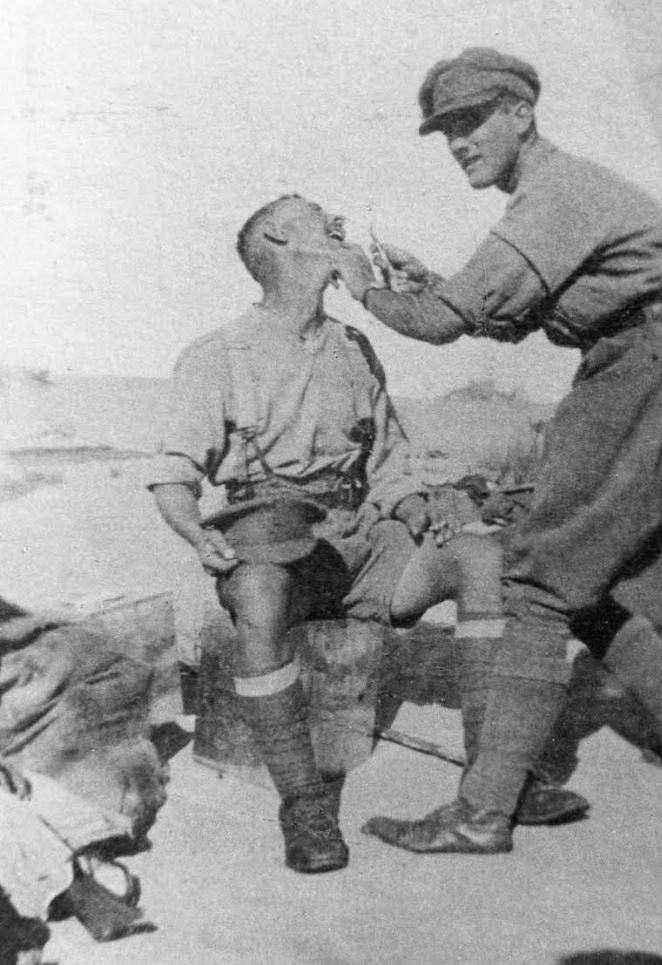
Look at photographs of trench warfare. Despite the mud, blood, and chaos, British soldiers are almost universally clean-shaven. That wasn’t coincidence— it was enforced standard. The introduction of chemical weapons triggered a cultural pivot. The British Army redefined grooming as operational hygiene, and shaving became a daily discipline tied directly to survivability, often battle buddies (Mates) shaved each other enabling better shaves in the trenches.
Section VI: Cold Water Shaving and the Military Razor
In “Good Morning, Vietnam”, the radio announcer tells troops to shave with cold water — and that wasn’t Hollywood fiction. The U.S. military found that a decent, comfortable shave could be achieved with cold water, and contracted Gillette to produce a lightweight, mild razor for Garrison and field use [7]. These military razors — weighing just 30 grams — were designed for low-irritation shaving in austere conditions [10][11]. Cold water shaving still remains a viable, medically sound option when done with proper technique and gear.
Section VII: Why I Don’t Use Canned Creams or Gels
In the field, bulk and weight are the enemies of efficiency. Canned shaving creams and gels may look convenient, but they’re:
– Bulky and fragile — pressurized cans take up space, risk damage, and don’t pack well.
– Water-hungry — they often require more water to rinse and clean up.
– Less adaptable — they don’t work well with brushes, and their lather lacks structure in cold or dry conditions to raise the hair for a clean, efficient cut.
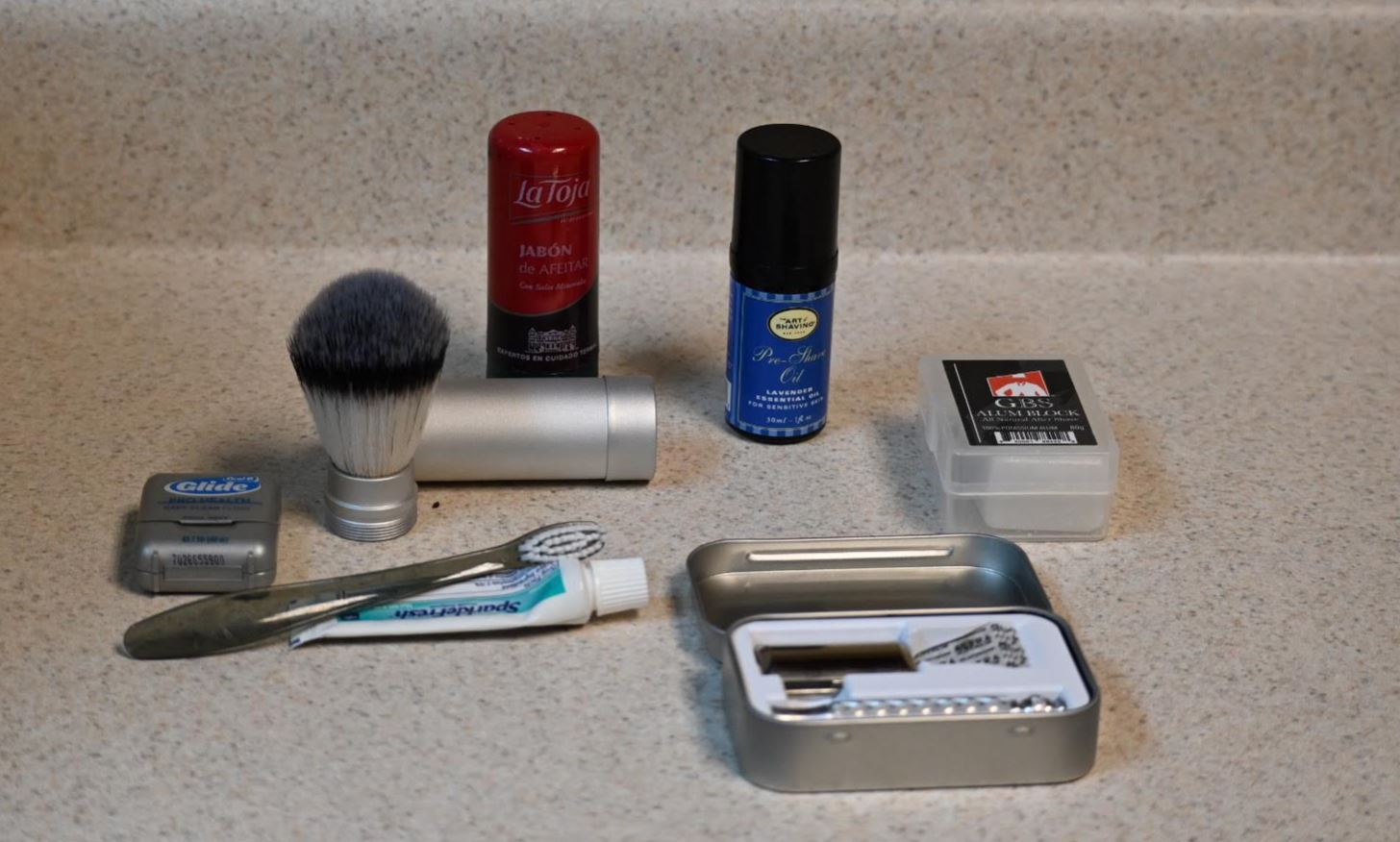
Instead, I use traditional shave soap sticks like La Toja and ARKO:
– Compact and durable — no risk of rupture, easy to pack, and lasts for months.
– Brush-compatible — rub directly on the face, then build lather with a moistened brush.
– Skin-friendly — La Toja’s mineral content soothes the skin; ARKO’s simplicity makes it ideal for austere environments.
These sticks are field-proven, medically sound, and operationally efficient. They belong in every man’s kit — especially when space, water, and skin health matter.
Pre-shave Oils — The Forgotten Layer of Protection
Before lathering, but after wetting my face, I apply a few drops of pre-shave oil — specifically a 50/50 blend of olive and castor oil. It’s not a luxury. It’s lubrication:
- Softens the beard and hydrates the skin
- Adds glide and reduces blade friction
- Preserves the skin barrier in dry or high-friction environments
- Absorbs quickly and doesn’t interfere with shave soap performance
A 10ml bottle lasts weeks and weighs less than a cartridge refill. In austere conditions, this blend is a tactical upgrade — not indulgence. It’s part of the ritual, and part of the survivability kit.
Section VIII: Brush Selection Matters
Travel brushes are available that store in their handle so they pack well.
Brushes clean and exfoliate the skin reducing incidence of Infection.
– Stiffer brushes — ideal for lifting coarse whiskers and working lather beneath them for a comfortable close shave. For men with PFB, the stiffer the better.
– Softer brushes — better for sensitive skin and luxury lather.
– Synthetic brushes (my field choice) come in both soft and stiff types, dry fast, resist mildew, and can be disinfected with a dip in 70% isopropyl alcohol or dipped in 10% bleach solution for 1 minute, or drop a water purification tablet in a canteen cup of water and allow to dissolve, dip the brush for 1 minute, then rinse well and dry — perfect for austere environments and field kits.
Section IX: Blade Selection — Test in Garrison, Pack for the Field
Not all blades are created equal — and the wrong blade can sabotage your skin, your seal, and your mission. Blade choice isn’t cosmetic. It’s operational.
Sharp vs. Smooth
– Feather: ultra-sharp, surgical precision — but harsh on sensitive skin
– Derby, Astra SP: smoother glide, gentler feel — may require more passes
– Gillette Silver Blue, Personna: balanced performance across skin types
Garrison Is Your Lab
– Test different blades in your chosen DE razor
– Track how your skin responds — irritation, glide, seal integrity
– Once dialed in, stock your field tin with your ideal combo and make it your daily razor. Master your razor like you do your weapons and equipment. Out in the field is not the place to refine your blade selection and technique.
Modern Mild Options — RazoRock Base Plates
For men seeking a contemporary razor with field-ready geometry, the RazoRock razor with a #2 base plate offers slightly milder blade exposure than the vintage Gillette Tech — ideal for daily use and mask seal integrity.
The #1 plate, even milder, is especially well-suited for men prone to PFB or with sensitive skin.
Both plates maintain angle discipline, reduce trauma, and pair well with smooth blades like Astra SP or Derby.
These aren’t luxury upgrades — they’re tactical choices for skin preservation and operational hygiene that fits in your tin.
Pack for the Mission
– Include backups for environmental shifts — dry, humid, cold
– Your blade is part of your survivability kit. Treat it like your med gear
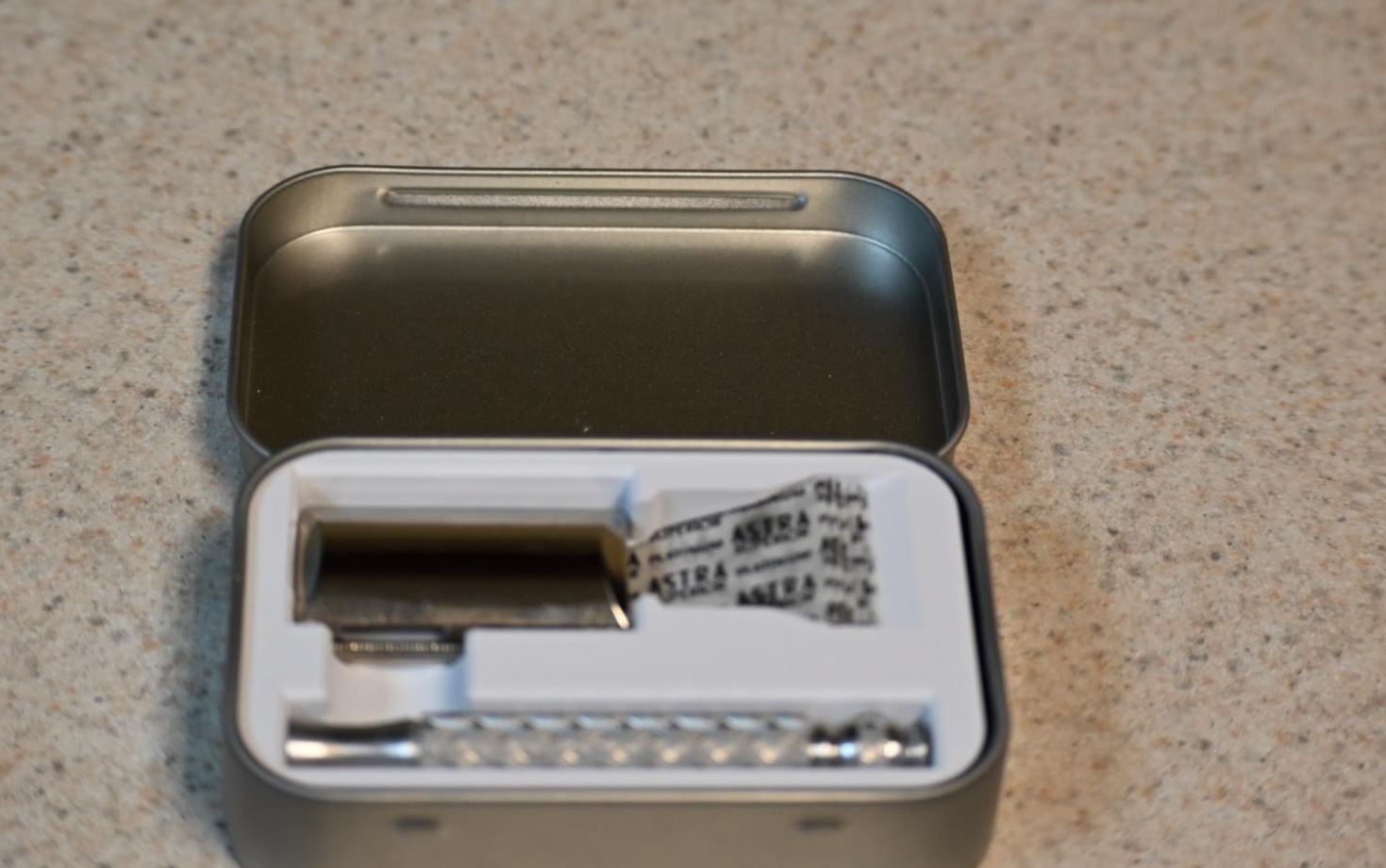
The Gillette 7 O’clock Sterling Razor — often dismissed as disposable because of its low price — becomes a doctrinal tool with one simple upgrade. Replace its plastic handle with a 76mm stainless steel or plated brass handle (available for ~$12), and you’ve recreated the geometry, balance, and blade feel of the vintage Gillette Tech that fits into an Altoid’s Tin.
- Same mild blade exposure
- Same closed comb design
- Same angle discipline
- Same PFB-safe performance
This modded Sterling is nearly identical to the Tech favored by African American barbers for decades — especially those who taught young men how to shave safely, avoid waivers, and preserve skin health in military environments. For ~$20, you’ve built a razor that teaches technique, respects the face, and fits in any field kit.
This isn’t grooming. It’s gear discipline.
Section X: Pseudofolliculitis Barbae — The Shaving Waiver Trap
If you’ve been profiled for PFB, don’t give up. The problem isn’t your skin — Often it’s your razor.
Pathophysiology
– Curly hair grows at an oblique angle
– Multi-blade razors tug the hair and slice it off below the skin level
– The sharpened tip retracts, pierces the follicular wall
– Result: inflammation, pustules, cysts — textbook PFB
Operational Consequences
– Compromised gas mask seal integrity
– Chronic irritation and scarring
– Medical disqualification or waiver status
– Reduced morale and field confidence
The Single-Blade Solution
– DE or straight razor cuts cleanly at the surface
– One light With the Grain Pass (WGP) is often enough
– Proper prep (hydration, lubrication, brush lift) prevents trauma
– Post-shave rinse and alum preserve the skin barrier
Waivers don’t solve the problem. Technique does.
Shaving correctly isn’t vanity — it’s survivability.
Most men with PFB can with time, treatment, and the right tools can reduce the severity of PFB and meet the Military standards and get a good seal on their Protective mask. But doing the same thing expecting a different result truly is insanity.
Section XI: My Field Routine — What I Actually Use
Here’s how I shave in austere conditions — pain-free, skin-safe, and seal-ready. This isn’t theory. It’s what I pack, what I teach, and what works.
- Lukewarm or cold water splash to soften the beard and wet the face
- Three drops of pre-shave oil for lubrication rubbed into the face and neck
- La Toja shave stick rubbed directly on the face
- Synthetic brush (stiff model) dipped into water to build lather and lift whiskers
- Gillette Tech razor + Astra SP blade In Altoid-size tin
- One WGP, one AGP — no pressure, just glide. Unlike cartridge razors, there’s no need to use pressure. Let the razor’s weight and blades sharpness do the work.
- Cool rinse to close the skin
- Rub the shaved face with alum. I carry a travel-size alum block in a plastic case — durable, hygienic, and field-ready. After rinsing, I rub it across the shaved area to seal micro-weepers, tighten the skin, and provide antiseptic protection. It’s fast, effective, and improves mask seal integrity by reducing surface moisture and inflammation.
- Small mirror so you can see what you’re doing.
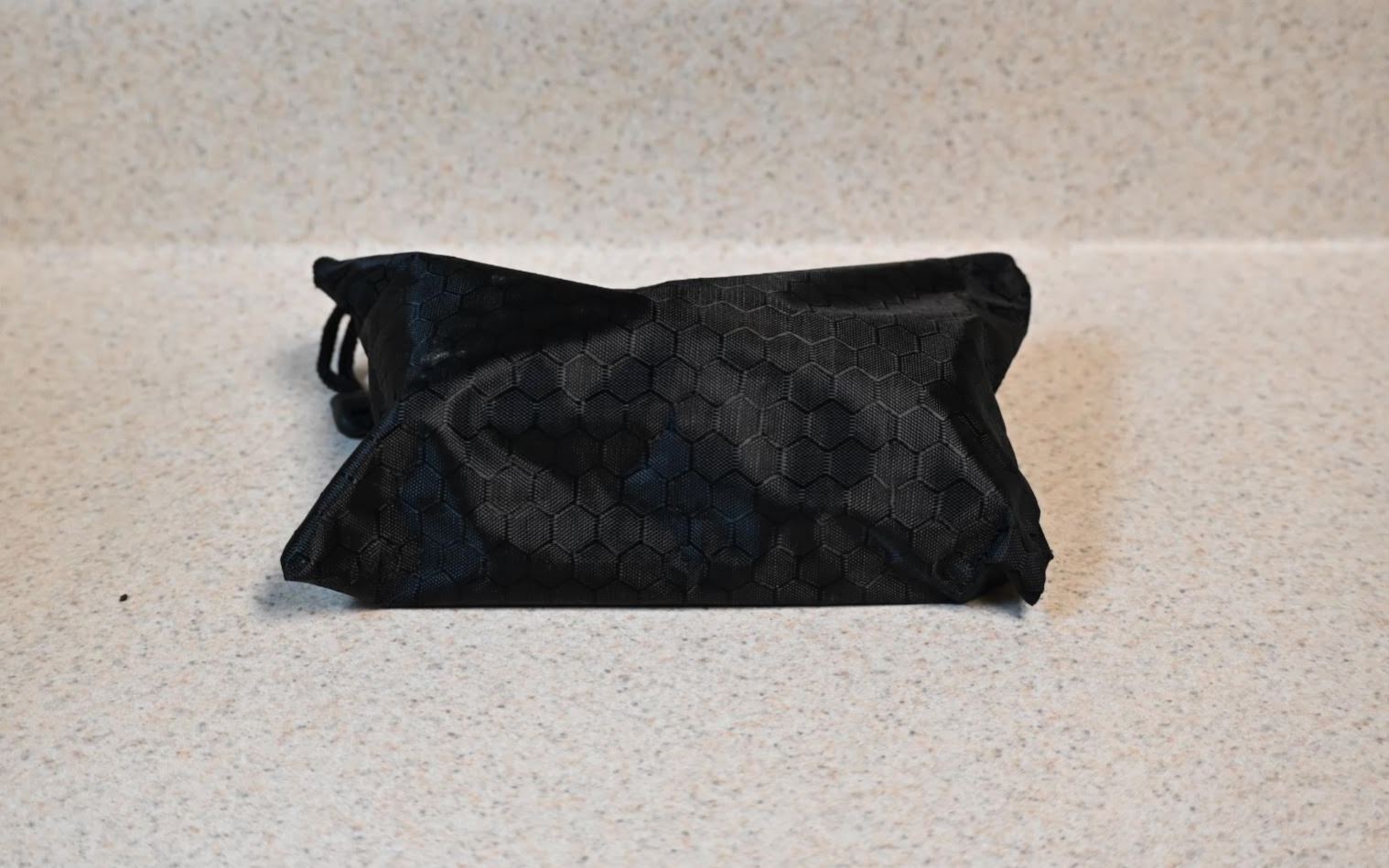
This method is simple, adaptable, and medically sound. It works in tents, trenches, and team houses — and it protects your skin, your seal, and your mindset while fitting in a small pouch probably smaller than what most are currently using now.
Conclusion: Restore the Ritual
Shaving isn’t a chore even in the field if done properly with the right kit — it’s a ritual of discipline, health, and operational clarity. Whether you’re prepping for patrol or decompressing after a mission, the right shave reinforces readiness. I’ve taught this technique to many — in garrison, in the field, and across units. It’s not theory. It’s lived doctrine. And it works.
It’s time to stop butchering faces and start teaching men how to shave — the right way.
Author’s Note: While this article focuses on technique and gear discipline, some men — especially those with severe PFB, scarring, or underlying skin conditions — may require dermatological evaluation and customized treatment. Technique matters, but tailored care does too.
—
References
[1] DermNet NZ. “Pseudofolliculitis Barbae.” https://dermnetnz.org/topics/pseudofolliculitis-barbae
[2] MDedge. “Beyond the Razor: Managing Pseudofolliculitis Barbae in Skin of Color.” https://blogs.the-hospitalist.org/content/beyond-razor-managing-pseudofolliculitis-barbae-skin-color
[3] Boodoo C, Duta D, Swift N, et al. “Multispectral Near-Infrared Spectroscopy Study Evaluating the Effect of Razor Design on Shaving-Induced Erythema.” *Skin Research and Technology*. 2024. https://doi.org/10.1111/srt.13598
[4] Derma Essentia. “Pseudofolliculitis Barbae: Causes and Management.” https://dermaessentia.com/razor-bumps/
[5] Art of Manliness Podcast #260. “Knights of the Razor: Black Barbers in Slavery and Freedom.” https://www.artofmanliness.com/style/shaving/podcast-260-knights-razor/
[6] Charleston County Public Library. “The Colonial Roots of Black Barbers and Hairdressers.” https://www.ccpl.org/charleston-time-machine/colonial-roots-black-barbers-and-hairdressers
[7] Smithsonian Magazine. “How Shaving Brushes Gave World War I Soldiers Anthrax.” May 3, 2017. https://www.smithsonianmag.com/smart-news/how-shaving-brushes-gave-world-war-i-soldiers-anthrax-180963125/
[8] Great War Forum. “Soldiers Shaving Kits.” https://www.greatwarforum.org/topic/61107-soldiers-shaving-kits/
[9] Centers for Disease Control and Prevention. “Anthrax Cases Linked to Shaving Brushes During WWI.” Cited in Smithsonian Magazine, 2017.
[10] Badger & Blade. “Tech.” Gillette Tech Razor History and Variants. https://www.badgerandblade.com/forum/wiki/Tech
[11] The Shave Den. “The Almost Sort of Comprehensive Guide to the Gillette Tech.” https://theshaveden.com/forums/threads/the-almost-sort-of-comprehensive-guide-to-the-gillette-tech.60189/
Author Bio
Hansel Rayner, PA-C, FASEPA, is a Endocrine medical provider, educator, and field survivability specialist with firsthand experience in chemical agent disposal and operational medicine. A graduate of the School of Aerospace Medicine at Fort Rucker, Alabama, he brings doctrinal clarity to operational hygiene and field grooming standards. Founder of Central Georgia Adrenal and Reproductive Endocrinology, he has taught shaving technique and skin health to troops, medics, and instructors across garrison and field environments. A published authority in wound ballistics and PPE doctrine, he currently serves on the SOFREP medical advisory board and continues to restore lost grooming standards through practical mentorship and doctrinal writing. Learn more at www.adrenalandendoga.com
Consulting & Mentorship
If you’re a unit leader, medic, or instructor looking to improve field grooming standards, reduce PFB risk, or build a survivability-focused shaving SOP — I offer direct consultation.
Reach out via www.adrenalandendoga.com or email me at [email protected] to discuss training briefs, gear selection, or doctrinal integration.








COMMENTS