


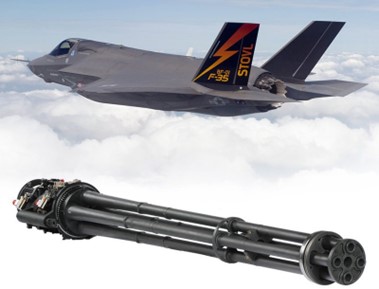
The GAU-22 fires the same very-powerful, high-velocity, 25mm ammunition, with a firing rate of 3,300 rounds per minute (55 rounds per second), and is approximately 20 percent more accurate than the GAU-12/U /U, hitting within a 15-foot circle at 1,000 yards, and with a maximum range of 2.27 miles. The weapon is mounted inside the left side of the fuselage, above the left air intake duct, and supplied with 180 rounds of ammunition, allowing for just 3.27 seconds of firing time. The weapon is typically fired in measured bursts of either 30, 60, or 80 rounds.
The F-35A Lightning II stealth fighter itself is an amazing, single-seat, single-engine, fifth-generation, multirole, combat aircraft, delivered to the air forces and/or navies of Australia, Belgium, Canada, Denmark, Finland, Germany, Greece, Israel, Italy, Japan, the Netherlands, Norway, Poland, South Korea, Singapore, Switzerland, and the United Kingdom. It’s powered by a Pratt and Whitney F135-PW-100 low-bypass, turbofan engine rated at 43,000 pounds of thrust with afterburning. The asymmetric, exhaust nozzle consists of 15 partially-overlapping flaps that create a sawtooth pattern at the trailing edge, which reduces radar signature, and creates vortices that reduce the infrared signature of the exhaust plume.
This raw power output allows for a top speed of Mach 1.6 with a full, internal payload at high altitude, or approximately Mach 1.0 at sea level. The F-35A has a combat radius of 770 miles on internal fuel only, with a 1,380-mile range, a maximum flight ceiling of 50,000 feet, and a structural g-limit of 9 gs. During flight testing, the stealthy aircraft scored a kill ratio of 15-to-one against an F-16CM aggressor squadron in a high-threat environment. The radar cross-section of the Lightning II has been described as lower than a metal golf ball at certain frequencies and angles.
The very stealthy F-35 is equipped with an APG-85 active, electronically-scanned array (AESA) radar with passive and active modes for either air-to-air combat or ground-attack missions, simultaneously tracking multiple targets as far away as 92 miles. This is supported by an AAQ-40 EOTS (Electro-Optical Tracking System), essentially a long-range, FLIR sensor for passive, thermal tracking of targets. The aircraft is equipped with fly-by-wire flight controls, a side-stick controller, like the F-16’s, a hands-on-throttle-and-stick (HOTAS) system, and a Martin-Baker US16E ejection seat.
Unfortunately, there is no indication yet that the F-35A is supplied with the new (since 2019), GAU-5A Aircrew Self-Defense Weapon (ASDW), based upon the M4 carbine platform, for downed pilots. The take-down GAU-5A, with a 12.5-inch barrel, was specifically designed to fit inside the standard, U.S. Air Force, ACES II ejection seat, but the F-35’s British-designed, Martin-Baker seat does not share the same dimensions.
In any event, American fighter pilots will still wear a new SIG M18 pistol on their survival vests in combat situations for self-defense on the ground, whereas Belgian fighter pilots will wear the FN Five-seveN MK2 in 5.7x28mm NATO chambering. Interestingly enough, Royal Netherlands Air Force (Belgium’s next-door neighbor to the north) F-16AM Fighting Falcon fighter pilots are issued the ultra-compact, folding-stock, B&T (Swiss) MP9N submachine gun in 9x19mm inside their seat survival kits since 2015. Whether these weapons will also be used in Dutch or Belgian F-35s remains to be seen.
The F-35A Lightning is defended by the ASQ-239 Barracuda electronic-warfare system, for detecting hostile radars with a radar-warning receiver (RWR), tracking those same threat aircraft, and jamming their radars. In addition, the F-35 pilot wears a $400,000, carbon-fiber, Collins Aerospace Gen. 3 helmet-mounted display system (HMDS), which interfaces with other aircraft systems to provide flight and combat information on the pilot’s visor, including infrared and night-vision imagery that allows the pilot to “see through” the aircraft body via a network of tiny cameras. This sophisticated, helmet system permits the pilot to simply turn his head in order to launch missiles off-boresight at hostile aircraft far off the fighter’s nose.
There is also an AAQ-37 Distributed Aperture System (DAS), consisting of six infrared sensors to provide all-aspect, missile-launch warning and target tracking, giving the pilot spherical, infrared and night-vision imagery on his helmet visor. An ASQ-242 Communications, Navigation, and Identification (CNI) suite employs a half-dozen physical links to provide sensor fusion, radio-frequency information, and infrared-sensor data to form a single, tactical picture for the pilot. And the cockpit features an Adacel speech-recognition system to respond to voice commands by the pilot.
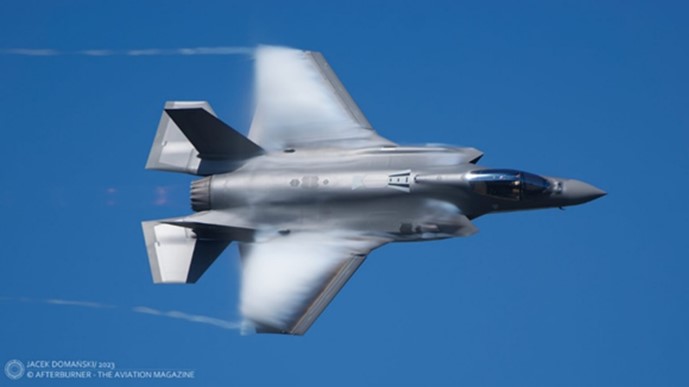
There are currently, as of late-October 2025, at least 195 F-35A stealth fighters within Western Europe, primarily in Belgium, Denmark, Finland, Germany, Greece, Italy, the Netherlands, Norway, Poland, and the United Kingdom, with many fully operational, plus 52 U.S. Air Force F-35As stationed at RAF Lakenheath, England, and that number is expected to rise to at least 600, possibly as high as 700, by 2035, with a growing sense of urgency, driven largely by Russia’s ongoing aggression in Ukraine, and their belligerent, military posturing against several NATO nations.
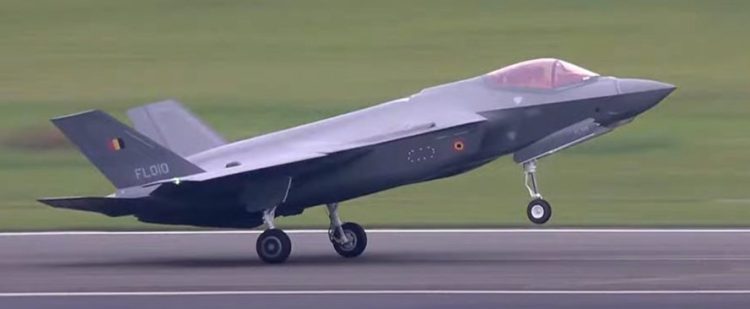
Belgian Defense Minister Ludivine Dedonder stated on October 13, 2025, that, “Today’s arrival of the F-35 marks a decisive leap forward for Belgium’s defense and technological ambitions. This milestone ensures that our air force remains ready to protect Belgian and European airspace for decades to come.”








COMMENTS