

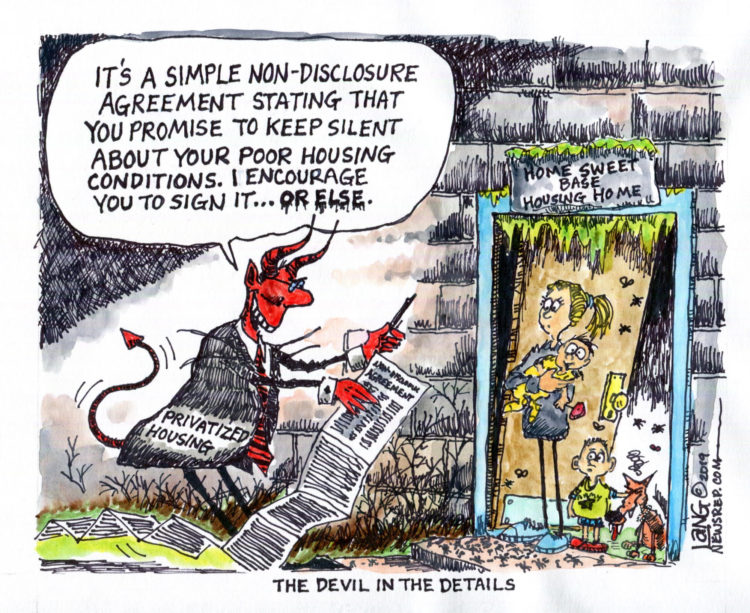
One Marine family, Matt and Sharon Limon, lived in on-base housing owned by the Lincoln Military Housing (LMH) company when they were literally pushed out by a mice infestation. The mice were so bad, “feces and urine” covered the floor. Although LMH sent pest control to lay traps, the mice soon returned after a water leak. The Limons had no choice but to take out a loan to find off-post housing—and LMH sent the family a bill for some of the damages that resulted from the mice.
“The two-year-old, he doesn’t say very many words, but ‘mouse poop’ is one of them,” said Sharon Limon, while speaking to Reuters. “I would pick him up out of bed in the morning and he’d have mouse poop stuck to his leg.”
Unfortunately, such conditions are common. Tuttle estimates about one in seven on-base housing units are unsafe. Although local and state laws shield civilians from slumlords, military personnel aren’t afforded the same protections. In many cases, the only option service members have to escape dangerous living conditions is to pay out-of-pocket for an off-base house or apartment.
The families have a choice,” said Jarl Bliss, Lincoln Military Housing’s president. “They don’t have to live with us.”
Firms such as Corvias and LMH have massive DOD contracts. In total, the DOD paid $4 billion a year for housing services. According to Reuters, LMH owns approximately 36,000 on-base housing units. Clearly, the military isn’t getting what it paid for, and that amount of money is certainly no excuse for substandard housing conditions.
Despite the widespread occurrences of housing-related health issues which affect service members and their families, little is published by Army Medical Command regarding this issue. One report from Army Military Command (MEDCOM) dated 2016 touted MEDCOM’s response to mold growth inside DOD-owned structures at Fort Knox. According to the report, MEDCOM takes mold growth seriously and conducted “60 mold evaluations” on different on-base structures, and brought in dozens of civilian contractors to remove the fungus.
“We’ve had up to 40 contractors at one time working mold remediation issues for us,” said Pat Walsh, director of public works at Fort Knox. “The reason for that large number of people is we treat every mold call as a life, health, and safety issue. It may or may not be, but we treat it that way. We respond to multiple calls and we have to bring more contract personnel to address the issue.”
These measures were implemented in DOD-owned buildings, but for the private off-base housing units owned by companies like Corvias and LMH, there’s little the DOD can do. There’s an Army office of people who are supposed to act as liaisons between the DOD and the housing companies, but many service members are unaware these people exist, or where to find them.
The organization, Residential Communities Initiative (RCI), covers “98 percent” of the “Army’s family housing inventory,” inside the United States. The RCI website boasts an online photo gallery of pristine houses available to Soldiers and their families. However, photos posted to social media platforms like twitter tell a different tale.
@JackMurphyRGR We are leading the grassroots effort for safe housing for military families! #Corvias #LincolnMilitaryHousing #BalfourBeaty #Hunt #Clark pic.twitter.com/bMaPEn35TY
— Crystal (@ccornwall) December 31, 2018
https://platform.twitter.com/widgets.js
@kathyprojo We are leading the grassroots effort to expose the “Picernes” of military housing! #LincolnMilitaryHousing #Hunt #Clark #BalfourBeaty #AllGarbage #StopPoisoningMilitaryFamilies pic.twitter.com/y8LjHoiTTl
— Crystal (@ccornwall) December 31, 2018
https://platform.twitter.com/widgets.js
7 fans, 1 window AC @ 8 PM #hotashell #needAC #admiralhartmanhousing #LincolnMilitaryHousing @LincolnMilitary pic.twitter.com/oNDUUs4Kpc
— Natalie Morrow (@NatalieMorrow1) September 15, 2014
https://platform.twitter.com/widgets.js
Live in #basehousing? Ever have problems with your energy bill? @KristineSpeaks https://t.co/HnVJXssbZV
— Jamie (@JamieLBPhD) October 3, 2017
https://platform.twitter.com/widgets.js
MEDCOM’s lack of response is surprising given its mission statement: “Army Medicine provides sustained health services and research in support of the Total Force to enable readiness and conserve the fighting strength while caring for our Soldiers for Life and Families.” However, with service members reporting serious health issues such as asthma and other respiratory ailments, it’s clear that with regard to decrepit housing, MEDCOM is failing to live up to its mission.
However, whatever actions happen in the future to ensure off-base housing units are safe for several military families who have been victimized by these private corporations, it’s too little too late.
“I might have to explain to my son that he can’t become a third generation Green Beret because of the medical issues he developed as a result of these living conditions,” said Tuttle.








COMMENTS