

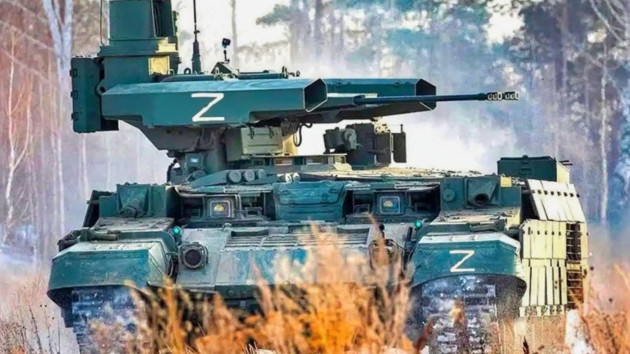
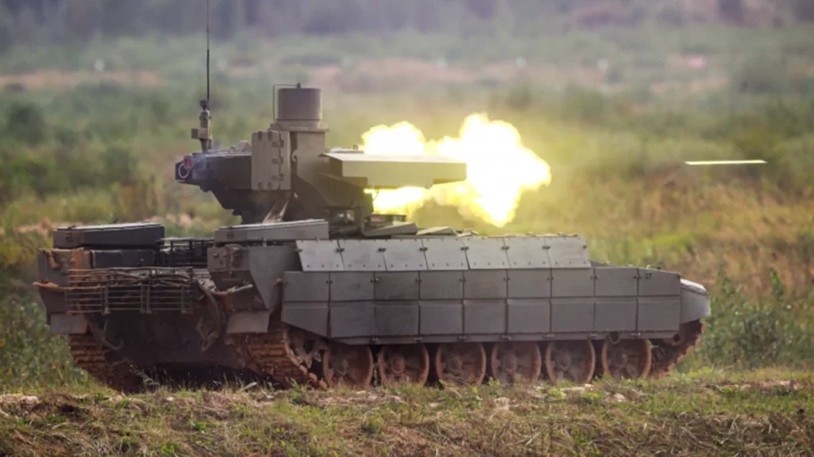
Normally, the Terminator carries two upgraded, 9M120M Atakas with 16-pound, tandem warheads to defeat armored vehicles equipped with composite armor or explosive-reactive armor (ERA), and two 9M120F variants with 21-pound, thermobaric (fuel-air explosive) warheads for anti-personnel use, as well as for engaging buildings and bunkers. There is also a 9M220O (the letter “O”, not zero) variant with an expanding-rod warhead and proximity fuze, for use against helicopters. When enemy attack helicopters are anticipated, at least one or two of the standard missiles will be replaced with the antiaircraft version.
In addition, the BMPT is armed with two AGS-17D Plamya (“Flame”) 30x29mm automatic grenade launchers, fired from two separate, 300-round, linked belts at a rate of 400 rpm. VOG-17M and VOG-30D ammunition is employed, with both types being high-explosive, blast-fragmentation designs, specifically to counter Chinese-style, “human-wave” assaults. These two side-mounted weapons, however, necessitate the addition of two extra crew members, one to fire each grenade launcher, thereby increasing the vehicle crew size from three (commander, driver, and gunner) two five, adding two grenade gunners. The grenade launchers have an effective range of just over one mile, and each grenade has a kill radius of 25 feet.
Within the tight confines of the Terminator hull, the crew wears camouflaged, 6B15 “Cowboy” uniforms (normally the standard, Tetris, or “Digital Flora” pattern), Ratnik (“Warrior”) 6B47 ballistic helmets, and is usually armed with folding-stock, assault rifles for their own survival, particularly the combat-proven, Kalashnikov AK-74M, the preferred, ultra-compact, AKS-74U, or the new AK-12M1 rifle, since 2022.
The basic, BMPT vehicle hull itself is a 47-ton, T-72BM3 tank chassis, with a combination of composite armor, reactive armor, and ordinary, steel plates, powered by a new, 12-cylinder, multi-fuel, Kharkiv V-92S2 turbo-diesel engine with 1,000 horsepower, and a seven-speed, manual transmission, capable of speeds up to 37 mph, with an operational range of 340 miles.
The Terminator’s fire-control system consists of the commander’s stabilized, B07-K1 panoramic sight atop the vehicle, with a 360-degree field of view, equipped with electro-optical, low-light TV, and laser-range-finding channels. The B07-K2 gunner’s sight has optical, infrared/thermal, missile-guidance, and laser capabilities, connected to a computerized, ballistic, fire-control system for engaging targets in the daytime or at night, and shooting on the move. The gunner may also use the commander’s sight if his own unit is disabled or destroyed, and the commander may likewise be able to override the gunner and take control of the cannon and missiles, if necessary, if the gunner is killed or injured.
By constantly scanning for targets for the gunner, the commander provides a hunter-killer capability, even against aerial targets, with target-detection capability out as far as 4.4 miles, even in poor weather conditions. There is also a GPS/GLONASS precision-navigation system, and a total of six automatic, smoke-grenade launchers on both sides of the vehicle for protection against infrared weapons, and for providing a smoke-screen camouflage in battle. An automatic, fire-fighting system also protects the crew from any internal fires.
The BMPT Terminator’s doctrine of operations is essentially to protect main battle tanks in difficult (urban or mountainous) terrain. In cities, each tank has two BMPT bodyguards, and elsewhere, the ratio is reversed, with one BMPT protecting each pair of tanks. The fearsome Terminator is fully capable of engaging multiple targets simultaneously, at different height levels, with powerful, overwhelming firepower. This increases the combat effectiveness of tank units by allowing the tanks to concentrate on their primary targets, while the BMPTs handle all anti-tank threats.
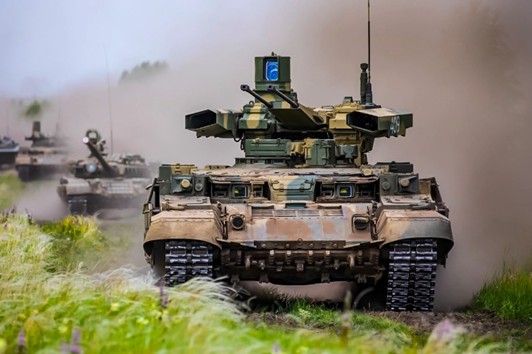
The Russian Army began their evaluation of the BMPT in small numbers in 2005, purchasing only 10 vehicles initially, and there were indications at the time that several Terminators were combat-tested three years later in South Ossetia and Georgia, probably with the 693rd Motorized Rifle Regiment of the 58th Army. The street fighting in the Battle of Tskhinvali, South Ossetia, in August 2008, was particularly intense.
In any event, the use of tank-protection vehicles was still a radical, new concept, difficult for conventional, armor officers to absorb, and the BMPT project was abruptly cancelled in 2010. The Russians reportedly wanted a more-modern, military force, not relying on old, Soviet-era equipment such as the outdated, T-72 chassis.
The armed forces of the Republic of Kazakhstan, however, ordered 10 Terminators in 2010, and 30 more in 2012, with 10 delivered so far. Azerbaijan expressed some interest in 2014, but made no orders. Then, in April 2016, the Algerian Army concluded an order agreement for 300 downgraded, BMPT-62 (not -72) Terminators, of which only 13 were received by the end of 2023. with only a single, 30mm cannon in a BMP-2 turret.
The Russian Ground Forces finally placed an official order in August 2017, but only for 10 Terminators, which entered service in from 2018 to 2021, with the 90th Guards Tank Division of the Central Military District. This is the largest, military district in the Russian Federation, just north of Kazakhstan and Mongolia.
In September 2013, the new, BMPT-72 “Terminator-2” was introduced, also built upon a T-72 tank hull, but it’s a retrofit package only, initially designed for the export market, but adapted for the Russian military in limited numbers. Basically, a new, Terminator turret can be mounted on almost any existing, T-72 MBT chassis at a minimal cost, to upgrade a nation’s armor capabilities.
The overall package is four tons lighter, being slightly shorter and thinner than an original BMPT, and the grenade launchers are removed, allowing the crew to revert to just three men again. The Ataka missiles are now protected with armor shielding to defend against shrapnel and small-arms fire, and there is extra, slat armor to safeguard the rear and sides of the vehicles against rocket-propelled grenades. The Terminator-2 also has an improved, fire-control system, an R-168-25UE-2 radio, and a laser detection system to counter enemy laser rangefinders and target designators.
There are media photographs showing that at least one BMPT-72 in desert-tan paint and camouflage netting was demonstrated and combat-tested in Syria in mid-2017, and possibly later in Iraq. Although produced in very limited numbers, the heavily-armed, BMPT-72 Terminator-2 series is bold, aggressive, intimidating, and absolutely ferocious in battle, with no direct counterparts among Western armies.
When the ongoing, Russia-Ukraine War began in February 2022, Russia had built 33 BMPT-72 Terminators, and at least 10 were deployed to eastern Ukraine on May 18, 2022, first observed in the Battle of Sieverodonetsk (May 6th to June 25th, 2022.) They were also used in combat in February 2023, during the hostilities near Kreminna (just north of the battle-ravaged, Serebriansky Forest), and near Avdiivka, in the Donetsk region. Apparently, 24 Russian Terminators have seen action in Ukraine over the past four years, and at least three have been lost in combat, including two in 2023 and one in 2024.
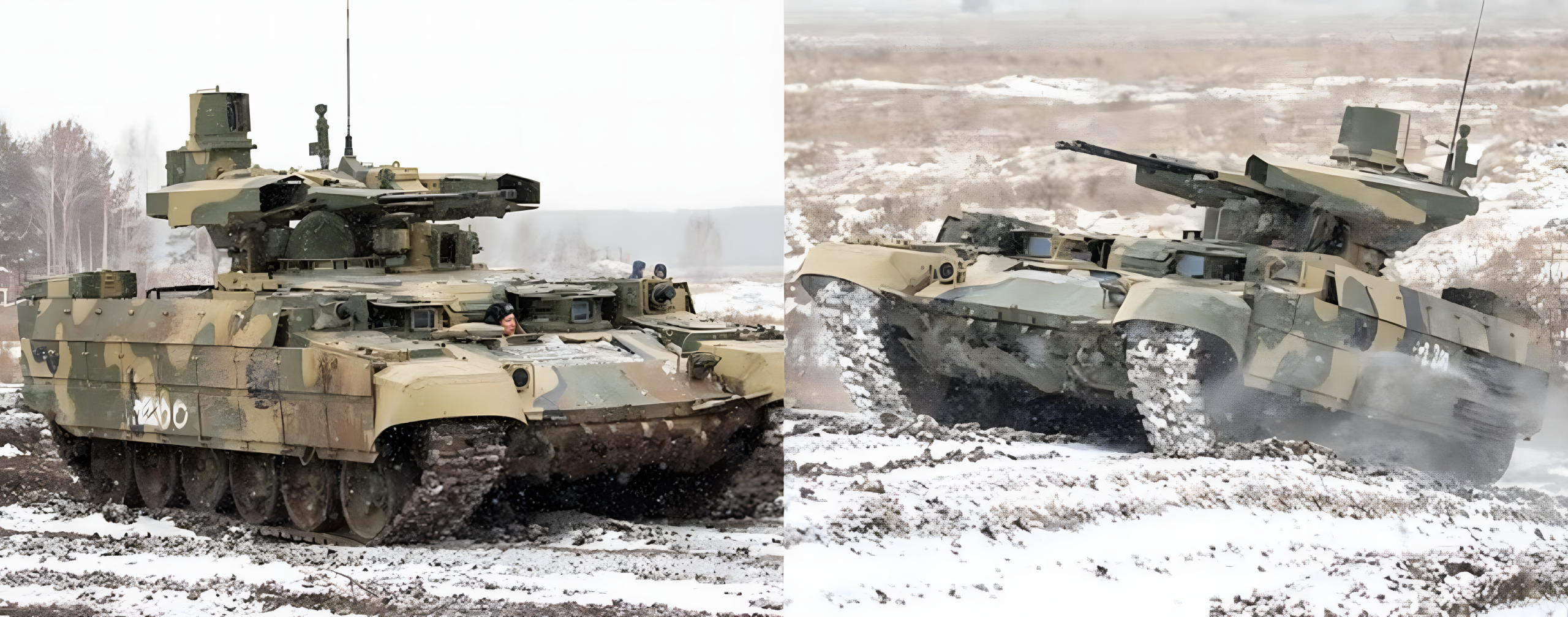
On February 9, 2023, the Ukrainian Marine Corps’ 140th Separate Reconnaissance Battalion assisted in destroying a BMPT-72, by providing the coordinates to artillery units. Their Facebook announcement stated, “So, we see that this allegedly ‘invincible’ and ‘unique’ combat vehicle burns just as well as the rest of Russian scrap metal…Hasta la vista, baby!” Thus, at least one Terminator won’t be back.
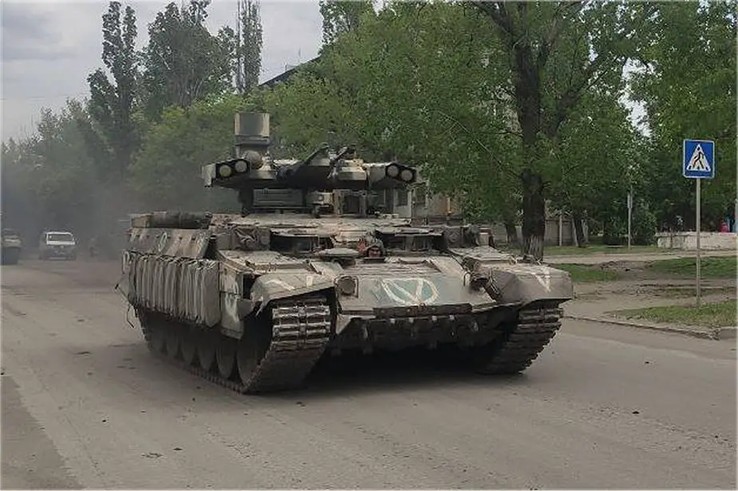
A recent, promotional video by the Russian Defense Ministry showed the BMPT-72’s twin, 30mm cannon vibrating significantly during firing, weaving from left to right, and raising serious questions about its accuracy and stability. It’s also vulnerable to attack from above by kamikaze drones or artillery fire, with thin armor on the roof.
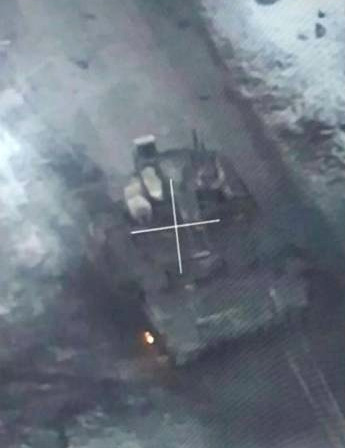
Journalist Brent M. Eastwood wrote for 19fortyfive.com on December 18, 2025, that “Russia’s BMPT Terminator Army ‘Tank’ Is Rolling To An Early Grave…The Terminator has been a bust, and it is another example of how the Russian Army has failed to bring modern weapon systems to the battlefield in a way that could turn the tide of the war.”
In conclusion, the Russian BMPT-72 Terminator-2 may be heavily-armed, fierce, versatile, and intimidating, but in battle, it exhibits shoddy construction, vibrating cannon, and has seen action in very limited numbers, indictive of more of an experimental status than as a primary, combat vehicle. Specifically designed for close-range, urban battle in a Chechnya scenario, it’s struggling with the open fields, the bogged-down, trench warfare, and radical, new, drone attacks in Ukraine, and not living up to its lofty promise as a valiant defender of Russian tanks.








COMMENTS