

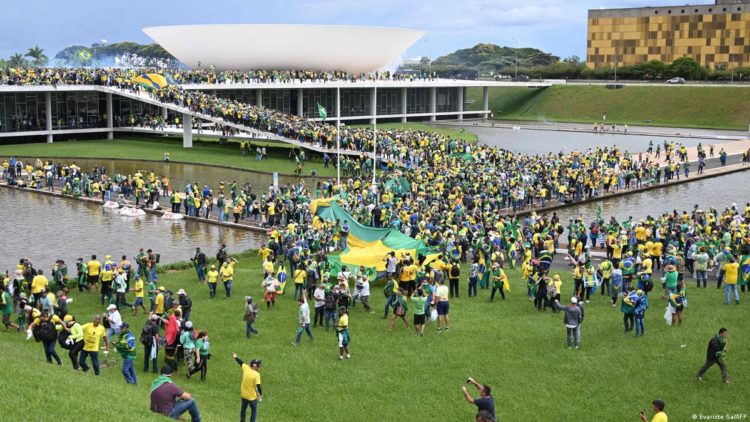
Their hope is that senior members of the military – many of whom have expressed support for Bolsonaro and sympathy for the protest camps that have been set up near army bases – would support the push to oust Lula.
Brazil has a long history of the armed forces not accepting civilian rule. The last military coup was in 1964. Of course, circumstances are different now from then – when in the heat of the Cold War, the coup was supported by outside governments, including the U.S.
Bolsonaro cultivated close ties to the Brazilian military by moving key military people into positions in government. Right-wing generals friendly with Bolsonaro became ministers of defense, chief of state and even the minister of health at the height of the COVID-19 crisis. Moreover, it is estimated about 6,000 active military personnel were given jobs in nonmilitary positions in government in the last eight years.
Bolsonaro supporters cheering the arrival of the military right before getting arrested by them pic.twitter.com/m49JZvqcSV
— Populism Updates (@PopulismUpdates) January 9, 2023
Some generals in both the Navy and the Air Force especially have been supporting the protests. Since the election, you have had generals proclaim that demonstrations demanding military intervention were legitimate.
I think it is fair to say that segments of Brazil’s military were encouraging what happened.
But when it came down to it, the armed forces were quiet. The military may have nurtured the protest, but when it came to the idea of a traditional coup – tanks on the streets stuff – that just didn’t happen.
So would you characterize this as an attempted coup?
That is a central question. As events unfurled on Jan. 8, it looked more like a protest that got violent and out of hand – the level of destruction inside some of the buildings attests to that.
But it was weeks in the making and well financed, in that hundreds of buses were paid for to get Bolsonaro supporters to the capital. And the expressed aim of many protesters was military intervention. So in that sense, I would say it more akin to an attempted coup.
What does the attack tell us about democracy in Brazil?
Brazil has been at a crossroads. The Bolsonaro presidency saw the country backslide on democracy, as trust in institutions eroded under attack from the president himself and through corruptions scandals. And close to half of the country voted for him despite his record of undermining democracy. But the election of Lula seems to indicate that even more want to rebuild democratic institutions in the country after four years of attack from Bolsonaro.
So this could be a turning point. The media in Brazil has come out strongly in denouncing the actions of demonstrators. In the coming days and weeks, there will be investigations into what happened, and hopefully some degree of accountability. What will be key is Lula’s ability to address the anti-democractic elements of the military.
Are comparisons to the Jan. 6 attack on the U.S. Capitol valid?
Trumpism and Bolsonarismo share a narrative of stolen elections, with supporters drawn from the right who support issues such as gun rights and traditional family structures.
An important difference is the role of the military. Although former military personnel were at the Jan. 6 attack in D.C., top U.S. military figures condemned it. Nor was the aim in the U.S. to see military intervention, unlike the Jan. 8, 2023, attack in Brasilia.
But there are clear parallels – in both we saw extreme right-wing, powerful groups and individuals refusing to accept the direction of a country and trying to storm institutions of power.
Now I’m wondering if there will also be parallels in what happens after the attack.
In the U.S., authorities have done a good job punishing a lot of people involved. I’m not sure we will see the same in Brazil, as they might need to confront powerful groups within the military and police forces around the country. So, democratic actors within and outside of the county will be essential in supporting the task of defending democracy in Brazil.
***
This piece is written by Rafael R. Ioris, Professor of Modern Latin America History from the University of Denver. Want to feature your story? Send your draft here today.








COMMENTS