

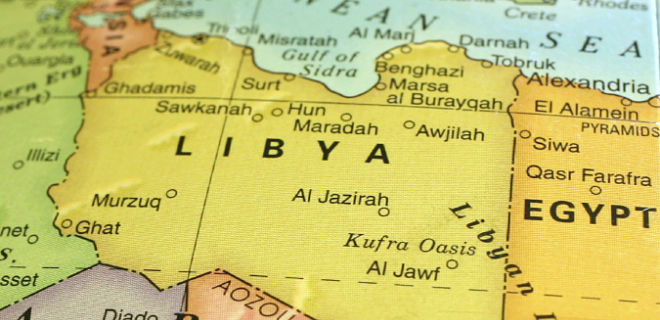
During his tenor as Deputy Chief of Mission to Libya, Stevens visited the north-eastern coast of Libya – a region known as a hotbed of Islamic extremism and for supplying Iraq with foreign fighters, including suicide bombers, who targeted American soldiers. The largest city on the north-eastern coast, Benghazi, a city of 600,000, and its smaller neighbor to the east, Derna, were the two leading exporters of Libyan jihadist warriors to global battlefields. (This author can attest to this personally, as he was in Mosul, Iraq in 2005 with 3rd Ranger Battalion and participated in missions which killed or captured Libyan foreign fighters.)
A large contingent of the citizens of Benghazi and Derna were proud of their sons for conducting suicide attacks in Iraq against the American soldiers there. Forming the eastern edge of the infamous Barbary Coast, these cities have a historical predilection towards resisting any and all forms of occupation going back to their resistance against the Ottomans and the Italian colonists in years past. This also translated into a resistance to the Gaddafi regime, which the Libyan Islamists saw as being allied with the American occupiers in Iraq. Post 9/11, Gaddafi had begun cooperating with the U.S. on the War on Terror, even allowing Libya to become a center in the CIA’s rendition flight network for detained suspected terrorists held by American operatives.
In the 1980’s the Libyan Islamists were similarly opposed to the Russian occupation of Afghanistan, Stevens writes in one cable. Residents of Benghazi and Derna traveled to Afghanistan at that time to fight against the Soviets, and when they returned home they brought with them some of the most radical and extreme religious ideas such as Wahhabi Islam originally from Saudi Arabia.
These ideas found a home in a place like Benghazi, particularly in the mosques spread throughout the area. These are closed, tightly bound communities, wary of outsiders. Those suspected of ratting them out to security forces were quickly ostracized, making it particularly difficult for Gaddafi’s security services to monitor what the Imam’s were preaching.
Other factors that contributed to northeastern Libya as a center for Islamic extremism include poverty and a perception that Gaddafi was deliberately keeping Eastern Libya as poor by not investing in jobs and infrastructure projects so that the people of Benghazi would be unable to project political power in Tripoli or against Gaddafi in anyway. With few economic and educational opportunities, young men were not able to marry until later in life (early to mid-30’s) and many felt that they had nothing to lose by striking out at Americans in Iraq as the only avenue to imbue their lives with meaning. The families of these martyrs were incentivized by payments from radical mosques, but the payments were no more than 150-200 Libyan dinars which is approximately half of what their sons could have been making by working a typical government job.
In one cable Stevens references documents seized on Objective Massey on the Iraq-Syria border in 2007 which pointed to Derna as the second largest pool of foreign fighters flowing into Iraq. This operation was conducted by 3rd Ranger Battalion of the 75th Ranger Regiment who hit Objective Massey in 2007. The Rangers were on standby for Time Sensitive Target (TST) missions in Mosul, Iraq when they got the call that they were to intercept a High Value Target at a small compound near the city of Sinjar where a group of terrorists were having a meeting. Donning their kit and loading rifles, they headed to the airfield to fly out to the objective.
When the Rangers hit the ground in Black Hawk helicopters they immediately came under fire from an enemy ambush. Maneuvering on the terrorists with an AC-130 gunship providing fire support, the Rangers killed two Saudi foreign fighters. Some of the Rangers cleared the trench line where the terrorists had been firing from while the others chased down several who were trying to escape.
With the objective secure, the Rangers then began conducting Sensitive Site Exploitation, or SSE, a method of evidence collection which would hopefully led them to other targets. SSE lasted about two hours and there was so much material at this terrorist way station that it couldn’t all be brought back so it was photographed before being burned.
Among the materials found were the dossiers on hundreds of foreign fighters who had been pouring into Iraq. These jihadist fighters were equipped with Glock pistols and Night Vision goggles and carried travel documents from Saudi Arabia and Syria. The CTC white paper shows that the majority of foreign fighters flowing into Iraq were coming from Saudi Arabia with Libya trailing in second place; however when we look at how many foreign fighters per capita made their way to Iraq, Libya is clearly in the top spot. When CTC broke down the numbers as to how many fighters originated from what city they found that Derna, Libya was nearly tied with Riyadh, Saudi Arabia. Third and fourth place belonged to Mecca and Benghazi respectfully. CTC found that 60.2% of the Libyan terrorists came from Derna and 23.9% came from Benghazi.
****
Benghazi and Derna have traditionally been the home of jama’ah al-libiyah al-muqatilah, the “Libyan Fighting Group,” which included Libyan veterans of the Afghan insurgency against the Soviets. The group’s emir was Abu Layth al-Libi until he was taken out by a Predator drone strike in Pakistan in 2008.
On November 3rd of 2007 Abu Layth al-Libi and Al Qaeda (AQ) leader Ayman al-Zawahiri announced that the Libyan Fighting Group and Al Qaeda were officially joining forces. This coalition also helped unify the United States and the Gaddafi regime together in the shared interest of fighting terrorism. Steven’s writes in a cable at the time that while the Libyan elite see emerging Islamic fundamentalism as a threat to their streams of income, many Libyan civilians welcomed the merger. While not fundamentalist in nature, they saw the Libyan Fighting Group as a challenge to the corrupt Gaddafi regime.
While Stevens comments on the difficulty faced in dealing with Gaddafi in regards to African regional issues, he does state outright to General Ward (AFRICOM commander prior to being removed for corruption) and Secretary Rice that Libya (pre-Civil War) was a strong ally in the fight against terrorism. He reiterates that Gaddafi feared a “terrorism belt” that stretched through the sahel on his southern border from Mauritania to Sudan and was proud of the fact that he convinced the touregs in the south to cease smuggling weapons and terrorists through the desert in exchange for economic incentives. Stevens makes it clear that Libyan security services take the threat of the Libyan Fighting Group and AQIM very seriously. So long as Gaddafi remained in power, these elements were kept in check internally by the dictator.
****
Libya’s Weapons Cache
What’s also clear from Stevens’s cable is the astonishing number of arms and ammunition flooding into Libya during Gaddafi’s last years in power – a vast weapons cache that could potentially outfit internal extremist elements should the dictator fall. Indeed behind the scenes were numerous weapons deals being made between the Gaddafi regime, arms manufacturers, and various foreign governments, in some instances in violation of international law. In one cable Stevens describes how York Guns of the United Kingdom was brokering a deal between Libya’s People’s Committee for Defense and an unknown Ukrainian arms manufacturer for 130,000 Kalashnikov pattern rifles. Stevens also notes that the Italian media had reported in 2007 that several weapons traffickers had been arrested for arranging a deal which would have delivered one million Chinese made T-56 rifles to Libya with a further ten million rounds of ammunition. At the time, Libya had a standing army of just 60,000 troops.
The media coverage of the Benghazi attack often overlooked Chris Steven’s previous experience in Libya in 2007 and again during the 2011 civil war. Steven’s likely had extensive knowledge of Libyan weapons stockpiles, perhaps making him the foremost expert on the subject in the US government. As Deputy Chief of Mission and later Special Representative to Libya, he knew much of Libya’s efforts to procure weapons and the various re-exportation schemes that the Gaddafi regime implemented across Africa. He was also aware of various back-channel agreements which the Libyan government had struck with arms dealers in the Ukraine, Romania, and other Eastern Bloc nations.
After the civil war, the White House recognized the gravity of the fact that Gaddafi’s millions of arms were now left unprotected. The administration more than likely capitalized on Stevens’s knowledge and used him to help re-consolidate many of the weapons, sometimes the on the ground work done by Western Private Military Companies. But whatever weapons were collected must have been a drop in the bucket. Libya’s rebels, including the Islamic extremist faction from Benghazi and Derna, were now armed to the teeth.
****
While it is an open secret that the United States has been facilitating, or at the very least allowing, large weapons transfers from Libya to rebel fighters in Syria, it is unlikely that Stevens was involved in these activities, as they do not fall under the purview of a foreign services officer in the State Department. Furthermore, Ambassador Stevens did not see eye to eye with White House Counter-Terrorism advisor John Brennan when it came to unilateral military action, which Stevens saw as counter-productive to his mission in Libya.
Stevens was trusted and respected by the Obama White House for his high levels of talent, confidence, and skill. However, John Brennan also ran a highly compartmentalized program out of the White House in regards to weapons transfers, and Stevens would not have been trusted with that type of information. Stevens likely helped consolidate as many weapons as possible after the war to safeguard them, at which point Brennan exported them overseas to start another conflict.
In this case, Stevens was probably not read on to the program due to his ideological differences with Brennan as much as for maintaining a need-to-know around the classified project. With the left hand not talking to the right hand, it was impossible for Stevens to see or predict the JSOC raid into Libya in late summer of 2012 which ultimately led to the Consulate attack.
(Featured Image Courtesy: civicfieldreports.wordpress.com)
— Coming Wednesday, Jan. 30 – Chapter Two: The Secret War in North Africa —
BENGHAZI. Copyright © 2013 by SOFREP, Inc. All rights reserved. Printed in the United States of America. No part of this book may be used or reproduced in any manner whatsoever without written permission except in the case of brief quotations embodied in critical articles and reviews. For information, address HarperCollins Publishers, 10 East 53rd Street, New York, NY 10022.
HarperCollins books may be purchased for educational, business, or sales promotional use. For information, please write: Special Markets Department, HarperCollins Publishers, 10 East 53rd Street, New York, NY 10022.
FIRST EDITION
Designed by
Library of Congress Cataloging-in-Publication Data has been applied for.
ISBN: 9780062276919








COMMENTS