

In 2021, Afghanistan was placed fourth on the list of nations that experienced the most attacks by Isis. Most of these assaults targeted the Taliban, according to open-source intelligence agency Jihad Analytics.
Analysts claimed that the attack of Isis-K on Chinese citizens was part of an effort to weaken the Taliban administration. Faran Jeffery, who is the Deputy Director and Head of the South Asia Terrorism Desk of the Islamic Theology of Counter Terrorism based in the UK, commented that “[Isis-K] has constantly endeavored to harm the Taliban’s relationship with nations like China, Pakistan, Russia…in its propaganda.”
It has also, every so often, threatened to launch strikes on the interests of these countries in Afghanistan at any given opportunity.
The US estimated in 2010 that Afghanistan had an estimated value of US$1 trillion in unexploited minerals, while the Afghan government said they were worth three times as much.
These untouched mineral deposits include substantial amounts of lithium, rare earth, and copper – materials that are essential for the worldwide green-energy revolution. As a result, according to Shaheen, Chinese entrepreneurs have been eyeing the country for mining and infrastructure projects.
Chinese firms have now acquired the right to dig copper at Mes Aynak in Logar province, which is around 40km (25 miles) southeast of Kabul. This area is home to one of the most massive copper deposits in the world. The unexplored minerals of Afghanistan are essential for its success and growth, but inadequate infrastructure, human resources, and security issues have hindered attempts to extract and benefit from the reserves.
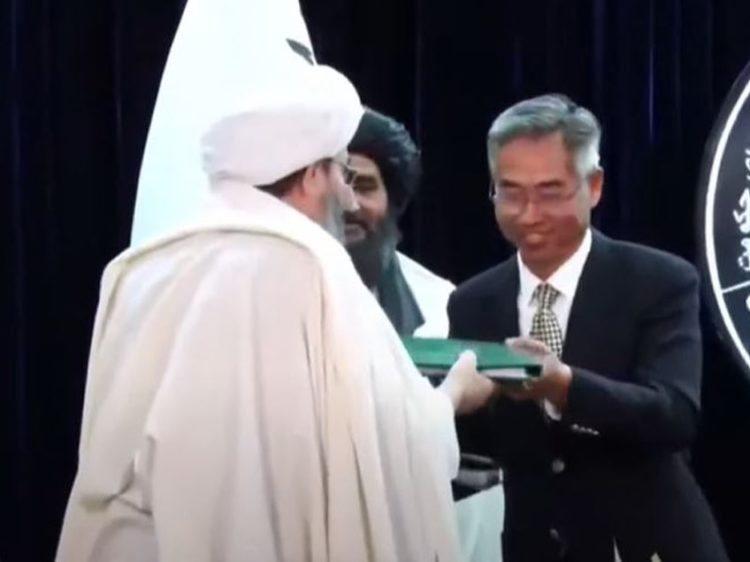
After the United States withdrew from Afghanistan in 2021, the Taliban endeavored to create solid ties with China, dubbing Beijing a “welcomed friend” for the nation’s reconstruction. Even though China has not formally recognized the Taliban as the legitimate government of Afghanistan, it was one of the first to get into contact with the group.
In July 2021, a month prior to the US withdrawal from Afghanistan, a high-level Taliban delegation visited the northern Chinese city of Tianjin for a meeting with then-foreign minister Wang Yi. In April 2022, Beijing approved the Taliban in Afghanistan, citing that recognizing the group as the country’s legitimate government would come “when conditions are ripe.”
In return for its support, Beijing is expecting the Taliban to take action against the East Turkestan Islamic Movement (ETIM), which they have claimed to be encouraging Uygur independence in Xinjiang. The militant group has a substantial presence in the Badakhshan province on the border of Xinjiang Uygur autonomous region and Faryab, Kabul, and Nuristan provinces. In addition, ETIM established training camps in Afghanistan during the late 1990s when they fled Chinese suppression in Xinjiang.
The Taliban stressed the importance of China’s connection with Afghanistan and accepted Chinese investment and understanding in helping to reconstruct the country. Shaheen commented that they have been reconstructing Afghanistan from the beginning, so they welcome investment that benefits investors and Afghan people. He added that China and Afghanistan have been peacefully coexisting for centuries and would like to gain some of China’s knowledge in developments that can be implemented in Afghanistan. Additionally, it was mentioned that the two countries are attempting to make their nations peaceful and affluent.
The Chinese are the biggest group of foreign investors in Afghanistan. In 2022, there were over 100 foreign companies registered in the country, contrasted with around 30 per year formerly, as reported by Reuters, drawing from the Afghanistan commerce ministry. Last month, Reuters reported a statement from Chinese entrepreneur Yu Minghui mentioning that 500 Chinese investors have entered Afghanistan to investigate business opportunities since the Taliban regained control in 2021, though only a few have committed to investment.








COMMENTS