

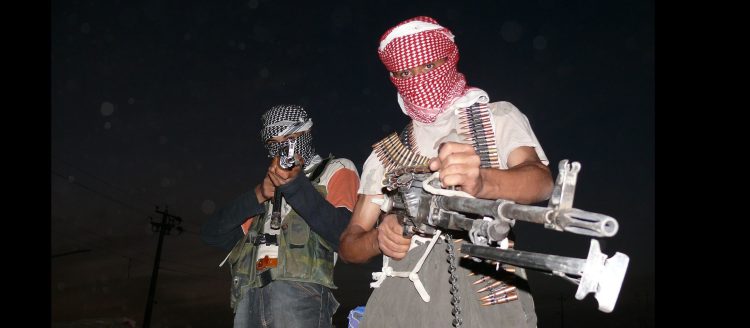
At the onset of the war, most expected a linear fight, a traditional fight. That fight did not last long. Conventionally speaking, it was a first-round knockout. But those who thought the fight was over were badly mistaken. In the Middle Eastern tradition, we had the watches, but they had the time. We were just beginning.
In time, the media would refer to what we had as an insurgency. That definition was debatable, given the myriad of characters in the plot. But one thing was for sure. The fight was not going to be linear. It was not going to be conventional.
The enemy sought to pit relative strength against relative weakness at the point of attack. They always looked for sheep that strayed from the flock. Weapons like IEDs gave them stand-off and enabled them to inflict damage and run away. They liked to fire at the last vehicle in a convoy.
For those of us on the ground, the nonlinear aspects of this were intuitive. We understood the rudiments of insurgencies and nonstandard warfare. However, we were not prepared for the personality of this one. Saddam’s regime had cast a wicked curse upon the country. Saddam believed in cruelty. Moreover, he believed in human debasement.
Saddam had a saying that was widely quoted. He said, he wanted every Iraqi family to have a story. The Iraqis said that is why he filmed torturing and executing the Iraqi people. Small children sold these CDs to the American Soldiers. The CDs were everywhere.
The cruelty in Saddam’s attacks on his people was exacerbated by the factor of humiliation. It seemed very important to Saddam that he greatly humiliate the person being punished. He seemed to think that it was the humiliation that made the memory of the murder more poignant and more lasting.
There was a famous story of an execution Saddam had performed in Fallujah. There was a general from the city whom Saddam had decided was plotting against him. No one knew if he was plotting or not. No one seemed to think that detail was very important to Saddam. These things were commonplace. What was not commonplace was how Saddam conducted the execution. He fed the man alive to dogs in front of bleachers filled with witnesses. Dogs are unholy according to the Koran. A follower of Islam will not touch a dog. To be eaten by this unholy animal added great insult to injury. This incident, the villagers told us, played a big part in the great hatred Fallujah had for Saddam.
As the nonlinear war evolved, it was apparent that there were many different players with multifarious motives. The members of al-Qaeda, many from other countries, were fighting a religious war. The Fedayeen Saddam was fighting for Saddam and the Ba’ath Party. The Shia were buying time for the Americans to put down their enemy, the Sunnis. And then there were the criminals. Every assortment of criminals was at work in Iraq – thieves, murderers, extortionists. Swimming in Saddam’s sea of sadism, these groups had the audacity to hide behind the cover of religion. It made for a particularly cruel brand of politics.
With all this in motion, the good Iraqis tried to stay alive. They tried to provide security for themselves and their families. They tried to create some sort of normalcy. At times, their suffering was hard to watch.
Philosophically, I questioned why this cruelty was allowed by divinity. It made me wonder if it was all an egotistical dream – a creation of our collective consciousness. If it is a dream, I pondered, what does it take to wake up?
INSURGENCY
We could see the insurgency
The nonlinear war
Relative strength against relative weakness
In our war colleges, we had studied for this test
Yet, there was no preparation for the cruelty to their own
So many innocent victims
So much disregard for humanity
So much enjoyment at cruel expense
In a distant village, we search for murderers
They are not soldiers, they are not jihadists, they are criminals (the Iraqis call them so)
They attempt to hide behind religion and politics
There fruits give them away
Above the desert winds a psychological operations unit blasts the voice of satan
The warning to all that judgment day has come
The women of the village run to surrender, holding their babies close to their breasts
A tiny little girl is forgotten in the panic
She runs desperately in the cloud of dust made by their bare feet
Her little legs stretching determinedly to keep up
No child should endure this, I think
She is not the criminal
The murderers have already fled
Her pain is so hard to watch
A quiet prayer will not stop the madness
Try as I may
I cannot awaken them from this horrible dream








COMMENTS