

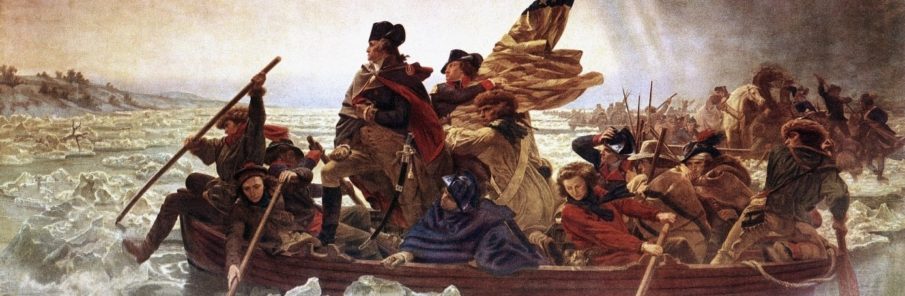
The weather delayed the crossing and set back the attack which was supposed to be a pre-dawn strike. But the weather also threw Washington’s plans completely off kilter. Neither General Cadwalader nor General Ewing were able to join the attack due to the severe weather conditions. As the men began marching towards Trenton, many of the men without boots were forced to tie rags around their feet and the snow was dyed red from their blood. Two men died of exposure on the way.
Only about 2 miles outside of town, Washington’s men ran into 50 armed American militia. Unaware of the plan to attack Trenton, they had just attacked a Hessian outpost. Washington was furious, believing that the Hessians would be alerted to their approach. However, Rall, having been warned by the British that the Americans would be planning an attack, believed the raid on the outpost was it and let his guard down, thinking that it was over.
Washington personally led the advance element when they ran headlong into another Hessian outpost about a mile from town. After the two sides exchanged fire, the Hessians realized they were facing a much larger force and beat a hasty but organized retreat, firing along the way.
It was then, General Sullivan and his troops entered from the south, which cut off the Hessian escape route and the firing increased. By the time Rall was assembling his three main regiments, his adjutant had informed him that Washington’s men had taken the main intersection of the town’s streets, where Rall’s engineers wanted to build a redoubt.
American cannons began to fire at the massing Hessians. Rall commanded one regiment to clear the guns. But as soon as they began advancing, the fire from the cannons broke up the attack. Rall ordered his own two cannons into action. They fired a few rounds each before accurate American return fire killed all of the crewmen and the cannons were captured.
The Hessian lines began to buckle. One regiment was pushed back and separated from the other two. The other two began to take heavy casualties from grapeshot and musket fire from the American infantry. A bayonet charge led by John Starke against the separated regiment broke them when their weapons wouldn’t fire due to wet powder.
Victory: Rall tried to reorganize his men and attack Washington’s flank. They marched in good order into the town’s streets where they briefly recaptured their cannons. But a determined American counterattack pushed them back. The Americans, firing from three directions broke up the attack. Rall was mortally wounded by cannon fire and his men retreated into an orchard where they quickly surrendered.
The third regiment of Hessians marched in the wrong direction and ran headlong into Sullivan’s troops who cut off their escape. Just minutes after the rest of the troops had surrendered, they too capitulated.
The battle was a stunning victory for Washington, who lost only the two men to frostbite and exposure on the march in and just five men wounded, including a near fatal wound to James Monroe who would later become the President of the United States. The Hessians lost 22 dead, including all four Colonels, 83 wounded and 896 men taken prisoner. Later, Sullivan captured another 200 Hessians who tried to escape to the British lines.
But even more importantly, the Americans, in dire need of food and supplies captured the Hessian’s stores at Trenton including food, arms, ammunition, clothing, shoes, boots, and bedding. Things which were all in short supply in the American Army. The ragtag Americans had gone toe-to-toe with a European army that had raised Cain in New York. Even British General Howe was surprised at the ease that the Americans had been able to dispatch the Hessians.
By noon on the 26th, Washington’s men and their prisoners were safely back across the Delaware and into Pennsylvania. The revolution would live on.
Illustration: National Archives








COMMENTS