Depleted uranium is used in modern munitions because it is dense, durable, and brutally effective against armored targets, but its use carries long-term health, environmental, and political costs tied mainly to internal exposure rather than radiation alone.
Depleted uranium, commonly referred to as DU, is uranium that has had most of the fissile isotope U-235 removed during the enrichment process. What remains is primarily U-238, a weakly radioactive but extremely dense heavy metal. That density, combined with unique physical properties under extreme stress, is what made DU attractive to military planners during the Cold War and beyond.
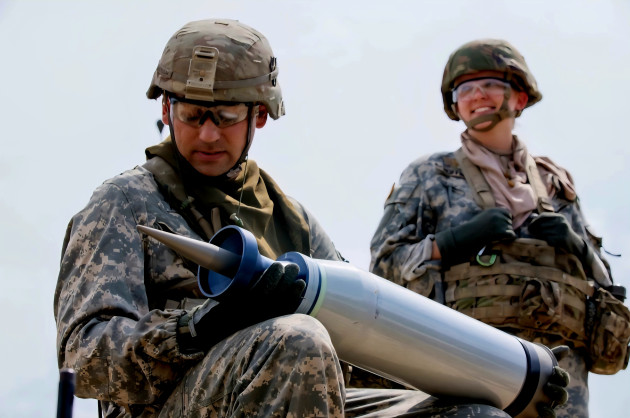
DU’s primary value lies in kinetic energy penetrators, especially armor-piercing fin-stabilized discarding sabot rounds fired from tank guns. At roughly 19.1 grams per cubic centimeter, DU is almost twice as dense as lead and comparable to tungsten.
This allows more mass to be concentrated into a narrow penetrator, increasing momentum and penetration when striking armored vehicles. Unlike some tungsten alloys, DU exhibits what engineers call “self-sharpening” behavior during impact. Instead of flattening or mushrooming, the material shears in a way that maintains a pointed tip, allowing it to punch deeper into armor.
DU is also pyrophoric. When it strikes armor at high velocity, friction and deformation can cause it to ignite. Inside a vehicle, this produces intense heat, burning fragments, and secondary fires that dramatically increase lethality by igniting fuel, ammunition, and interior materials. From a purely battlefield perspective, DU does not just defeat armor. It kills the vehicle and crew with high reliability.
Those advantages come with costs. DU is chemically toxic, behaves like other heavy metals once inside the body, and leaves behind contamination in and around destroyed vehicles. While DU is radioactive, the primary health risk is not external radiation exposure. The main danger comes from internal exposure through inhalation, ingestion, or embedded fragments.
When a DU round strikes armor, part of the penetrator aerosolizes into fine uranium oxide particles. These particles can linger as dust inside wrecked vehicles and nearby debris. People most at risk are vehicle crews, troops entering destroyed vehicles soon after impact, recovery and intelligence teams handling wreckage, and civilians who scavenge or loiter around wrecks. External exposure from simply being near a wreck is generally low. The risk rises sharply when dust is breathed in, swallowed, or when fragments remain lodged in the body.
Once inside the body, uranium is filtered through the kidneys, making them the primary organ at risk. High or prolonged internal exposure can damage kidney function. Radiation adds a secondary risk, particularly with embedded fragments that provide long-term internal exposure.
Symptoms are often delayed and non-specific, which complicates diagnosis. Early exposure may cause no symptoms at all.
Over time, individuals may experience unexplained fatigue, persistent flank or lower back pain, nausea, or changes in urination. Warning signs include reduced urine output, dark or foamy urine, swelling in the feet or ankles, and elevated blood pressure. Those with retained fragments require long-term medical monitoring, including urine testing for uranium levels and kidney function assessments.
From a military standpoint, DU offers unmatched reliability against heavy armor and has proven effective in combat. From a broader perspective, it carries environmental persistence, post-conflict cleanup challenges, political fallout, and lingering health concerns that complicate its use. Alternatives such as advanced tungsten penetrators reduce some of the controversy but may sacrifice certain performance advantages.
Already have an account? Sign In
Two ways to continue to read this article.
Subscribe
$1.99
every 4 weeks
- Unlimited access to all articles
- Support independent journalism
- Ad-free reading experience
Subscribe Now
Recurring Monthly. Cancel Anytime.
Depleted uranium is a tool optimized for destroying armored vehicles, and like many such tools, its effectiveness on the battlefield must be weighed against the long-term costs left behind once the fighting stops.
COMMENTS
You must become a subscriber or login to view or post comments on this article.