

A Motivational Article You’ll Probably Read Tomorrow…
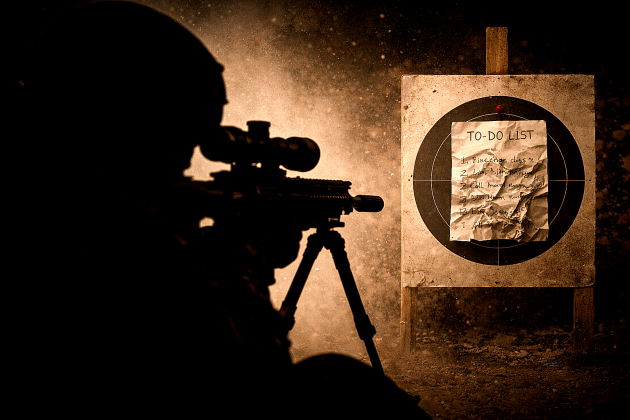
The sniper has been motionless for six hours. His joints ache. His bladder is full. A fly landed on his cheek twenty minutes ago and crawled toward his eye before finally leaving. He didn’t flinch.
Somewhere, a teenager is playing a video game where a sniper character takes the shot, hits the target, and moves to the next mission in under thirty seconds. That’s what most people think the job is: the shot, the moment, the thing that makes the highlight reel.
It’s not.
The shot is a fraction of a second. The discipline that makes it possible happens in silence, over years, in moments no one will ever see or celebrate.
I’ve been thinking about discipline lately and what it actually means versus what we pretend it means. We talk about it like it’s some internal fire or motivational engine that drives people to greatness. But that’s not discipline. That’s enthusiasm. And enthusiasm fades the moment something stops being fun.
Discipline is doing what you don’t want to do. That’s it. That’s the whole definition.
The martial artist doesn’t earn the black belt during the tournament. She earns it on the ten thousandth repetition. The same old kick, same form, trained on days when she’d rather be anywhere else. Her body learned to move because she showed up when she wasn’t inspired.
The author doesn’t write the book during a burst of creative genius. He writes it in the daily grind of facing a blank page when nothing comes. “I only write when inspiration strikes,” Somerset Maugham reportedly said. “Fortunately, it strikes every morning at nine o’clock sharp.” That’s not a joke about inspiration. It’s a confession about discipline.
And the leader? The leader doesn’t build a strong team by avoiding hard conversations. Sometimes discipline means sitting across from someone and saying the words neither of you wants to hear.
“This isn’t working.”
“I agree.”
“Your last day will be Friday.”
That conversation is never enjoyable. But I’ve seen what happens when leaders avoid it and let a bad fit linger because the confrontation feels too uncomfortable. The whole team suffers. Morale erodes. Good people leave because bad situations don’t.
The leader who fires the wrong person promptly isn’t cruel. They’re disciplined. They’re doing the thing they don’t want to do so that something better becomes possible.
So, here’s the practical application.
If discipline is doing what you don’t want to do, then your day should be structured around that truth. The tasks you most dread… do them first. The tedious, uncomfortable, soul-grinding work that you’ve been putting off? That’s your morning.
Why? Because the enjoyable tasks will get done no matter what. You don’t need discipline for those. You don’t need willpower to do the things you already want to do. If time runs short at the end of the day, you’ll make time for the fun stuff. You’ll stay up late. You’ll squeeze it in.
Remember the famous quote, “I just ran out of hours to do the things I really wanted to?” Neither do I.
The burdensome tasks that make your brain whisper, “You could do this tomorrow,” get pushed… and pushed… and pushed again… until they’re either abandoned entirely or completed in a panic at the last possible moment, poorly, with your stress level through the roof. Sound familiar?
Eat the frog first (no offense to the SEALs out there). That’s the old saying. Do the worst thing on your list before you do anything else. Once it’s done, everything that comes after it feels lighter. You’ve already won the day by 9 a.m.
It’s 2026, the first week of a new year. Social media is flooded with goals, vision boards, and declarations of what this year is going to be. Gyms are packed. Journals are crisp. Everyone’s got a plan.
Yet, here’s the kicker: for most people, posting the goal is the progress. And I mean the end of it. The dopamine hit of announcing the intention scratches the reward itch just enough that the actual work never has to happen.
You don’t need another vision board, a better planner, a new app, or a morning routine you saw on a podcast. Just identify the one or two tasks you’ve been avoiding, the ones quietly sitting on your list, getting scrolled past as they fire off a little .22-caliber bullet of guilt each time you see them, and do them before noon today.
The sniper doesn’t get a medal for lying still. But without the stillness, there is no shot.
Do the work no one sees. Change your focus to a system that ultimately fills your days with more positivity. That’s where the real progress lives. That’s discipline.
—
Tegan Broadwater is an entrepreneur, author, musician, former undercover officer, podcast host, and positive change-maker. His popular book, “Life in the Fishbowl,” details his two-year, deep undercover operation that took down 51 violent Crip gang members. All profits benefit children of incarcerated parents. Learn more about his latest projects at TeganBroadwater.com








COMMENTS