

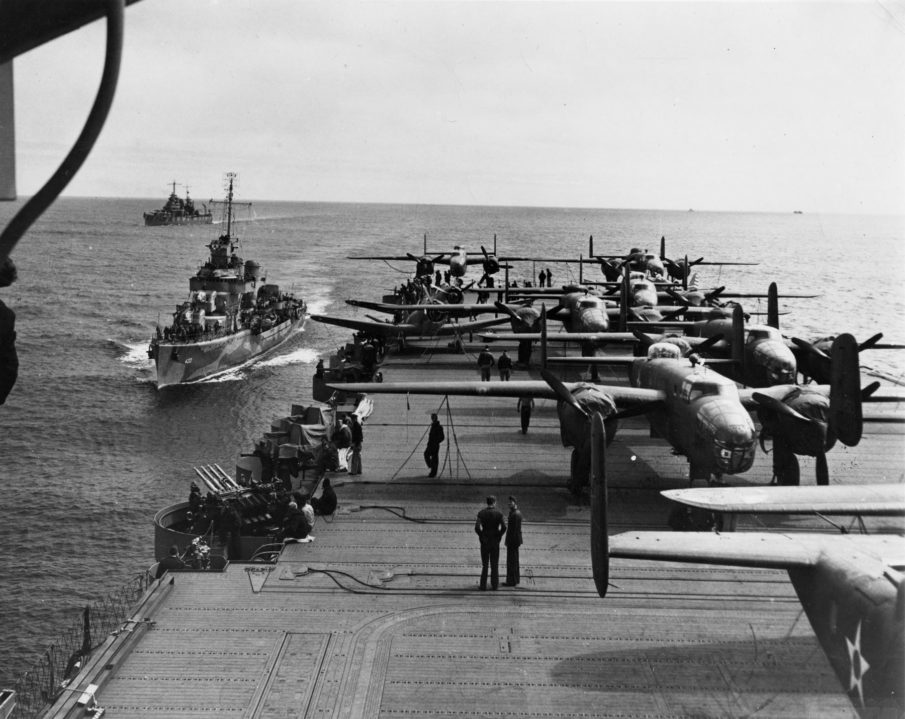
Because he had brought the eight reserve aircrews along, Doolittle asked if any of the men wished to back out of the mission now that they targets had been revealed; none did.
Doolittle’s plan was to sail within 450 miles of Japan, launch the aircraft, bomb Tokyo and then make the 650 miles to China. But on the morning of April 18, the task force was sighted by a Japanese picket ship, the Nitto Maru. Rather than risk the carriers so far from home, the order was given to launch the aircraft, 823 miles from Tokyo. This was a full ten hours before scheduled launch. Originally the raid was supposed to take place in hours of darkness. Instead, it was to take place around noon time.
The B-25s all managed to take off without incident and headed to their targets. Their surprise was complete. There were few Japanese interceptors in the sky and the anti-aircraft fire was light and ineffective. Only one bomber received damage from anti-aircraft fire.
Doolittle flew his plane at 100 feet AGL and once over his target, he climbed to 1500 feet and dropped his small bombload. Once his bombs were away, he again dove for the deck and sped south to confuse the Japanese where he came from and where he was going.
Despite having only 16 bombers and a light payload, Oil storage tanks, factory areas, military installations were bombed in Tokyo, Kobe, Yokohama, and Nagoya. One bomb slightly damaged the ship Ryuho which was in dry-dock and was being refitted as a carrier. Doolittle reported, “Damage far exceeded the most optimistic expectations.”
The Japanese tried to issue propaganda that the raid had lost nine planes had caused no damage other than hitting schools and hospitals but the word got out. It was a tremendous loss of face as the Japanese had tasted nothing but victory and now their capital had been bombed. The commanding officer in charge of Tokyo’s air defenses committed ritual suicide because he felt dishonored and ashamed by the American attack.
Argentinian commercial attaché to Japan Ramon Muniz Lavelle witnessed and documented the outcome of the raid and he had this to say dispelling the Japanese propaganda of little damage:
“I ran up to our roof and saw four American bombers flying in over the rooftops. They couldn’t have been more than 100 feet off the ground. I looked down the streets. All Tokyo seemed to be in panic…. I could see fires starting near the port…. That raid by Doolittle was one of the greatest psychological tricks ever used. It caught [the Japanese] by surprise. Their unbounded confidence began to crack.”
The pilots headed for China. One pilot flew northwest and landed at the Soviet island of Vladivostok. The plane was confiscated and the crew interned. The remainder headed for China. Aided by a strong tailwind they flew on thru the darkness, rain, and clouds until their tanks ran dry.
The Japanese captured eight crew members after two of the crew members drowned while ditching in the ocean. They were charged with war crimes and in October of 1942 three were executed. The remaining five spent the rest of the war in horrible conditions as POWs. One more died in captivity of disease. 50 more raiders bailed out over China, and 49 were rescued by the Chinese, one died in the parachute jump. The Chinese rescued another 10 more men that crashed landed near the coast.
The resultant morale boost for the American public was tremendous. But the effect the raid had on the Japanese was profound. They were shaken to their core and as a result changed their strategic plans.
They first sent additional troops into China and seized the airfields that the Americans were aiming to land on. They then took terrible reprisals against the Chinese people for helping the US pilots. Chinese estimates put the number of dead after being slaughtered is about 250,000. The amazing thing was that the Chinese people didn’t have hard feelings against the Americans for the reprisals suffered. They treated the pilots as heroes.
The Japanese thought the bombers came from Midway Island so they set out to take it with a diversionary attack in the Aleutian Islands. That took precious resources away from the attack on Port Moresby in the Battle of the Coral Sea. The resulting battle was a draw, but the Japanese navy withdrew.
The US had cracked the Japanese codes and because of this, knew what the operational plan was. The Battle of Midway was a crushing loss for Japan as they lost four of the top aircraft carriers but also all of the combat tested pilots as well.
Japan’s offensive power was crushed at Midway and they’d be forced to fight a strategic defensive battle from that point on.
All of the pilots on the mission received the Distinguished Flying Cross for their bravery. The few raiders that were captured also received a Purple Heart. Jimmy Doolittle was promoted to Brigadier General and was awarded the Medal of Honor by President Roosevelt after returning home.
Richard Cole is the last surviving Doolittle Raider, as was their custom on the anniversary of the raid, he went and toasted the men as well as the raiders that passed away since the last reunion. At 101-years old, Doolittle’s co-pilot toasted his comrades with the 1896 Hennessey Cognac (the birth year of Doolittle) that has been the tradition.
During those dark days of World War II, the Doolittle Raiders gave the American people the morale boost that they so sorely needed. It remains one of the most daring raids that the US has ever carried out. And it set the tone for later in the war when the US would fill the sky with 500 bombers over Tokyo.
Just a year to the day after the raid, the US intercepted a Japanese message that Admiral Yamamoto, the mastermind of the attack on Pearl Harbor would be visiting the Solomon Islands on an inspection.
The US scrambled long range P-38 fighters and shot down Yamamoto’s Betty bomber killing him in the crash into the jungle.
Photo courtesy of Doolittle Raiders








COMMENTS