



Ethiopia was ill prepared to face an invasion by a modern industrial power. The Emperor, Haile Selassie, went to Geneva to plead for help at the League of Nations. Both Ethiopia and Italy were members (Ethiopia since the 1920s) The Emperor gave a dignifies and eloquent speech, though Italian reporters in the back tried heckling him. He finished by saying, “It is us today, it will be you tomorrow.” He gained much respect, especially from populations of many countries, and was named Time Magazine’s “Man of the Year,” But very little help would come from the League or its members. After conquering Ethiopia, Italy would renounce its membership in the League.

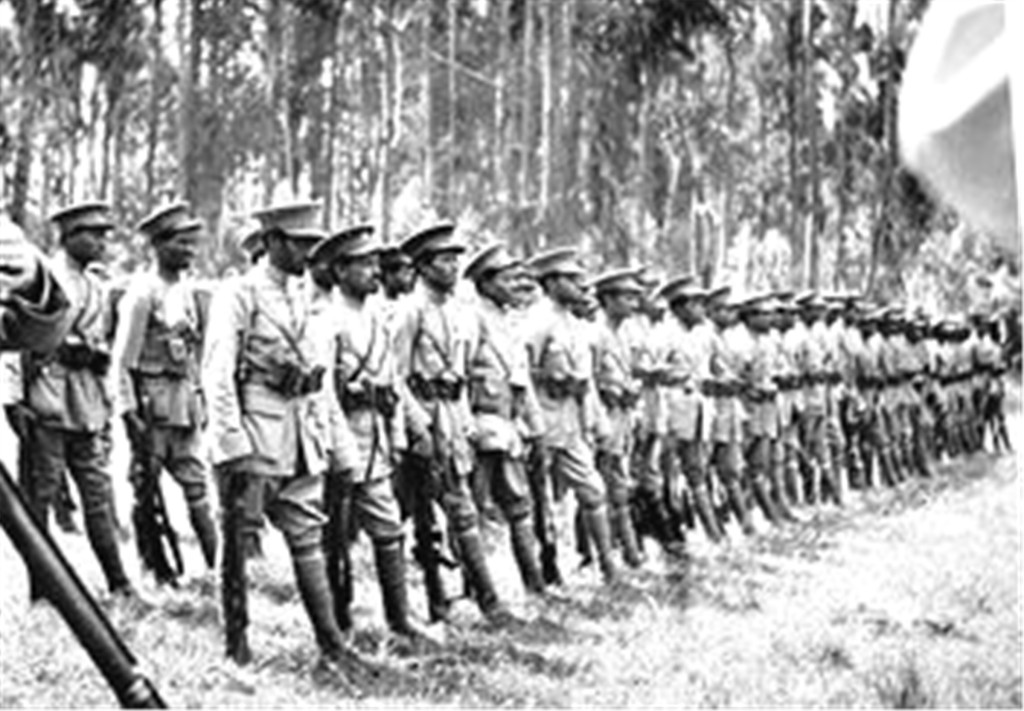
Some very feeble sanctions were enacted, The British government was forced by public opinion to close the Suez Canal to Italian troop ships, but otherwise tried not to offend Italy. Many countries openly violated sanctions. The only sanction that would have hurt was an oil embargo, but the Soviet Union negotiated a trade deal with Mussolini to make up any shortages. Ethiopia had a brave and relatively well trained and equipped Imperial Guard, but it was too small to handle entire field armies. The majority of troops would be tribal warriors, often with swords and spears.

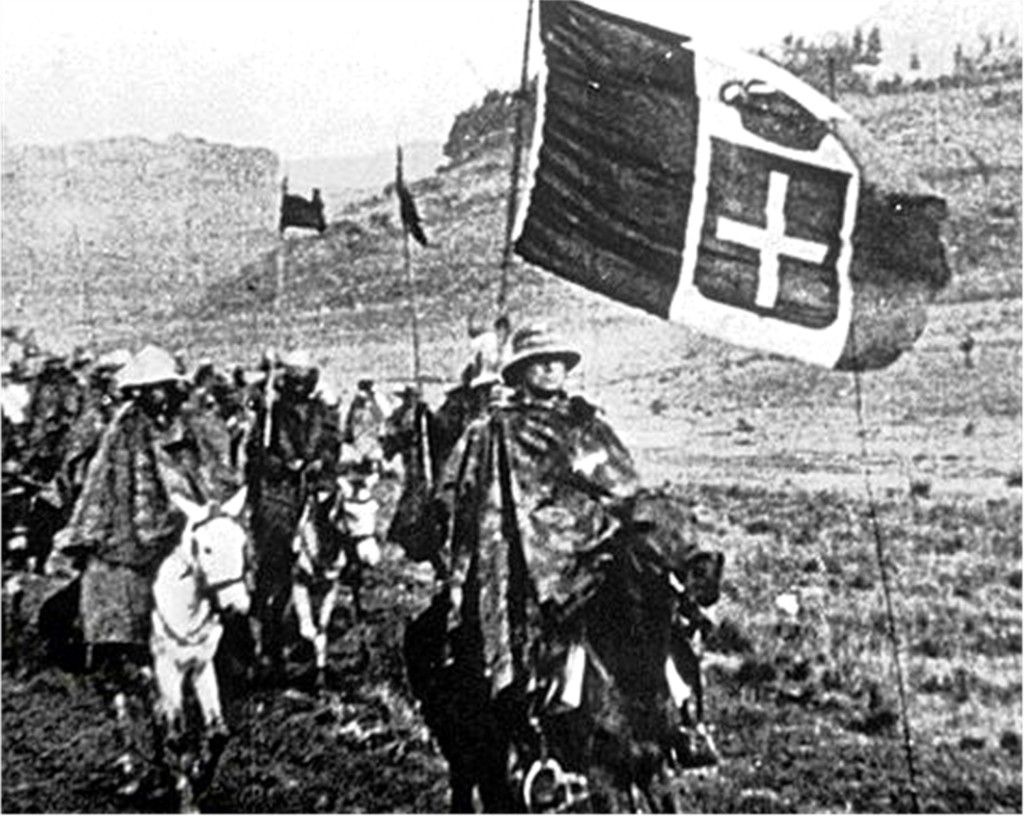
The Italians would soon notice the difference, Whenever possible they would target the khaki clad Guardsmen over the tribal warriors who were generally clad in white. The rains stopped and the Italians moved. Italian tanks and aircraft could not be stopped by the forces available (though the tanks stopped chasing tribesmen into rough areas without infantry support. The warriors would get to close range, then swarm over tanks, Half a tank battalion wiped out in one morning that way,) Mussolini authorized the use of poison gas against not only Ethiopian troops, but civilians as well.
Swedish Red Cross facilities (clearly marked) would also be attacked. Many populations around the world sympathized with Ethiopia. Their governments generally pretended not to see, or worse, The British Undersecretary, Lord Stanhope said that the UK would not sell arms to the Ethiopians as that, “would be going back on the white man everywhere,” Ethiopia had deeply admired Japan. It had survived the “Scramble For Asia” and had rapidly modernized itself.
Relations between the two countries had been very cordial. But when the Italians invaded, Japan made its support for Italy known, There were actual disorders among the Japanese population (quickly suppressed) who had been impressed by Ethiopia using them as a model. The Emperor was ready to try anything. He deeded 1/2 of Ethiopia to Standard Oil (U.S.) hoping to save something from the advancing Italian forces. The U.S. Secretary of State announced that he was “voiding” the deed, forbidding Standard Oil or any other U.S. firm from accepting such a document.
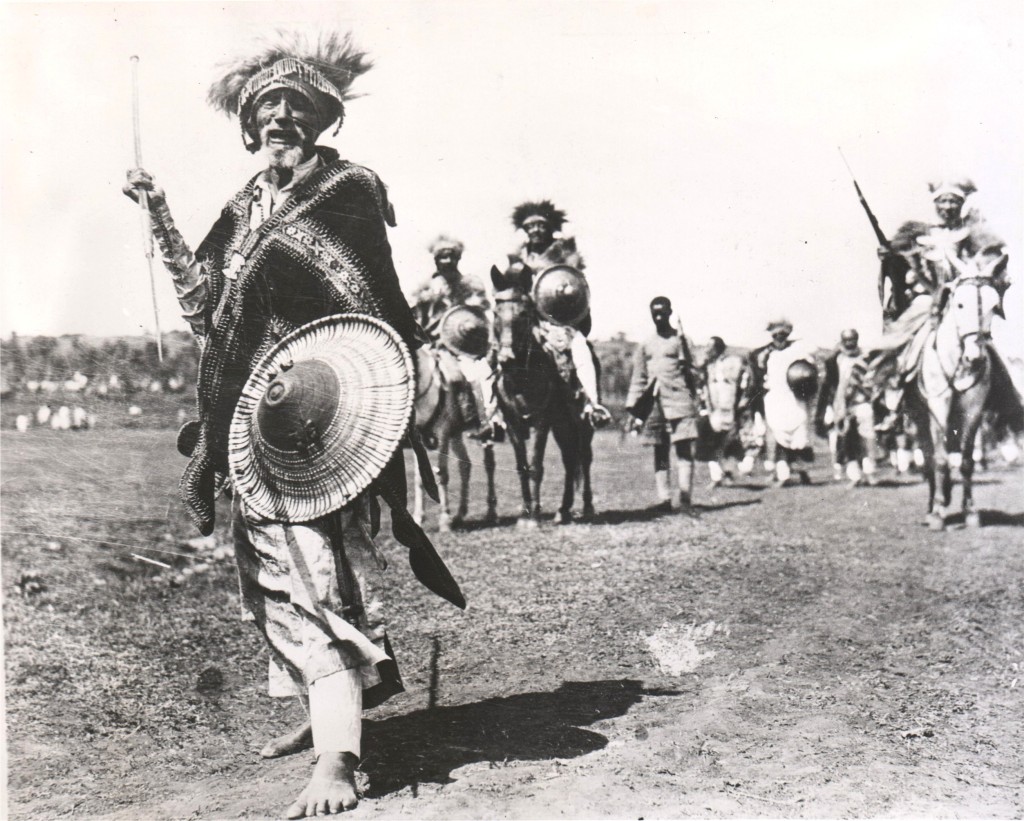
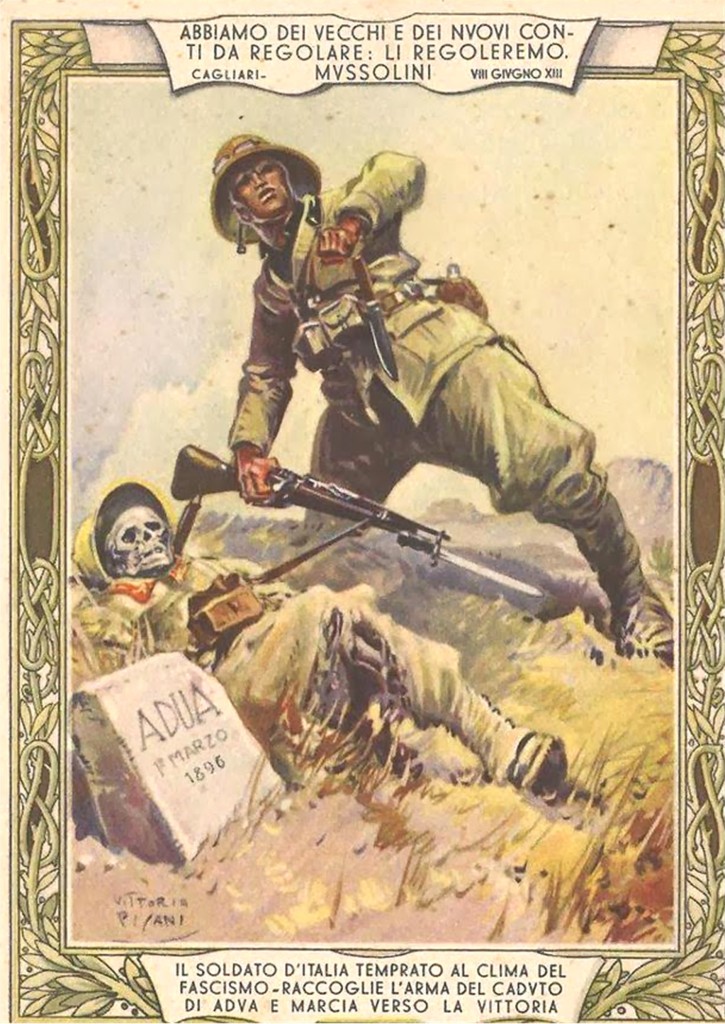
Mussolini declared that he was fighting a war against a “savage people without culture,” ignoring Ethiopia’s ancient culture and rich history. He also called for all Italians around the world to support him.
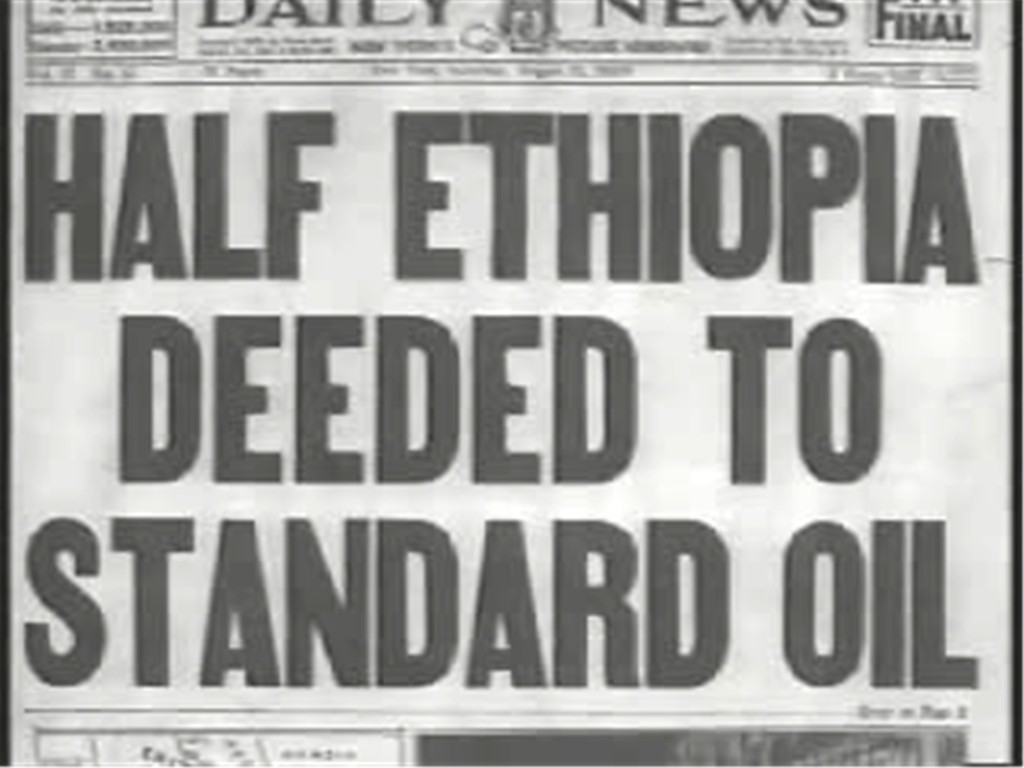
Back in Italy the population (not fully aware of just how barbaric their country’s attack was) went wild with joy. The Italian Catholic Church blessed the campaign. Mussolini held the view that no matter where an Italian lived, down to the 7th generation, he was an Italian national. He called for Italian Americans to become involved. In the U.S. many Italian Americans in New York City, encouraged by Mayor LaGuardia, prepared to travel to either join the Italian forces, or to be settlers in Ethiopia.
Local politicians got the State Department to rush through travel documents (in clear violation of American neutrality,) (Mussolini would lose many Italian American supporters as he moved closer to Hitler, and most of the rest when he invaded France.) Blacks in Haiti and in the United States identified with Ethiopia. A great many American blacks tried to enlist in the Ethiopian Army, but the United States Government prevented all but a handful from ever leaving the country. The FBI had encouraged the government to prevent black enlistees, suspected that at best they would return and be “disruptive,” and at worst were “Reds,” (See youtube footage at bottom)

By May 31, 1936 Italian forces entered Addis Ababa, the capital, and declared the war over. Little did they know that it was just entering a new phase. General Graziani confiscated Ethiopia’s gold reserves (kept in the form of Austrian coins) It is said that he kept half for himself. Many religious, historical, and cultural treasures were sent to the Vatican by order of Mussolini.
In June Mussolini sent two ominous telegrams to his generals and bureaucrats in Ethiopia. They were to kill any prisoners taken from that point on. And there would be no power sharing with Ethiopian nationals. Ethiopians would be (in Hitler’s words re the Slavs) “hewers of wood and carriers of water,” SRIT 13 Italian political and military leaders in Ethiopia would soon discover a great many differences from Libya. They could not take their time as they had in Libya, Mussolini eager to clear the decks for European troubles (starting with Spain.)
The population was much larger, and the terrain was far different, in many places a nightmare to a modern army. And Ethiopians who might have responded to a “new deal” became embittered against continued Italian oppression. A significant part of the country in the North was not occupied, At least 25,000 guerrillas would tie down 500,000 Italian and Eritrean troops. Poor Italian peasant families had volunteered to farm tracts in Ethiopia, so too soldiers discharged there. Many of the peasants were disillusioned. Some had pictures of becoming “gentlemen farmers” with vast plantations worked by Ethiopian labor. This was only true of the already rich or politically connected. Many farmers wound up with less than ideal land, maybe an Ethiopian laborer or two.
Worse, many were settled in areas without large Italian garrisons. No garrison, no safety, The roads belonged to the Army, when they had large heavily armed convoys on them. Graziani was under orders not to share power with chiefs or nobles, but he would give them orders. Sometimes he would have them report to him at his villa at Lake Tana. Those who annoyed him were fed to the crocodiles, (Later an Italian Count would be made Viceroy, He honestly tried to improve matters, but he had no control over the military until it was too late.)
An attempt was made on Graziani’s life by non Ethiopian nationals. In response, in short order more than 30,000 Ethiopians were slaughtered, including the 300 monks at the country’s holiest shrine, and half of the young well educated people in the country that the Emperor had sent abroad for foreign educations.
In 1940 the U.S. State Department decided that the U.S. should cozy up to Mussolini and offer to recognize the “validity” of his conquest of Ethiopia. But before this unholy deal could be consummated, Italy invaded France. While Graziani was winning the hearts and minds of the crocodiles, the Emperor, at the entry of Italy into WWII moved from London to Khartoum to be closer to his resistance fighters and to inspect new Ethiopian regular recruits.

Winston Churchill had been opposed to Britain’s shameful dealings with Ethiopia, but he was a touch too paternalistic, thinking that Ethiopia would maybe be best served as a member state in the British Empire. Some British officers and politicos in the field had an even more restrictive view of Ethiopia’s future, one perhaps without the Emperor. When Britain invaded Ethiopia to kick out the Italians, regular forces including the South African Army handled the main campaign. The irregular campaign was led by (acting) Lt. Colonel Orde Wingate (of later Burma Chindit fame as a general).

The British had kicked Wingate out of Palestine because he “exceeded his orders” re commanding Jewish settlers against Arab raiders from Syria. He helped arm, train, and organize (and often led) an aggressive strike force that would become the Palmach. While not in any degree Jewish (from a severely religious Protestant family) he was an ardent Zionist. He called his mixed irregular force that was tearing through Ethiopia “Gideon Force,” Regional command (without informing Churchill) decided that it might be “convenient” if Haile Selassie was not permitted to enter Addis Ababa when it was liberated, and not interfere with their ideas about how Ethiopia should be run.
Some officers even toyed with breaking the Muslim Ethiopians away. Wingate had left one “holy war” and had found a new one. He ignored “serious suggestions” re detaining the Emperor and charged him right into the capital. Wingate was immediately reduced to his permanent grade of Major and bundled off to Egypt by the outraged local British brass hats, (Churchill would take over his fate from there, sending him on to Burma as a general) So Ethiopia joined the “United Nations.”
It declared war on Germany and Japan, (see Kagnew story for film of Ethiopians at Japanese peace treaty during the Korean War,) SRIT 16 The Emperor was forced by the British to sign a very restrictive treaty with them, It might have been intended to bind Ethiopia to the British Empire, but by 1944 Ethiopia was a backwater and a new and less restrictive treaty signed. After the war Ethiopia found itself still “under the bus.”
The United States, the Western Allies, and later the United Nations decided that Italy must not be antagonized by massive war crimes trials such as those going on in Germany. Italy had finished the war as an “ally” after it dumped Mussolini. There were fears that it would go Communist. So Ethiopia’s claims for justice and compensation would be given low priority.
An arbitrary and relatively low financial sum trotted out by the Allies. The Ethiopians were given very little time to prepare their brief. It was decided that Ethiopia would not be permitted to file charges of “genocide” but rather “murder” charges, which had a far higher burden of proof. (Poland was able to file “genocide” charges against Germany because of the targeting for extermination of their educated elites, exactly what had been done in Ethiopia.)
For compensation purposes the U.N. declared that the Ethiopian invasion was not “part of WWII,” though the Japanese invasion of China had been labeled as such, The U.N. ultimately decided that Ethiopia should take its claims directly to the Italian government. Not only was that unproductive, but some Italian newspapers used the same sort of language about Ethiopia that the hecklers had at the League of Nations. Had German newspapers done the same re a complaining country the Allied Occupying Powers would have tossed the editors into prison for a couple of years.
The Vatican did not act on the claims of the Ethiopian government regarding return of their religious, historical, and cultural treasures. The U.N. would not get involved. Field Martial Graziani was tried and was given a very heavy sentence. After four months he was released because “He was only obeying orders,” (Those convicted at Nuremberg might have wondered about that,)

So Ethiopia was thrown under the bus and remained there for about 12 years. But somehow, in 1951 they sent their finest troops to stand beside American, British, and U.N. forces. I guess that they were just not as “practical” as those who let them down. “Throughout history, it has been the inaction of those who could have acted; the indifference of those who should have known better; the silence of the voice of justice when it mattered most; that has made it possible for evil to triumph.” -Haile Selassie- – YP-
So Ethiopia was thrown under the bus and remained there for about 12 years. But somehow, in 1951 they sent their finest troops to stand beside American, British, and U.N. forces. I guess that they were just not as “practical” as those who let them down.
“Throughout history, it has been the inaction of those who could have acted; the indifference of those who should have known better; the silence of the voice of justice when it mattered most; that has made it possible for evil to triumph.” -Haile Selassie
Suggested Reading
Days of Emperor and Clown: The Italo-Ethiopian War, 1935-1936
Fire in the Night: Wingate of Burma, Ethiopia, and Zion
Haile Salassie’s War: The Ethiopian-Italian Campaign, 1935-1940
Appeal To Pope Francis I Re: A Vatican Justice Delayed For Over 75 Years
A Monument for Graziani: Italy’s unresolved relations to its violent colonial past
Film :Italian invasion, Black Americans wanting to enlist http://www.youtube.com/watch?v=QtxL3idYS6k








COMMENTS