News + Intel

Evening Brief: Iran Squeezes Global Oil While US War Effort Shows Cracks

Back-channel messages are flying, the Strait is being quietly throttled, and while the Pentagon counts targets like yardage, the war keeps moving on its own terms.

Trump’s Back-Channel War: Messages Move While Missiles Fly

If you’re looking for diplomacy in this war, don’t look at the podium. Watch the pauses after ultimatums, the sudden shifts in tone, and the countries quietly stepping into the middle. That’s where the real conversation is happening.

Advertisement

The picture is not clean. Washington says there are “constructive” talks underway. Tehran says there are none. At the same time, messages are moving through a widening web of intermediaries, Turkey, Egypt, Pakistan, Qatar, with additional channels in play. One of those channels is more specific than the talking points suggest. U.S. envoys have been in contact with Iranian parliament speaker Mohammad Bagher Ghalibaf. That is not a rumor-mill detail; it is a signal that lines of communication exist, even as both sides deny them.

The bigger problem is not whether messages are moving. It is who can answer them.

Since late February, U.S. and Israeli strikes have killed large portions of Iran’s senior leadership. Ayatollah Ali Khamenei is gone. His successor, Mojtaba Khamenei, was installed under pressure from the IRGC after a contested process and has yet to appear publicly in any meaningful way. His first “statement” was read by a news anchor from a still image. That is not a position of strength. That is a system trying to project continuity while scrambling behind the curtain. Even U.S. officials have admitted they are not sure who on the Iranian side can make a decision and enforce it.

Advertisement

Against that backdrop, the White House issued a 48-hour ultimatum targeting Iranian infrastructure, then pivoted into what became a short de-escalation window, effectively a five-day pause framed as progress. This was not hesitation on our part. It was pressure management. Escalate, pause, signal, repeat. Enough force to create leverage, but not enough to trigger a wider regional break.

Regional actors are not just passing notes. They are shaping the tempo. Gulf states are pushing to contain the conflict before it spreads. Oman, which carried much of the pre-war negotiation load, has signaled that talks had been making progress before the shooting started, and has continued trying to broker some kind of off-ramp. That effort is less about peace and more about preventing the kind of regional fire that no one can control.

Advertisement

Both sides are also shaping the narrative. Washington sells the pause as diplomacy working. Tehran sells it as American hesitation. Both propaganda stories serve a purpose, and both can be true at the same time.

This is not a peace process. It is message traffic under fire, an attempt to manage escalation without committing to an end state. The air campaign continues. Proxy forces remain active. The back channel exists, but it is indirect, contested, and fragile.

For now, it buys time. It does not buy an ending.

Advertisement

The Strait of Hormuz Isn’t Closed. It’s Being Controlled. And That’s Worse.

If you’re waiting for Iran to “close” the Strait of Hormuz, you’re thinking about this the wrong way.

They don’t need to shut it down. They just need to make it unpredictable, expensive, and dangerous enough that the rest of the world hesitates. That’s exactly what’s happening.

Roughly 20 percent of the world’s oil supply moves through a narrow set of shipping lanes only a few miles wide inside the Strait. That’s not simply a geographic anomaly. That’s leverage. When traffic through Hormuz stutters, even briefly, markets react instantly, not because supply is gone, but because certainty is.

Iran understands this better than anyone.
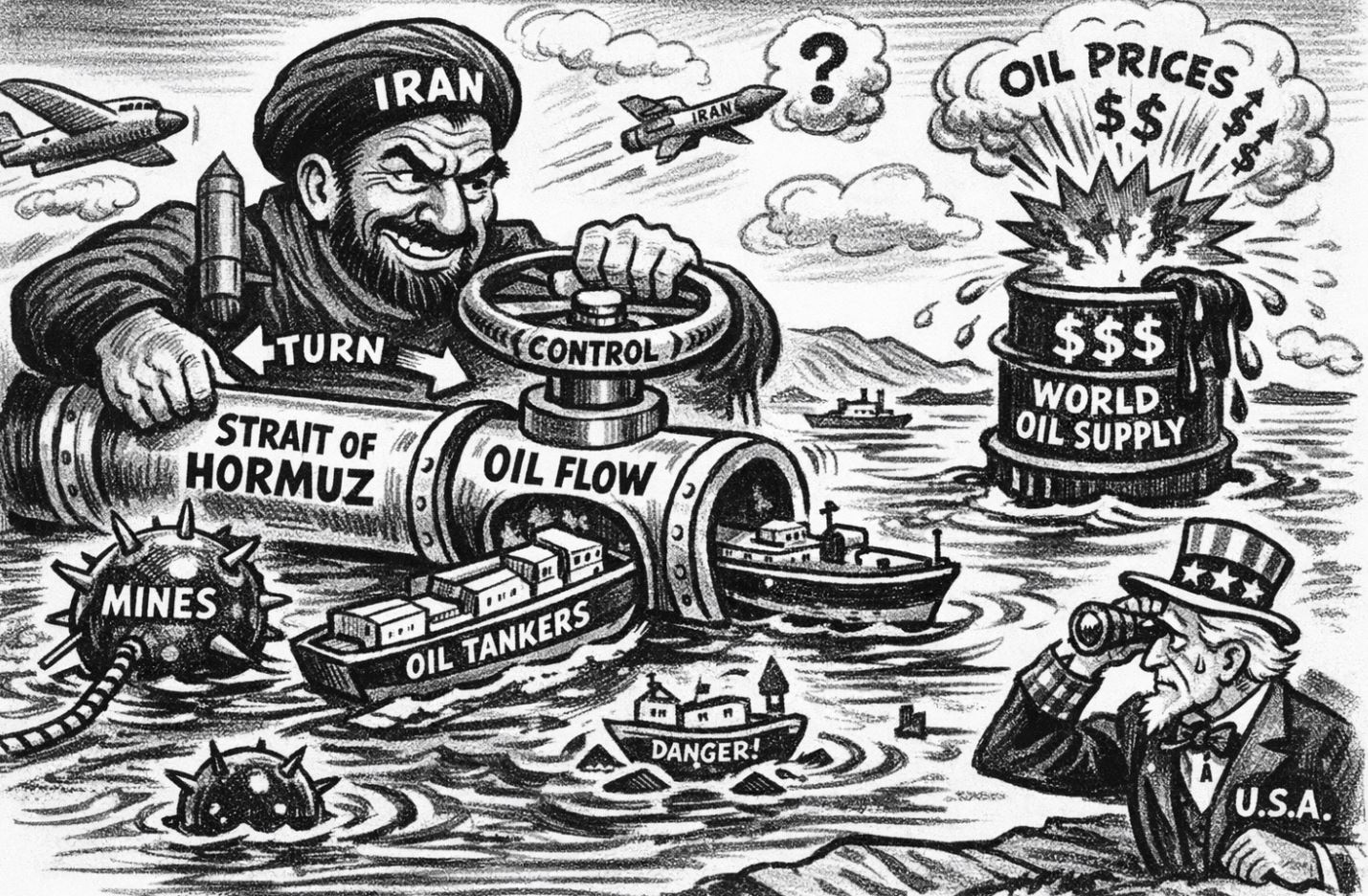
Iran Cartoon

Instead of trying to dominate the Strait outright, Tehran is working the margins. Harassment, drone overflights, and reported mine threats have created just enough friction to make insurers nervous and shipping companies cautious, a trend reflected in rising war risk premiums and vessel tracking slowdowns. That’s all it takes. You don’t need to sink tankers if you can convince them not to sail.

And some are already choosing not to. This is affecting all Americans. If you’ve been to the gas pumps lately, you know exactly what I’m talking about. In short order, it will make it to our grocery shelves. Those crops don’t pick themselves, and they certainly don’t deliver themselves to your local grocer of choice.

As part of the bigger picture,  shipping firms are rerouting or delaying voyages. Even the possibility of mines or targeting can halt movement faster than confirmed attacks. The Strait isn’t sealed. It’s being throttled, and Iran is firmly at the controls.

Maritime tracking data and industry reporting indicate that some vessels continue to transit while others hold back, creating the effect of a valve rather than a blockade. That’s a far more sophisticated play. A closed Strait invites overwhelming military response. A controlled one bleeds the system slowly while staying just below the threshold that forces a decisive reaction. It’s a pretty clever strategy, actually.

That pressure shows up immediately in the markets. Oil prices rise on disruption risk alone, and because crude is globally priced, the effects move fast, from tanker routes to fuel costs to inflation signals that reach directly into the U.S. economy.

This is the part that gets lost in the daily strike counts and Pentagon briefings.

Iran is not trying to win a conventional fight at sea. It’s using geography as a weapon, turning a narrow maritime corridor into a pressure point on the global economy and, by extension, Washington itself.

No sunk fleet required. No decisive battle. Just enough disruption to make the global economy flinch.

The Strait isn’t closed.

It’s under new management.

In War, Numbers Are Often Just Activity, Not Outcome.

Strike Counts and the Illusion of Progress

If you listen to enough Pentagon briefings, war starts to sound like a stat sheet.

Targets hit. Sorties flown. Weapons expended. Numbers delivered with confidence, like a sportscaster reading off the yardage a quarterback got on a forward pass. Yeah, they moved the ball a bit, but no points were scored.

It feels like progress.

In the grand scheme of things, it isn’t.

In war, numbers are often just activity, not outcome.

The United States can hit almost anything it wants. That’s not in question. Precision strike capability is real, tested, and brutally effective at the tactical level.

The problem is what comes next.

In Vietnam, body counts became the scoreboard. The numbers climbed. Briefings sounded optimistic. And yet the North Vietnamese and Viet Cong kept fighting, absorbing losses, adjusting tactics, and continuing the war on their own terms. The metrics looked good. The strategy was hollow.

Different war. Same temptation.

Strike counts measure what is easiest to count, not what is hardest to achieve.

It’s like scoring a boxing match on punch totals while your opponent keeps walking forward, bloodied, unsteady, but still coming. You can win the numbers and still lose the fight. Let’s not forget that lesson.

And the more you lean on those numbers, the more the enemy learns how to break them.

Targets disperse. Leadership decentralizes. Operations shrink into smaller, harder-to-find pieces. What starts as a clean campaign against fixed infrastructure turns into a grinding hunt for fleeting targets and diminishing returns. The strike count goes up. The strategic effect flattens.

That’s not progress. That’s motion.

You can crater runways, collapse facilities, and kill senior figures, and still fail to change the one variable that matters: the enemy’s decision to keep going. That decision is political. It is ideological. And it is often insulated from the kind of damage airpower is designed to inflict.

Look at the current campaign. Thousands of targets hit. Impressive numbers. Clean execution.

And yet the fight continues. Leadership regenerates. Proxies stay active. The system bends, but it doesn’t break.

Airpower can disrupt, degrade, and delay. It can buy time. What it cannot do, on its own, is deliver a coherent end to a war. That requires a strategy that connects military action to a clear, achievable outcome.

Numbers won’t give you that.

They’ll give you the appearance of control while the underlying problem remains untouched.

So the charts fill up. The totals climb. The briefings stay upbeat.

Meanwhile, the enemy keeps fighting.

That’s the part the numbers don’t capture.

Because in the end, this isn’t about how much you destroy. It’s about whether what you’re doing is forcing the other side any closer to stopping.

And right now, that answer is a lot less clear than the strike count suggests.

Advertisement

What readers are saying

Generating a quick summary of the conversation...

This summary is AI-generated. AI can make mistakes and this summary is not a replacement for reading the comments.